Freshly Printed - allow 10 days lead
Couldn't load pickup availability
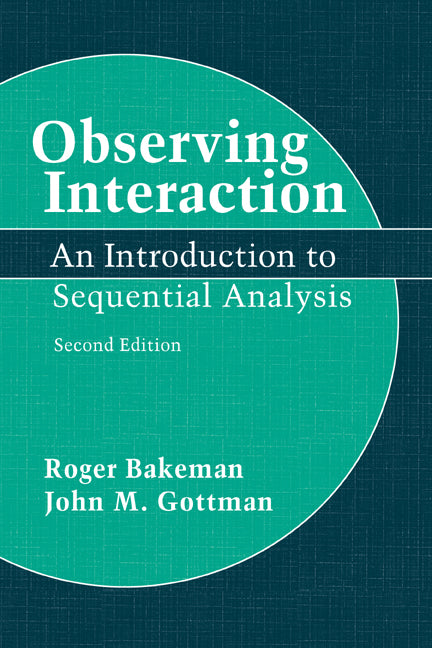
Observing Interaction
An Introduction to Sequential Analysis
This book provides a straightforward introduction to scientific methods for observing social behavior.
Roger Bakeman (Author), John M. Gottman (Author)
9780521574273, Cambridge University Press
Paperback / softback, published 13 March 1997
224 pages, 30 b/w illus. 13 tables
22.8 x 15.3 x 1.5 cm, 0.315 kg
'The book is an excellent primer for the novice and a good methods reminder for the experienced. Its major point, that sequential observation has been ignored, is a good one. It is written in a clear, readable, self-contained style with the exception of the last two chapters which require the use of additional resources listed in the bibliography. It contains very useful tables and figures, examples, and repeated summaries of major points made in each chapter and chapter section.' American Journal of Primatology
Mothers and infants exchanging gleeful vocalizations, married couples discussing their problems, children playing, birds courting and monkeys fighting have this in common: their interactions with others unfold over time. Almost anyone who is interested can observe and describe such phenomena. But usually scientists demand more. They want observations that are replicable and amenable to scientific analysis, while still faithful to the dynamics of the phenomena studied. This book provides a straightforward introduction to scientific methods for observing social behavior. Because of the importance of time in the dynamics of social interaction, sequential approaches to analyzing and understanding social behavior are emphasized. An advanced knowledge of statistical analysis is not required. Instead, the authors present fundamental concepts and offer practical advice.
Preface
1. Introduction
2. Developing a coding scheme
3. Recording behavioral sequences
4. Assessing observer agreement
5. Representing observational data
6. Analyzing sequential data: first steps
7. Analyzing event sequences
8. Issues in sequential analysis
9. Analyzing time sequences
10. Analyzing cross-classified events
11. Epilogue
Appendix
References
Index.
Subject Areas: Sociolinguistics [CFB]