Freshly Printed - allow 10 days lead
Couldn't load pickup availability
Observations on the Topography of the Plain of Troy
And on the Principal Objects within, and around it Described, or Alluded to, in the Iliad
In this 1814 work, geographer James Rennell compares the topography of the hypothetical site of Troy with ancient accounts.
James Rennell (Author)
9781108071826, Cambridge University Press
Paperback / softback, published 25 September 2014
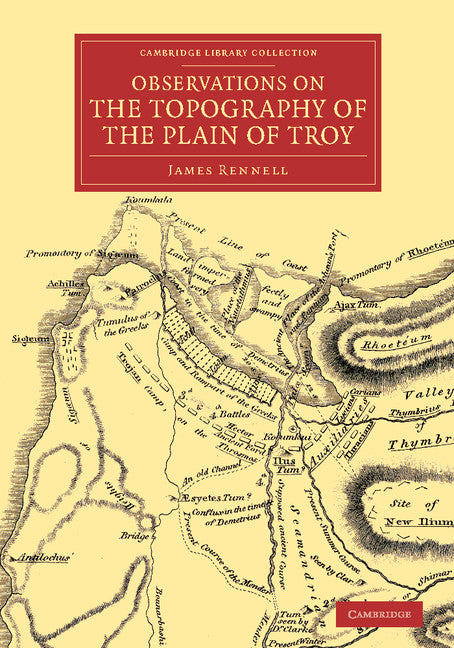
184 pages, 1 map
25.4 x 17.8 x 1 cm, 0.33 kg
James Rennell (1742–1830) could be claimed as the father of historical geography. After a long career at sea and in India, during which he had learned surveying and cartography, he returned to England and entered the circle of Sir Joseph Banks, who encouraged him to widen his interests to include the geography of the ancient world. In this work, published in 1814, Rennell compares the actual topography of the area in which Troy was believed to be located with the accounts of ancient commentators on Homer, with the Homeric accounts themselves, and finally with the work of ancient geographers. Without offering his own solution to the problem, he demolishes with zest the then current theory that Troy was located at the village of Bournabashi - a conclusion with which Heinrich Schliemann later agreed. Rennell's posthumously published work on the topography of Western Asia is also reissued in this series.
Preface
Notices respecting the maps
Part I. The Ideas of the Ancient Geographers: 1. Preliminary observations
2. Concerning the region of Ida
3. A comparison of the report of Demetrius of Scepsis, with the actual topography of the Troad
Part II. A Comparison of the Topography of Homeric Troy, with that of Demetrius and with the Actual Topography: 1. A comparison of the topography of Homer with that of Demetrius
2. The position of the camp and rampart of the Greeks
3. Concerning the monument of Ilus
4. Concerning the lower part of the course of the Scamander
5. Concerning the Throsmos
6. Concerning the tumulus of Aesyetes
Part III. Concerning What May Be Collected from the Ancients, Respecting the Site of Troy: 1. Concerning the site of ancient Troy
2. Concerning the places of the fields of battle
3. Tumulus of Hector
4. Conclusion
Addenda
Index.
Subject Areas: Ancient history: to c 500 CE [HBLA]