Freshly Printed - allow 10 days lead
Couldn't load pickup availability
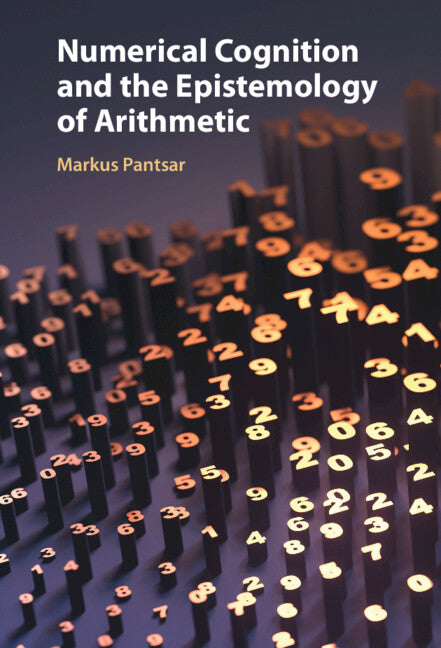
Numerical Cognition and the Epistemology of Arithmetic
The first book-length philosophical account of arithmetical knowledge that is based on the state-of-the-art empirical studies of numerical cognition.
Markus Pantsar (Author)
9781009468886, Cambridge University Press
Hardback, published 28 March 2024
266 pages
23.5 x 15.8 x 2 cm, 0.54 kg
'This book is a refreshing, genuinely interdisciplinary exploration of cognitive and epistemological issues concerning numbers. Pantsar argues for the controversial thesis that arithmetic, although rooted in our shared cognitive abilities, is a cultural product. He then explores this thesis's various repercussions, tackling in a novel way traditional philosophical problems about mathematics.' Silvia de Toffoli, Scuola Universitaria Superiore IUSS Pavia
Arithmetic is one of the foundations of our educational systems, but what exactly is it? Numbers are everywhere in our modern societies, but what is our knowledge of numbers really about? This book provides a philosophical account of arithmetical knowledge that is based on the state-of-the-art empirical studies of numerical cognition. It explains how humans have developed arithmetic from humble origins to its modern status as an almost universally possessed knowledge and skill. Central to the account is the realisation that, while arithmetic is a human creation, the development of arithmetic is constrained by our evolutionarily developed cognitive architecture. Arithmetic is a sophisticated cultural development, but it is ultimately based on abilities with numerosities that we already possess as infants and share with many non-human animals. Therefore, arithmetic is not purely conventional, an arbitrary game akin to chess. Instead, arithmetic is deeply connected to our basic cognitive capacities.
Preface
Introduction: a fractured landscape
Part I. Ontogeny: 1. Proto-arithmetical
2. Acquisition of number concepts
3. Enculturation
Part II. Phylogeny and History: 4. The phylogeny and cultural history of number concepts
5. The Development of arithmetic
6. Cumulative cultural evolution
Part III. Epistemology and Ontology: 7. Conventionalism and intersubjectivity
8. The character of arithmetical knowledge
9. Ontological considerations
Conclusion
Bibliography
Index.
Subject Areas: Philosophy of science [PDA]