Freshly Printed - allow 10 days lead
Couldn't load pickup availability
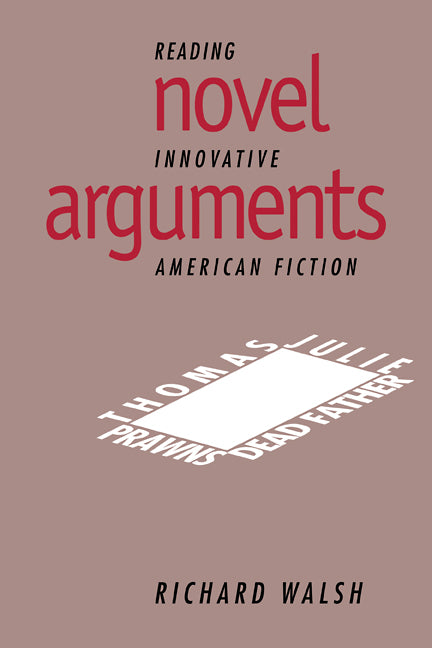
Novel Arguments
Reading Innovative American Fiction
Novel Arguments, first published in 1995, argues that innovative fiction extends our ways of thinking about the world.
Richard Walsh (Author)
9780521107037, Cambridge University Press
Paperback / softback, published 2 April 2009
200 pages
22.9 x 15.2 x 1.2 cm, 0.3 kg
Novel Arguments argues that innovative fiction - by which is meant writing that has been variously labelled as postmodern, metafictional, experimental - extends our ways of thinking about the world, rejecting the critical consensus that, under the rubrics of postmodernism and metafiction, homogenises this fiction as autonomous and self-absorbed. Play, self-consciousness and immanence - supposed symptoms of innovative fiction's autonomy - are here reconsidered as integral to its means of engagement. The 1995 book advances a concept of the 'argument' of fiction as a construct wedding structure and content into a highly evolved and expressive form. The argument, not the content, is established as the site of a fiction's 'aboutness' and thus the usual emphasis upon the generalities of innovative form is replaced by a concern for the logic of specific literary effects. Walsh deftly argues for an understanding of fictional cognition at the theoretical level and in an act of unmatched critical creativity, discards altogether the flattening totalities of received postmodern formulations.
Preface
Acknowledgements
1. The idea of innovative fiction
2. How to succeed: Donald Barthelme's The Dead Father
3. 'A man's story is his gris-gris': cultural slavery, literary emancipation and Ishmael Reed's Flight to Canada
4. Narrative inscription, history and the reader in Robert Coover's The Public Burning
5. 'One's image of oneself': Structured identity in Walter Abish's How German Is It
6. The quest for love and the writing of female desire in Kathy Acker's Don Quixote
Conclusion
Notes
Index.
Subject Areas: Literary studies: from c 1900 - [DSBH]