Freshly Printed - allow 10 days lead
Couldn't load pickup availability
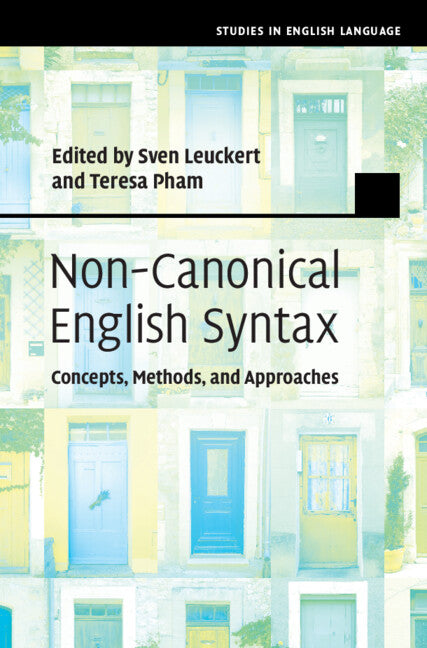
Non-Canonical English Syntax
Concepts, Methods, and Approaches
Drawing on a range of case studies, this book explores non-canonical syntax across a range of varieties of English.
Sven Leuckert (Edited by), Teresa Pham (Edited by)
9781108836128, Cambridge University Press
Hardback, published 28 August 2025
364 pages
23.5 x 16 x 2.5 cm, 0.68 kg
The term non-canonical syntax generally refers to deviations from 'typical' word order. These represent a fascinating phenomenon in natural language use. With contributions from a team of renowned scholars, this book presents a range of case-studies on non-canonical syntax across historical, register-based, and non-native varieties of English. Each chapter investigates a different non-canonical construction and assesses to what extent it can be called 'non-canonical' in a theory-based and frequency-based understanding of non-canonical syntax. A range of state-of-the-art methodologies are used, highlighting that an empirical approach to non-canonical syntactic constructions is particularly fruitful. An introduction, a synopsis, a terminological chapter, and three section introductions frame the case studies and present overviews of the theory behind non-canonical syntax and previous work, while also illustrating open questions and opportunities for future research. The volume is essential reading for advanced students of English grammar and researchers working on non-canonical syntax and syntactic variation. This title is also available as Open Access on Cambridge Core.
1. Introduction: New Perspectives on Syntax Beyond the Canon Teresa Pham and Sven Leuckert
2. Talking about (Non-)Canonicity: A Study of Linguistic Terminology Sven Leuckert and Sofia Rüdiger
Part I. Non-Canonical Syntax in Historical Varieties of English: 3. Introduction: Trying to Hit a Moving Target: (Non-)Canonical Word Order in the History of English Marianne Hundt
4. Full-Verb Inversion in the History of English: Continuation or Emergence of a Non-Canonical Word Order? Gea Dreschler
5. There's thieves in the house: Existential there-Constructions in Late Modern English Claudia Lange
6. 'Tis goodly language this, what would it mean? Demonstrative ProTags in the History English Louise Mycock and Sharon Glaas
Part II. Non-Canonical Syntax in Register-Based Varieties of English
7. Introduction: Different Ways of Saying Different Things: Non-Canonical Syntax in Registers of English Heidrun Dorgeloh and Anja Wanner
8. The President wide awake at 3:14 AM tweeting about CNN: Informational Non-Canonical Reduced Structures in TV News Broadcasts Douglas Biber, Stacey Wizner, and Randi Reppen
9. What was it about it that you loved? Clefts in Evaluative Language Teresa Pham
10. Cognitive Complexity and Non-Canonicity: Zooming in on Particle Placement Christine Günther
Part III. Non-Canonical Syntax in Non-Native Varieties of English: 11. Introduction: Multicultural Communicative Situations: Non-Canonical Syntax in Non-Native Englishes Devyani Sharma
12. Non-Canonical Syntax in South Asian Varieties of English: A Corpus-Based Study on the Introductory-it Pattern Sandra Götz and Kathrin Kircili
13. Adverbial Fronting Phenomena in German Learner Language: A Corpus-Based Study Kathrin Kircili
14. Non-Canonical Syntax in English as a Lingua Franca: Minus-Plurals between Language Contact and Emergent Grammar Theresa Neumaier and Sven Leuckert
15. Synopsis: Concepts, Approaches, and Methods in Non-Canonical Syntax Sven Leuckert and Teresa Pham.
Subject Areas: Grammar, syntax & morphology [CFK]