Freshly Printed - allow 8 days lead
Couldn't load pickup availability
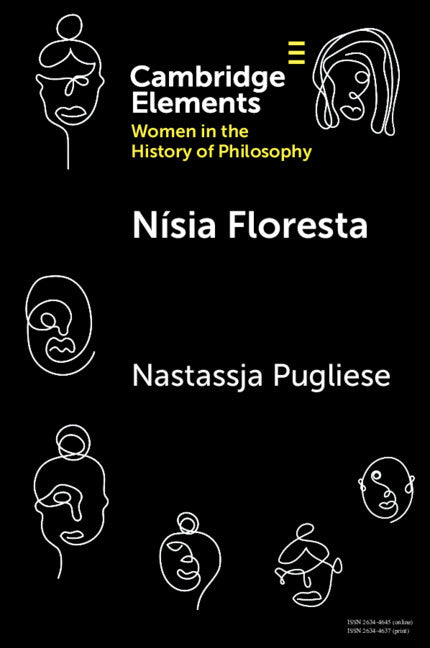
Nísia Floresta
This Element presents the contributions of Nísia Floresta, a 19th century feminist philosopher who defended abolition and indigenous rights.
Nastassja Pugliese (Author)
9781009124133, Cambridge University Press
Paperback / softback, published 20 July 2023
75 pages
22.9 x 15.2 x 0.3 cm, 0.105 kg
This Element presents the philosophical contributions of Nísia Floresta, a feminist philosopher of education from the 19th century in early post-colonial Brazil, who defended abolition and indigenous rights. Focusing on five central works (Direitos, Lágrima, Opúsculo, Páginas, and Woman), it shows them connected by a critique of colonialism grounded on feminist principles. Influenced by the practical Cartesianism of Poulain de la Barre through the pamphlets of Sophia, Floresta applies to the social structures the feminist principle that reason has no gender, arguing that a nation's civilizational level depends on whether natural equality is expressed in terms of social rights. Describing the suffering experienced by women, indigenous people, and the black enslaved population, she defends education as a strategy against colonialism. As such, education should aim towards physical and intellectual emancipation, restoring the lost dignity of individuals. Floresta's works thus foreground slavery and colonization as events that shaped philosophical modernity.
1. A woman philosopher in post-colonial Brazil
2. Beyond the 'Brazilian Wollstonecraft' myth
3. Floresta: translator of the anonymous Sophia and author of her own vindicatory works
4. Equality: from naturally given to a measure of social justice
5. The colonialist principle: instrumentalization of suffering as a strategy of domination
6. Dignity as true liberation: educating for physical and intellectual emancipation
7. Locating Floresta in the history of philosophy
Nísia Floresta's works
Posthumous editions
References.
Subject Areas: History of Western philosophy [HPC]