Freshly Printed - allow 10 days lead
Couldn't load pickup availability
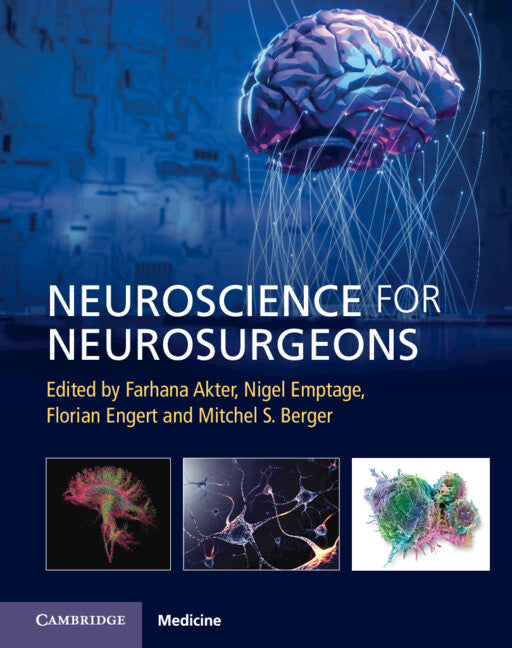
Neuroscience for Neurosurgeons
Highlights the principles of basic neuroscience, allowing surgeons to combine academia and clinical practice to improve patient prognosis.
Farhana Akter (Edited by), Nigel Emptage (Edited by), Florian Engert (Edited by), Mitchel S. Berger (Edited by)
9781108831468, Cambridge University Press
Hardback, published 25 January 2024
443 pages
26 x 20.7 x 2.6 cm, 1.24 kg
With advances in medicine and medical innovation, the face of neurosurgery has changed dramatically. A new era of surgeons value the need to undertake research in everyday practice and actively participate in the clinic and laboratory in order to improve patient prognosis. Highlighting the principles of basic neuroscience and its application to neurosurgical disease, this book breaks down neurological conditions into current academic themes and advances. The book is split into two sections, with the first covering basic and computational neuroscience including neuroanatomy, neurophysiology, and the growing use of artificial intelligence. The second section concentrates on specific conditions, such as gliomas, degenerative cervical myelopathy and peripheral nerve injury. Outlining the pathophysiological underpinnings of neurosurgical conditions and the key investigative tools used to study disease burden, this book will be an invaluable source for the academic neurosurgeon undertaking basic and translational research.
Section 1. Basic and computational neuroscience: 1. Neuroanatomy Farhana Akter, Charles Reilly, Christophe Dupre, and Shifa Hossain
2. Cerebral autoregulation Xingping Qin, Parisa Nikrouz and Farhana Akter
3. Neuroimmune interactions Allison Chang
4. Anatomy and physiology of the neuron Oluwatobi Ariyo and Farhana Akter
5. Synaptic transmission Katrina Hon and Nigel Emptage
6. Sensory pathways Rachel Chau, Megan Chau and Farhana Akter
7. Somatosensory and somatic motor systems Maria Kaltchenko and Farhana Akter
8. Neuron models Kumaresh Krishnan
9. An introduction to artificial intelligence and machine learning Shun Yao, Ye Wu and Farhana Akter
10. Artificial intelligence in neuroscience Will Xiao, Mengmi Zhang and Gabriel Kreiman
11. Probability and statistics Zachary T. Miller
Section 2. Clinical neurosurgical diseases
12. Glioma David M. Ashley and Justin T. Low
13. Brain metastases: molecules to medicine Ethan S. Srinivasan, Vadim Tsvankin, Eric W. Sankey, Matthew M. Grabowski, Pakawat Chongsathidkiet and Peter E. Fecci
14. Benign adult brain tumors and pediatric brain tumors Shun Yao, Umar Raza and Farhana Akter
15. Biomechanics of the spine Gaetano De Biase and Kingsley Abode-Iyamah
16. Degenerative cervical myelopathy Timothy J. Florence, Joel S. Beckett and Langston T. Holly
17. Spondylolisthesis Yike Jin, Ann Liu, Ravi Medikonda and Timothy F. Witham
18. Radiculopathy Yingda Li and Michael Y Wang
19. Spinal tumors Ziev B. Moses, Matthew Trawczynski and John E O'Toole
20. Acute spinal cord injury and spinal trauma Dominique M. O. Higgins, Pavan S. Upadhyayula, Michael Argenziano and Paul McCormick
21. Traumatic brain injury Kristin A. Keith and Jason H. Huang
22. Vascular neurosurgery Karol P. Budohoski and Adib A. Abla
23. Pediatric vascular malformations Alaa Montaser and Edward R. Smith
24. Craniofacial neurosurgery John T. Smetona and John A. Persing
25. Hydrocephalus Benjamin C. Reeves, Jason K. Karimy, Phan Q. Duy and Kristopher T. Kahle
26. Peripheral nerve injury response mechanisms Andrew S. Jack and Line Jacques
27. Clinical peripheral nerve injury models Andrew S. Jack, Charlotte J. Huie and Line Jacques
28. The neuroscience of functional neurosurgery Joseph S. Bell, TJ Florence, Maya Harary, Maxwell D. Melin, Hiro Sparks and Nader Pouratian
29. Neuroradiology: focused ultrasound in neurosurgery Massimiliano Del Bene, Roberto Eleopra, Francesco Prada and Francesco DiMeco
30. Magnetic resonance imaging in neurosurgery David J. Segar, Jasmine A. Thum, Dhiego Bastos and Alexandra J. Golby
31. Brain mapping Anthony T. Lee, Cecilia Dalle Ore and Shawn L. Hervey-Jumper.
Subject Areas: Neurology & clinical neurophysiology [MJN]