Freshly Printed - allow 10 days lead
Couldn't load pickup availability
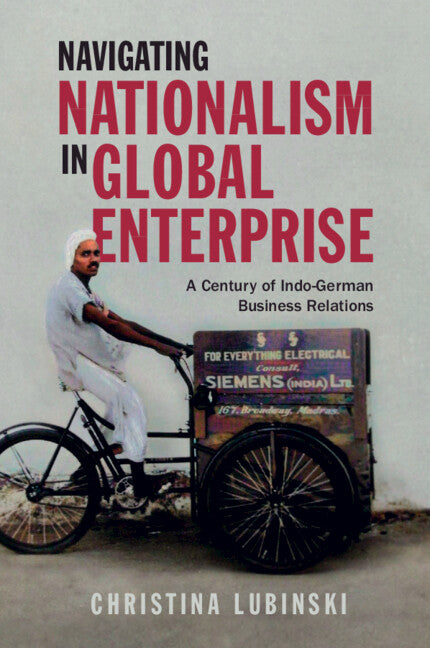
Navigating Nationalism in Global Enterprise
A Century of Indo-German Business Relations
Reveals how nationalism shapes global business strategy with a focus on the historical example of German firms in India.
Christina Lubinski (Author)
9781009054003, Cambridge University Press
Paperback / softback, published 8 May 2025
300 pages
22.9 x 15.2 x 1.6 cm, 0.437 kg
'A richly contextualized and deeply researched historical case study that proposes different ways of thinking about these categories and ideas that we often do not sufficiently question.' Stephanie Decker, Administrative Science Quarterly
Navigating Nationalism in Global Enterprise analyzes the role of nationalism in global business strategy, showing how multinationals act not just as drivers of globalization but also as sophisticated operators in a world of nations. Using the case study of German companies in colonial and post-colonial India, Christina Lubinski traces how nationalism's influence on business competitive strategies changed over the twentieth century and across major political turning points, such as two world wars and India's transition to independence. She highlights how national imaginings are both relational because they derive from comparisons with other nations, and historical because they mobilize the past to legitimize future aspirations. Lubinski stresses that learning from the past is how multinationals engage strategically with the content of nationalism – i.e., a nation's history, aspirations, and relationships with other nations. In India, German companies' competitiveness was continuously dependent on navigating nationalism and on understanding that nationalism and globalization are inextricably linked.
List of figures
List of tables
Acknowledgments
Introduction
Part I. Nationalism and Competitive Dynamics: 1. The invention of nationality
2. Bazaar goods 'made in Germany'
3. Mapping enemies in World War I
4. The alliance of the disillusioned
Part II. Emergent Strategy in a World of Nations: 5. Refining political capabilities
6. Planning for uncertain futures
7. Stability in a wobbly world
8. Reimagining the world in stages
Conclusion: Re-Historicizing nations
Appendices
Bibliography
Index.
Subject Areas: Economic history [KCZ], Nationalism [JPFN], 20th century history: c 1900 to c 2000 [HBLW], Asian history [HBJF]