Freshly Printed - allow 10 days lead
Couldn't load pickup availability
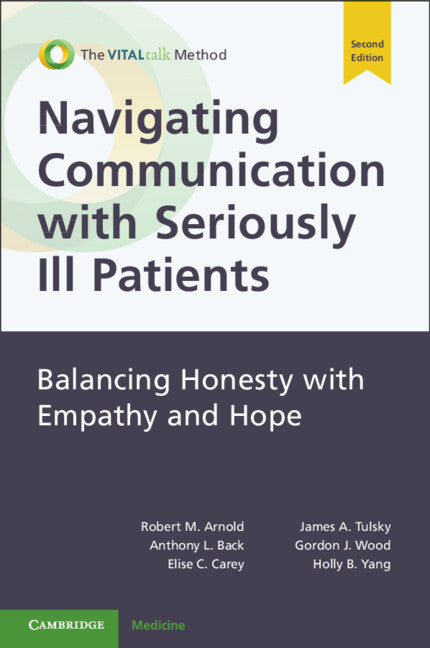
Navigating Communication with Seriously Ill Patients
Balancing Honesty with Empathy and Hope
A practical guide to help clinicians communicate more effectively with seriously ill patients and their families about what matters most.
Robert M. Arnold (Author), Anthony L. Back (Author), Elise C. Carey (Author), James A. Tulsky (Author), Gordon J. Wood (Author), Holly B. Yang (Author)
9781108925853, Cambridge University Press
Paperback / softback, published 25 April 2024
256 pages
22.9 x 15.4 x 1.2 cm, 0.43 kg
'For a family physician, this book can supply the words to label the challenges encountered in difficult emotional conversations. Clinicians will recognize the pitfalls and derailments of the clinical conversations portrayed and will be reassured by learning skills that can be relied on when faced with challenging encounters. The book can be read as a whole or used as a go-to reminder of a cognitive map and strategies to manage these conversations. … We recommend that physicians in training and seasoned clinicians read this book and keep it close at hand as they gradually strengthen the practice of person-centered communication in the most difficult situations.' Mary Talen, Family Medicine
When clinicians communicate effectively, patients retain more information, have higher trust and a better quality of life. Such a patient-centred approach is the future of clinical care, and this book is an essential how-to guide on improving these skills. Grounded in innovative and evidence-based methodology, perfected through over twenty years of teaching in the VitalTalk training program, content includes foundational communication skills, how to help patients plan for the future, what to do when you are really stuck, and strategies to work through conflicts with colleagues. In this updated edition, emphasis is placed on the roles privilege, race, and power play in the medical encounter, and new tools are provided to help clinicians navigate this landscape with greater self-awareness and sensitivity. This practical guide is filled with skills and roadmaps, demonstrating how to be clearer when sharing information, more competent at understanding patient concerns, and more effective when making recommendations.
Preface
Acknowledgments
1. Taking your skills to the next level
2. Foundation communication skills
3. Talking about serious news
4. Discussing prognosis
5. Planning for the future: discussing what's important, well before a crisis
6. Discussing treatment decisions
7. Between the big events
8. Goals of care in late- stage disease
9. Conducting a family conference
10. Dealing with conflicts between clinicians and patients
11. Working through conflicts with colleagues
12. When you're really stuck
13. Talking about dying
14. Cultivating your skills
Index.
Subject Areas: Medicine: general issues [MB]