Freshly Printed - allow 7 days lead
Couldn't load pickup availability
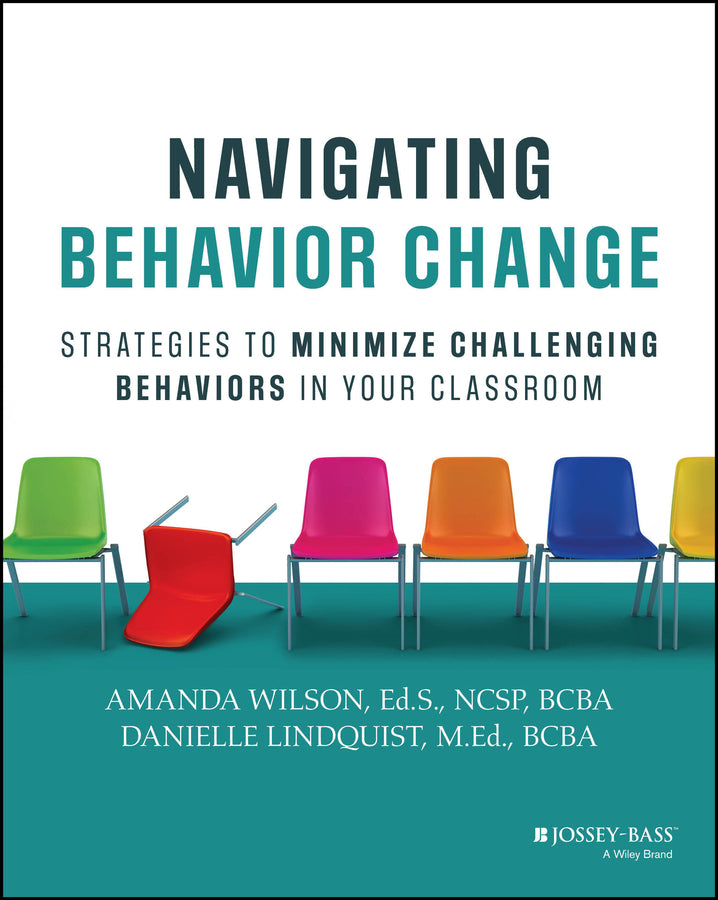
Navigating Behavior Change
Strategies to Minimize Challenging Behaviors in Your Classroom
Praise for Navigating Behavior Change “Amanda and Danielle bring together their lessons learned from years in educational settings to create an incredibly accessible and useful resource full of information, opportunities for reflection, and easy to apply strategies that span from preschool through high school. This book is perfect for professional learning communities, collaborating and coaching staff, and individuals that are seeking to create an effective classroom setting where learning happens in a safe and supported environment for everyone.” —Krista Rice, School Psychologist, Anchorage School District “This engaging and practical book offers educators powerful strategies that are easy to implement in the classroom. Whether you’re a general or special education teacher, a behavior support professional, or a school or district administrator, the insights shared by the authors—based on their own experiences—will enhance your ability to create a more positive, supportive learning environment. It’s a must-read for anyone committed to strengthening universal supports and improving school climate for students and staff alike.” —Dawn Spurlock, Director of Special Services, Caldwell School District in Caldwell, Idaho “In a space filled with noise, Wilson and Lindquist deliver clarity. Their focus on universal supports as foundational—not optional—is a message we can’t repeat enough. This book reinforces many of the same principles I advocate for and does so with heart and precision.” —Dr. Paul "Paulie" Gavoni, WSJ and USA Today bestselling author and founder of Heart & Science International and The Behavioral Toolbox “Navigating Behavior Change is a gem! It’s brimming with relatable wisdom and practical classroom strategies rooted in evidence-based practices focusing on universal supports for all students to enhance learning. Teachers, university faculty preparing teachers, and others supporting teachers will undoubtedly find the perspectives, strategies, and tools valuable in real-world situations and immediately actionable.” —Michael F. Giangreco, PhD, University Distinguished Professor Emeritus of Special Education, University of Vermont “Navigating Behavior Change provides a step-by-step roadmap for teachers, school psychologists, and other educators to effectuate positive behavior change in classrooms. It is a must-read for current school professionals as well as pre-service educators in higher education training programs.” —Katherine A. Dockweiler, Assistant Professor of School Psychology and President of the Nevada State Board of Education “Teachers, school leaders, educational consultants—this book is ideal for anyone who needs user-friendly tools and a framework when navigating behavior change to improve student progress in classrooms. Busting myths with evidence-based strategies, Amanda and Danielle break down components of quality instructional practices with solid rationales and guiding questions to apply effective tools and strategies the next day!” —Alison Lovelace, PhD, BCBA-D
Amanda Wilson (Author), Danielle Lindquist (Author)
9781394282692, Wiley
Paperback / softback, published 28 July 2025
224 pages
23.1 x 18.8 x 1.5 cm, 0.318 kg
A master class in preventing challenging student behavior with confidence Navigating Behavior Change is a book for all the teachers and school professionals who struggle with the constant cycle of reacting to student behavior. This guide outlines universal practices which should be in place within every classroom to prevent challenging behaviors before they start. When students are focused and ready to learn, educators can do the important work of teaching. In this book, school psychologist Amanda Wilson and special educator Danielle Lindquist help you build your skill set, so you can create an environment where students are regulated and motivated to learn. Inside, you'll find a comprehensive framework of components that you can implement in any K-12 classroom to prevent challenging behaviors and increase student engagement. This book will help K-12 teachers, special education teachers, school counselors, and other service providers, instructional coaches, and administrators of students with behavior challenges. Take a proactive approach to behavior and help students so you can spend more time teaching and they can spend more time learning.
Foreword xiii About the Authors xv Introduction xvii How It All Began xvii Why We Wrote This Book xviii How to Use This Book xx Format xx Activities xx Resources xxi 1 Foundations of Behavior 1 What Does Behavior Have to Do with Universal Supports? 1 The Brain: The Not-So-Big Elephant in the Room 5 Why We Do What We Do 9 2 So You Want to Manage a Classroom? 17 Debunking Common Classroom Management Myths 17 Starting with the End in Mind 19 We Ride “The Blame Train” 20 We Make Assumptions 20 We Opt for Compliance or Bust 20 We Get Cozy in Consequence Land 21 Values 22 Components of Effective Universal Supports 24 3 Structuring Your Way to Success 29 An Organized Classroom Supports Organized Behavior 29 Arranging the Physical Layout 30 What It Is 31 Why It’s Effective 31 How to Do It 31 Communicating the Message Through Visual Aids 36 What It Is 37 Why It’s Effective 37 How to Do It 38 Additional Considerations 38 Ensuring Predictability with Schedules and Lesson Agendas 40 What It Is 41 Why It’s Effective 41 How to Do It 41 Additional Considerations 42 Creating Exceptional Expectations 42 What It Is 44 Why It’s Effective 46 How to Do It 46 Additional Considerations 49 Road Mapping Routines for Independence 51 What It Is 51 Why It’s Effective 52 How to Do It 52 Additional Considerations 56 4 Leveling Up Your Instructional Practices 59 Preparing with Precorrection 59 What It Is 60 Why It’s Effective 61 How to Do It 61 Additional Considerations 62 Encouraging Cooperation with Instructional Choice 64 What It Is 64 Why It’s Effective 65 How to Do It 65 Additional Considerations 68 Increasing Opportunities to Respond 70 What It Is 71 Why It’s Effective 71 How to Do It 72 Additional Considerations 76 Getting Our Steps in with Active Supervision 77 What It Is 77 Why It’s Effective 78 How to Do It 78 Additional Considerations 81 Packaging Up Your Lesson Delivery 82 What It Is 83 Why It’s Effective 83 How to Do It 84 Additional Considerations 89 5 Reinforcing Desirable Behaviors 91 Rewards and Incentives and Bribery, Oh My! 91 Common Statements and Misunderstandings Regarding Reinforcement 92 Improving Feedback with Behavior-Specific Praise 96 What It Is 97 Why It’s Effective 98 How to Do It 99 Additional Considerations 101 Embedding Reinforcement into the Classroom 105 6 Responding to Challenging Behaviors 111 Breaking Tradition 111 Misapplied 112 Overused 113 Unresponsive 113 Common Motivations for Ineffective Responses 114 The Mirror: Taking a Long, Hard Look 117 Responding Rather than Reacting 118 Checking Our Communication 120 Regulating: The Art of Defusing 123 Why It’s Effective 123 Developing Your Response Framework 124 Additional Considerations 132 Reflecting: Problem-Solving and Planning for the Future 133 What It Is 134 Why It’s Effective 134 How to Do It 135 Additional Considerations 136 Restoring: Fixing Harm Done 137 What It Is 137 Why It Is Effective 137 How to Do It 137 Re-Engaging: Getting Everyone Back on Track 138 What It Is 138 Why It Is Effective 139 How to Do It 139 7 Putting It All Together 141 Common Classroom Challenges 141 Transitions and Tribulations 143 Circle Time Circus 146 Writing Retaliation 149 Direct Instruction Disaster 152 8 Problem-Solving Barriers 157 Fidelity of Implementation 157 Gaining Buy-In and Advocating for Change 158 Appendix 163 Reproducible Forms 163 References 187 Glossary 189 Index 191
Subject Areas: Education [JN]