Freshly Printed - allow 10 days lead
Couldn't load pickup availability
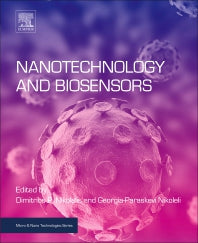
Nanotechnology and Biosensors
Explores how nanotechnology is used to create more efficient, cheaper biosensors, and explores their use in a range of industrial applications
Dimitrios P Nikolelis (Edited by), Georgia Paraskevi Nikoleli (Edited by)
9780128138557, Elsevier Science
Paperback, published 19 June 2018
470 pages
23.4 x 19 x 2.9 cm, 0.45 kg
"This text covers a lot of ground and will be of interest to those wishing for a general overview of the range of nanomaterials used for biosensing in environmental, food and medical sensing applications. There is some repetition of introduction and technical detail between the chapters which allows them to be read in isolation and all are well referenced for those looking for more detail in a particular application." --Johnson Matthey Technology Review
Nanotechnology and Biosensors shows how nanotechnology is used to create affordable, mass-produced, portable, small sized biosensors to directly monitor environmental pollutants. In addition, it provides information on their integration into components and systems for mass market applications in food analysis, environmental monitoring and health diagnostics. Nanotechnology has led to a dramatic improvement in the performance, sensitivity and selectivity of biosensors. As metal-oxide and carbon nanostructures, gold and magnetite nanoparticles, and the integration of dendrimers in biosensors using nanotechnology have contributed greatly in making biosensors more effective and affordable on a mass-market level, this book presents a timely resource on the topic.
1. Prototype biosensing devices: design and microfabrication based on nanotechnological tools for the rapid in the field detection of food toxicants and environmental pollutants
2. Biosensors for intracellular and less invasive sensors based on nanostructured metal oxides
3. Carbon electrodes in electrochemical analysis of biomolecules and bioactive substances: roles of surface structures and chemical groups
4. Carbon based nanomaterials for electrochemical DNA sensing
5. Gold nanoparticle-based technologies in photothermal/photodynamic treatment: the challenges and prospects
6. Encapsulated Magnetite Nanoparticles: Preparation and Application as Contrast Agents for Magnetic Resonance Imaging
7. Metal nanomaterial-assisted aptasensors for emerging pollutants detection
8. Impedimetric aptamer biosensing employing nanomaterials
9. Metal-oxide nanostructures for energy harvesting and sensing
10. Electroanalytical bioplatforms based on carbon nanostructures as new tools for diagnosis
11. Dendrimers integrated biosensors for healthcare applications
12. Electrochemical DNA and aptasensors based on nanomaterials for medical diagnostics
Subject Areas: Materials science [TGM], Nanotechnology [TBN]