Freshly Printed - allow 10 days lead
Couldn't load pickup availability
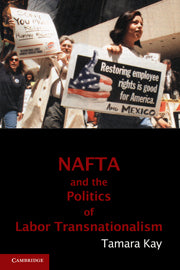
NAFTA and the Politics of Labor Transnationalism
This book argues that, collectively, unions can help shape how the rules governing the global economy are made.
Tamara Kay (Author)
9780521762878, Cambridge University Press
Hardback, published 31 January 2011
338 pages, 5 b/w illus. 9 tables
23.1 x 15.7 x 2.3 cm, 0.56 kg
“Anybody concerned with social movements in the 21st century, and especially the prospects for labor transnationalism, needs to read this book. Tamara Kay shows why and how a few U.S. and Mexican unions were able to turn NAFTA, which they had viewed as a threat, into an opportunity for new cross-border strategies. The results point to promising ways forward for global movements.”
—Chris Tilly, Director of the Institute for Research on Labor and Employment, University of California, Los Angeles
When NAFTA went into effect in 1994, many feared it would intensify animosity among North American unions, lead to the scapegoating of Mexican workers and immigrants, and eclipse any possibility for cross-border labor cooperation. But far from polarizing workers, NAFTA unexpectedly helped stimulate labor transnationalism among key North American unions and erode union policies and discourses rooted in racism. The emergence of labor transnationalism in North America presents compelling political and sociological puzzles: how did NAFTA, the concrete manifestation of globalization processes in North America, help deepen labor solidarity on the continent? In addition to making the provocative argument that global governance institutions can play a pivotal role in the development of transnational social movements, this book suggests that globalization need not undermine labor movements: collectively, unions can help shape how the rules governing the global economy are made.
1. Introduction: NAFTA and labor transnationalism
Part I. The Emergence of Transnationalism: 2. Labor nationalism: diplomacy and distance among unions prior to NAFTA
3. NAFTA as catalyst: constituting transnational actors and interests
4. Constituting transnational labor rights
5. Seizing the opportunity NAFTA provided
Part II. Variations in Transnationalism: 6. Missing the opportunity NAFTA provided
7. Explaining variation in the emergence of labor transnationalism
Part III. Conclusions: 8. Global governance and labor transnationalism.
Subject Areas: Comparative politics [JPB], Politics & government [JP]