Freshly Printed - allow 10 days lead
Couldn't load pickup availability
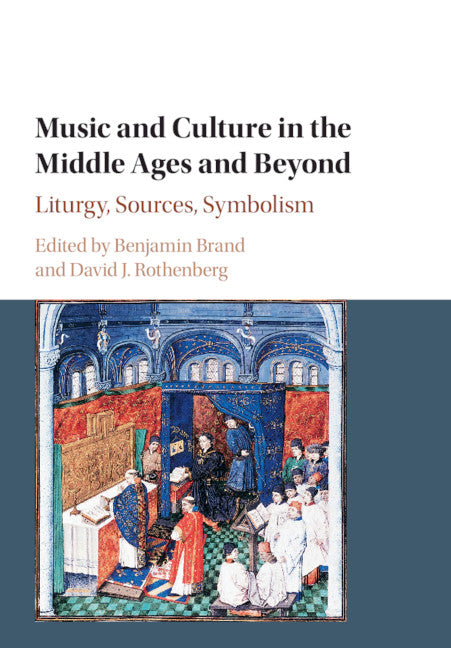
Music and Culture in the Middle Ages and Beyond
Liturgy, Sources, Symbolism
The essays in this volume offer diverse, innovative approaches to medieval music and culture.
Benjamin Brand (Edited by), David J. Rothenberg (Edited by)
9781108792639, Cambridge University Press
Paperback / softback, published 20 February 2020
380 pages, 18 tables 31 music examples
24.4 x 17 x 2 cm, 0.6 kg
'This collection groups its fifteen essays into three themes reflecting its dedicatee Craig Wright's interests in sources, ceremonies, and symbolism. The editor's introductory chapter frames the volume, but also provides a useful literature review within these fields and of Craig Wright's distinctive contributions … The fifteen essays' thematic alignment is a testament to Craig Wright's breadth and vision, and the editors' syncretizing ingenuity.' Magnus Williamson, Renaissance Quarterly
It has become widely accepted among musicologists that medieval music is most profitably studied from interdisciplinary perspectives that situate it within broad cultural contexts. The origins of this consensus lie in a decisive reorientation of the field that began approximately four decades ago. For much of the twentieth century, research on medieval music had focused on the discovery and evaluation of musical and theoretical sources. The 1970s and 1980s, by contrast, witnessed calls for broader methodologies and more fully contextual approaches that in turn anticipated the emergence of the so-called 'New Musicology'. The fifteen essays in the present collection explore three interrelated areas of inquiry that proved particularly significant: the liturgy, sources (musical and archival), and musical symbolism. In so doing, these essays not only acknowledge past achievements but also illustrate how this broad, interdisciplinary approach remains a source for scholarly innovation.
Introduction Benjamin Brand and David J. Rothenberg
1. Music and liturgy in medieval Capua Thomas Forrest Kelly
2. Theory meets practice: the model antiphon series Primum quaerite in Hucbald's Office In plateis and in other post-Carolingian chant Barbara Haggh-Huglo
3. Singing from the pulpit: polyphonic improvisation and public ritual in medieval Tuscany Benjamin Brand
4. Liturgy and politics in Renaissance Florence: the creation of the 1526 Office for St Zenobius Marica S. Tacconi
5. Music and pageantry in the formation of Hispano-Christian identity: the Feast of St Hippolytus in sixteenth-century Mexico City Lorenza Candelaria
Part II. Archival and Source Studies: 6. The sources and the sanctorale: dating by the decade in thirteenth-century Paris Rebecca A. Baltzer
7. Vernacular contexts for the monophonic motet: notes from a new source Mark Everist
8. Tradition and innovation in fourteenth-century instrumental music: evidence from archival and musical sources Keith Polk
9. Melchior or Marchion de Civilibus, prepositus brixiensis: new documents Margaret Bent
10. Papal musicians at Cambrai in the early fifteenth century Alejandro Enrique Planchart
11. Sixtus IV, the Franciscans, and the beginning of music printing in fifteenth-century Rome Jane A. Bernstein
Part III. Symbolism: 12. The gate that carries Christ: wordplay and liturgical imagery in a motet from c.1300 David J. Rothenberg
13. A musical lesson for a king from the Roman de Fauvel Anne Walters Robertson
14. Preaching to the choir? Obrecht's Motet for the Dedication of the Church M. Jennifer Bloxam
15. The Madonna triptych: a mystical reading of three early music videos Andrew Tomasello.
Subject Areas: History: specific events & topics [HBT], History [HB], Techniques of music / music tutorials [AVS], Musical scores, lyrics & libretti [AVQ], Individual composers & musicians, specific bands & groups [AVH], Music: styles & genres [AVG], Theory of music & musicology [AVA], Music [AV]