Freshly Printed - allow 7 days lead
Couldn't load pickup availability
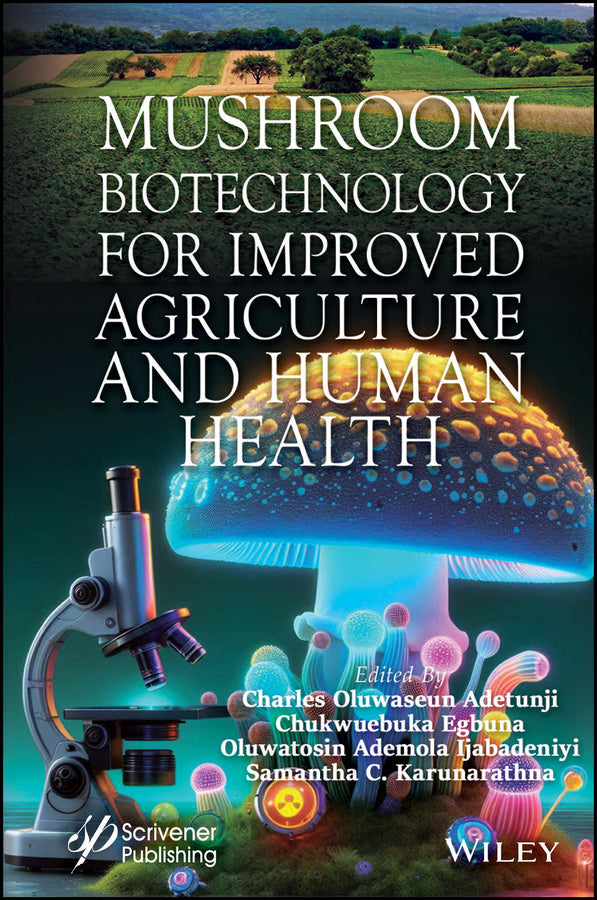
Mushroom Biotechnology for Improved Agriculture and Human Health
Charles Oluwaseun Adetunji (Edited by), Adetunji (Author), Chukwuebuka Egbuna (Edited by), Oluwatosin Ademola Ijabadeniyi (Edited by), Samantha C. Karunarathna (Edited by)
9781394212637, Wiley
Hardback, published 7 May 2025
400 pages
28 x 19 x 2.6 cm, 0.737 kg
The book is essential for those seeking to understand innovative and sustainable solutions to global food insecurity and health challenges, as it offers invaluable insights into the transformative potential of mushroom biotechnology and its applications. The intervention of microbial biotechnology in various sectors has displayed remarkable growth linked to sustainable innovations and biotechnological utilization of beneficial microorganisms, such as mushrooms, for the benefit of humanity. Recent advancements in mushroom biotechnology will prove successful due to mushrooms’ nature as natural problem solvers, including their ability to enhance nutritional values obtained from agricultural crops, sustained health benefits derived from pharmacologically active substances used to manage human diseases, and improve crop production. This book will serve as one of the first volumes addressing the usefulness of mushroom biotechnology, giving detailed state-of-the-art information on recent advancements and how the industry could maximize profits. The volume will also assist the pharmaceutical and medical sectors by examining the discovery of novel pharmacological and bioactive compounds that could replace the various adverse effects when using synthetic drugs. It presents a simple, adaptable, reproducible methodology that will help researchers and scientists adopt these methodologies for similar projects. Readers will find that the book: Audience The book is valuable reference work for scientists and researchers working in the fields of pharmaceutical sciences, agricultural microbiology, plant pathology, botany, agriculture, microbiology, biotechnology, nanotechnology, environmental microbiology, and microbial biotechnology.
Preface xv 1 Application of Mushrooms in the Bioremediation of Environmental Pollutants 1 Introduction 2 Unique Characteristics of Fungi 4 Specific Contaminants Targeted by Mushrooms 6 Mechanisms of Mushroom Bioremediation 7 Absorption and Accumulation of Contaminants by Mushrooms 9 Transformation and Degradation of Pollutants 10 Role of Enzymes and Metabolic Processes 12 Advancements and Research in Mushroom Bioremediation 13 Emerging Trends in Fungal Bioremediation 15 Genetic Modification of Mushrooms for Enhanced Bioremediation 16 Benefits of Mushroom Bioremediation 19 Challenges and Limitations of Using Mushrooms 21 Future Prospects and Research Opportunities 22 Conclusion and Recommendations 24 References 26 2 Application of Mushroom in the Management of Pest and Diseases Affecting Agricultural Crops 29 2.1 Introduction 30 2.2 Properties of Mushroom as Biocontrol Agents (Basidiomycetes) 31 2.3 Mushroom Substrate as Biocontrol Agent for Plant 33 2.4 Mechanism of Action of Mushrooms in the Control of Pests and Diseases 34 2.5 Several Areas Where Mushrooms Can Be Applied 36 2.6 Mushrooms as Disease Control Agents 37 2.7 Conclusion 38 References 38 3 Agricultural Applications of Novel Mushroom-Based Nanopesticide 45 3.1 Introduction 46 3.2 Advantages of Nanobiopesticides Over Conventional Pesticides 50 3.3 Mushrooms as Nanobiopesticide Sources 52 3.4 Bioactive Compounds in Mushrooms Suitable for Nanobiopesticide Development 55 3.5 Role of Mushroom Extracts in Nanoparticle Synthesis 56 3.6 Mechanisms of Action of Nanobiopesticides on Pests and Pathogens 57 3.7 Production and Formulation of Nanobiopesticides 60 3.8 Agricultural Applications of Nanobiopesticides 61 3.9 Future Prospects and Research Directions 64 3.10 Recommendation and Conclusion 66 References 67 4 Mass Production of Mushroom for Animal Feed 71 4.1 Introduction 72 4.2 Mushroom 73 4.3 Mushroom Production 74 4.3.1 Mass Production of Mushrooms for Animal Feed 75 4.3.2 Mushroom Substrate (Spent) for Feed 77 4.3.3 Mushroom Substrate (Spent) for Poultry 77 4.3.4 Mushroom Substrate (Spent) for Ruminants 77 4.4 Benefits of Feeding Animals with Mushrooms 78 4.5 Conclusion 79 References 80 5 Application of Mushrooms in Management of Soil-Borne Parasites, Nematodes, Bacteria and Fungi 85 5.1 Introduction 86 5.2 Soil-Borne Parasites, Nematodes, Bacteria, and Fungi 88 5.2.1 Soil-Borne Nematodes 89 5.2.2 Types of Soil-Borne Bacteria 93 5.2.3 Types of Soil-Borne Fungi 95 5.3 Mushrooms as Biocontrol Agents 98 5.3.1 Mushrooms as Natural Biopesticide 99 5.3.2 Mechanisms of Mushroom-Mediated Biocontrol 101 5.4 Mushroom Species and Biocontrol Potential 102 5.5 Advantages of Mushroom Biocontrol 107 5.6 Challenges and Limitations of Mushroom Bio-Control 108 5.7 Conclusion and Future Outlook 108 References 109 6 Production of Stable Enzymes from Mushrooms with Numerous Biomedical Applications 123 6.1 Introduction 124 6.2 Classes/Types of Mushrooms 126 6.2.1 Button Mushroom (Agaricus bisporus) 126 6.2.2 Oyster (Pleurotus ostreatus) 126 6.2.3 Portabello 127 6.2.4 Morel (Morchella) 127 6.2.5 Reishi (Ganoderma lucidum) 128 6.2.6 Burnt Matches (Eutypellascorpia) 129 6.2.7 Chanterelle (Cantharellus) 129 6.2.8 Laetiporus sulphureus 129 6.2.9 Cordyceps (Cordyceps militaris) 129 6.2.10 Enokitake (Flammulina velutipes) 129 6.2.11 Giraffe Spots (Endophora albobadia) 130 6.2.12 Destroying Angel (Amanita sp.) 130 6.2.13 Green-Spored Lepiota (Chloropyhllum) 130 6.2.14 Matsutake Mushroom 130 6.2.15 Shiitake Mushroom (Lentinula edodes) 131 6.2.16 Truffles 131 6.2.17 Shimeji 131 6.3 Stable Enzymes Produced by Mushrooms 131 6.3.1 Ligninolytic Enzymes 132 6.3.1.1 Lignin Peroxidase 132 6.3.1.2 Manganese Peroxidase 133 6.3.1.3 Versatile Peroxidase 133 6.3.1.4 Laccases 133 6.3.1.5 Tyrosinase 134 6.3.2 Hydrolases 134 6.3.2.1 Cellulases 134 6.3.2.2 Xylanase 135 6.3.2.3 Pectinases 135 6.3.2.4 Amylases 135 6.3.2.5 Proteases 136 6.3.2.6 Esterase 136 6.3.3 Stress Enzymes 136 6.4 Biomedical and Biotechnological Applications of Stable Mushroom Enzymes 137 6.4.1 Mushroom Enzymes as Antimicrobial Agents 138 6.4.2 Mushroom Enzymes as Anticancer and Antitumor Agents 139 6.4.3 Mushroom Enzymes as Antioxidants 140 6.4.4 Other Applications of Mushroom Enzymes 141 6.5 Some Limitations of Mushroom Enzymes 145 6.6 Conclusion and Future Perspectives 146 References 147 7 Relevance of Mushrooms for Biological Control of Diverse Biotic Agent Mitigating Against Agricultural Crops 159 7.1 Introduction 160 7.1.1 Benefits of Using Mushrooms in Pest and Disease Management 161 7.1.2 Challenges of Mycopesticides 162 7.2 Fungal Biopesticides 163 7.2.1 How Fungal Biopesticides Work 163 7.2.2 Advantages of Fungal Biopesticides 164 7.2.3 Challenges and Considerations of Fungal Biopesticides 165 7.2.4 Some Key Points Regarding Fungal Biopesticides 166 7.3 Mycoparasitism 167 7.4 Nutrient Cycling and Soil Health 170 7.5 Companion Planting 172 7.6 Challenges and Considerations 174 7.7 Conclusion and Future Perspectives 175 7.7.1 Future Perspectives 176 References 177 8 Discovery and Relevance of Novel Pharmacological Substances from Beneficial Mushrooms 183 8.1 Introduction 184 8.1.1 Brief Overview of Beneficial Mushrooms 185 8.1.2 Importance of Discovering Novel Pharmacological Substances in Mushrooms 187 8.1.3 Beneficial Mushrooms as a Source of Pharmacological Substances 188 8.1.4 Historical Use of Mushrooms in Traditional Medicine 190 8.2 Bioactive Compounds in Mushrooms 192 8.3 Pharmacological Activities of Mushroom-Derived Compounds 193 8.4 Clinical Applications and Relevance 195 8.5 Challenges and Future Directions 196 Conclusion 197 References 197 9 Application of Mushroom in the Management of Diabetes Mellitus 209 Introduction 210 Pathophysiology of Diabetes Mellitus 210 Mushroom and Its Biomolecules 212 Mushroom and Health 213 Therapeutic Potential of Mushroom in the Management of Diabetes Mellitus 214 Conclusion 216 References 217 10 Application of Mushrooms in the Management of Cardiovascular Diseases 221 10.1 Introduction 222 10.2 Selected Medicinal Mushrooms 224 10.2.1 Ganoderma lucidum 224 10.2.2 Hericium erinaceus (Lions Mane Mushroom) 225 10.2.3 Agaricus bisporus 226 10.3 Nutritional Composition of Mushrooms 227 10.4 Bioactive Compounds in Mushrooms 229 10.4.1 The Polysaccharide 229 10.4.2 Terpenoids 230 10.4.3 Steroids 230 10.4.4 Phenolics 231 10.4.5 Alkaloids 232 10.5 Cardioprotective Effect of Mushrooms 232 10.6 Conclusion 233 References 234 11 Application of Mushroom in the Regulation of Gut Microbiome and Maintenance of Gut Health 239 Introduction 240 Gut Microbiome in Health and Disease 241 Mushrooms and Their Derived Bioactive Molecules 243 Health Benefits of Edible Mushroom Associated with Maintenance of Gut Health 245 Conclusion 246 References 247 12 Applications of Mushrooms in the Management of Cancers 251 12.1 Introduction 252 12.2 Cancer 253 12.2.1 Types of Cancer 254 12.3 Mushrooms 254 12.3.1 Major Bioactive Compounds in Medicinal Mushroom 256 12.3.1.1 Metabolites with a Substantial Molecular Weight 256 12.3.1.2 Metabolites with a Low Molecular Weight 262 12.3.1.3 Polyphenolic Compounds (Styrylpyrone-Class of Phenols) 264 12.3.2 Mechanisms by Which Certain Mushrooms Exhibit Anti-Cancer Effects 265 12.3.2.1 Immune Modulation 266 12.3.2.2 Angiogenesis 268 12.3.2.3 DNA Repair Inhibition 269 12.3.2.4 Apoptosis 269 12.3.2.5 Metastasis 271 12.3.3 Some Mushrooms and Their Anti-Cancer Properties 272 12.3.3.1 Agaricus bisporus 272 12.3.3.2 Antrodia cinnamomea 274 12.3.3.3 Cordyceps sinensis 274 12.3.3.4 Coriolus versicolor 275 12.3.3.5 Ganoderma lucidum 275 12.3.3.6 Grifola frondosa (Maitake) 276 12.3.3.7 Lentinula edodes (Shitake) 277 12.3.3.8 Pleurotus ostreatus (Jacq.) 278 12.3.4 Exploring Novel Mushroom-Derived Therapies for Cancer 280 12.3.4.1 Vaccinotherapy 280 12.3.4.2 Nanovectors for Drug Delivery 280 12.4 Conclusion 281 References 281 13 Applications of Mushrooms as Immune Boosters 289 13.1 Introduction 290 13.2 Mushroom Composites 293 13.3 β-Glucans and Their Nutritional Components 296 13.4 Antiproliferative and Other Human Health Reactions of Medicinal Mushrooms 297 Conclusion 302 References 303 14 The Influence of Mushroom on the Taphonomic Process of Cadaver 307 14.1 Introduction 308 14.2 Mushroom and the Fungus Phylogeny 309 14.3 Mushroom Taphonomic Process 310 14.4 Influence of Mushroom on Cadaver Taphonomy 311 14.5 Conclusion 312 References 313 15 Role of Nanobiopesticides Derived from Mushrooms: Recent Advances 317 15.1 Introduction 318 15.2 Environmental and Health Concerns with Chemical Pesticides 321 15.3 Mushrooms as a Source of Bioactive Compounds 322 15.4 Antimicrobial and Insecticidal Properties of Mushrooms 324 15.4.1 Antimicrobial Properties 324 15.4.2 Antiparasitic Activity 324 15.5 Nanotechnology and its Applications in Agriculture 325 15.6 Mechanisms of Action of Nanobiopesticides 327 15.7 Benefits and Advantages of Nanobiopesticides 328 15.8 Conclusion and Future Perspectives 329 15.8.1 Conclusion 329 15.8.2 Future Perspectives 330 References 331 16 Nutraceutical, Mineral, Proximate Constituents from Beneficial Mushrooms 337 16.1 Introduction 338 16.2 Nutraceutical Constituents of Mushrooms 339 16.3 Mineral Constituents of Mushrooms 342 16.4 Proximate Constituents of Mushrooms 345 16.5 Variation among Mushroom Species 347 16.6 Health Implications and Potential Benefits 348 16.7 Conclusion 352 References 352 17 Application of Mushrooms in the Promotion of Longevity 359 17.1 Introduction 359 17.2 Health Benefits of Mushrooms 361 17.3 Conclusion 365 References 366 Index 371
Isibor Patrick Omoregie, Oluwafemi Adebayo Oyewole, Kayode-Edwards Ihotu, Agbontaen Osagie David, Konjerimam Ishaku Chimbekujwo, Simon Sunday Ameh, Samuel Adeniyi Oyegbade and Charles Oluwaseun Adetunji
Ruth Ebunoluwa Bodunrinde, Konjerimam Ishaku Chimbekujwo, Oluwafemi Adebayo Oyewole, Charles Oluwaseun Adetunji, Oluwabukola Atinuke Popoola, John Tsado Mathew and Adeyomoye Olorunsola Israel
Isibor Patrick Omoregie, Oluwafemi Adebayo Oyewole, Adamu Binta Buba, Alhassan Muhammad Alhassan and Charles Oluwaseun Adetunji
Konjerimam Ishaku Chimbekujwo, Ruth Ebunoluwa Bodunrinde, Oluwafemi Adebayo Oyewole, Charles Oluwaseun Adetunji, Oluwabukola Atinuke Popoola, John Tsado Mathew and Adeyomoye Olorunsola Israel
Aisha Bisola Bello, Abdullahi Idris Dabban, Wuna Muhammad Muhammad, Adioha Amarachi, Joseph Odey Oko, Hammed Opeyemi, Oluwafemi Adebayo Oyewole and Charles Oluwaseun Adetunji
Idris Abdullahi Dabban, Olorunshola Lucky Opeyemi, Mustapha Adamu, Bashaku Yakubu Dabban, Auwalu Bala, Oyegbade Samuel Adeniyi, Oluwafemi Adebayo Oyewole and Charles Oluwaseun Adetunji
Oluwabukola Atinuke Popoola, Charles Oluwaseun Adetunji, Oluwafemi Adebayo Oyewole, Abel Inobeme and Adeyomoye Olorunsola Israel
Oluwabukola Atinuke Popoola, Charles Oluwaseun Adetunji, Oluwafemi Adebayo Oyewole, Abel Inobeme and Adeyomoye Olorunsola Israel
Adeyomoye Olorunsola Israel, Charles Oluwaseun Adetunji, Oluwafemi Adebayo Oyewole, Oluwabukola Atinuke Popoola and John Tsado Mathew
Enitan Emmanuella Lawal, Frances Iseghohi, Aishat Sani Rabiu, Amarachi Rosemary Osi, Oluwafemi Adebayo Oyewole, Charles Oluwaseun Adetunji, Oluwabukola Atinuke Popoola, and Adeyomoye Olorunsola Israel
Adeyomoye Olorunsola Israel, Charles Oluwaseun Adetunji, Oluwafemi Adebayo Oyewole, Oluwabukola Atinuke Popoola and John Tsado Mathew
Tsado Priscilla Yetu, Iseghohi Frances, Sani Rabiu Aishat, Oluwafemi Adebayo Oyewole, Idris Abdullahi Dabban, Charles Oluwaseun Adetunji, Oluwabukola Atinuke Popoola and Adeyomoye Olorunsola Israel
Margaret Ikhiwili Oniha, Clement Shina Olusanya, Oluwafemi Adebayo Oyewole, Priscilla Yetu Tsado, Charles Oluwaseun Adetunji, Oluwabukola Atinuke Popoola and Adeyomoye Olorunsola Israel
Willy Barinem Vidona, Charles Oluwaseun Adetunji and Charity Willy-Vidona
John Tsado Mathew, Charles Oluwaseun Adetunji, Abel Inobeme, Abdulfatai Aideye Otori, Elijah Yanda Shaba, Musah Monday, Yakubu Azeh, Jibrin Noah Akoji, Amos Mamman, Oluwafemi Adebayo Oyewole, Eniola K. I. T. and Mohammed Bello Yerima
John Tsado Mathew, Abel Inobeme, Charles Oluwaseun Adetunji, Abdulfatai Aideye Otori, Elijah Yanda Shaba, Musah Monday, Yakubu Azeh, Ismail Haruna, Amos Mamman, Jemkur Maurice, Oluwafemi Adebayo Oyewole, Eniola K. I. T. and Mohammed Bello Yerima
Victory Igiku, Charles Oluwaseun Adetunji, Oluwafemi Adebayo Oyewole, Eniola K. I. T. and Mohammed Bello Yerima
Subject Areas: Science: general issues [PD]