Freshly Printed - allow 10 days lead
Couldn't load pickup availability
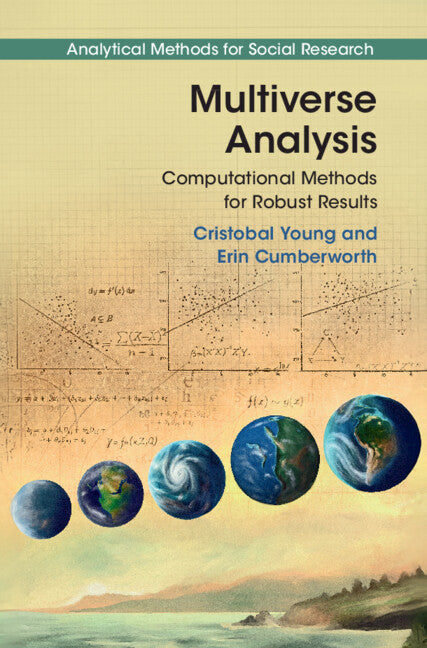
Multiverse Analysis
Computational Methods for Robust Results
This book uses computational tools to improve the credibility and transparency of science.
Cristobal Young (Author), Erin Cumberworth (Author)
9781316518786, Cambridge University Press
Hardback, published 6 March 2025
286 pages
22.9 x 15.2 x 1.8 cm, 0.573 kg
''The multiverse' is less of a method than a way of thinking about choices in coding, analysis, and reporting. This new book works through a range of social-science examples to demonstrate how to use the multiverse to be open about uncertainty as a way to guide research and understanding, instead of the traditional 'robustness study' whose goal is to shield fragile results from criticism.' Andrew Gelman, Department of Statistics and Department of Computer Science, Columbia University
There are many ways of conducting an analysis, but most studies show only a few carefully curated estimates. Applied research involves a complex array of analytical decisions, often leading to a 'garden of forking paths' where each choice can lead to different results. By systematically exploring how alternative analytical choices affect the findings, Multiverse Analysis reveals the full range of estimates that the data can support and uncovers insights that single-path analyses often miss. It shows which modelling decisions are most critical to the results and reveals how data and assumptions work together to produce empirical estimates. Focusing on intuitive understanding rather than complex mathematics, and drawing on real-world datasets, this book provides a step-by-step guide to comprehensive multiverse analysis. Go beyond traditional, single-path methods and discover how multiverse analysis can lead to more transparent, illuminating, and persuasive empirical contributions to science.
Part I. Introduction: 1. The Many Worlds of Analysis
2. The Multiverse as a Philosophy of Science
Part II. The Computational Multiverse: 3. Hurricane Names: An Applied Introduction
4. The Multiverse Algorithm
5. Empirical Multiverses
6. Influence Analysis and Scope Conditions
7. Good and Bad Controls
8. Some Alternative Approaches
Part III. Expanding the Multiverse: 9. Functional Form Robustness
10. Data Processing: Invisible Decisions that Matter
11. A Data-Processing Multiverse: Re-Analysis of Regnerus (2012) and Critics
12. Retractions in Social Science: Mis-Adventures in Data Processing
13. Weights in the Multiverse
14. Conclusion
Appendix: Coding with MULTIVRS in Stata.
Subject Areas: Social research & statistics [JHBC]