Freshly Printed - allow 10 days lead
Couldn't load pickup availability
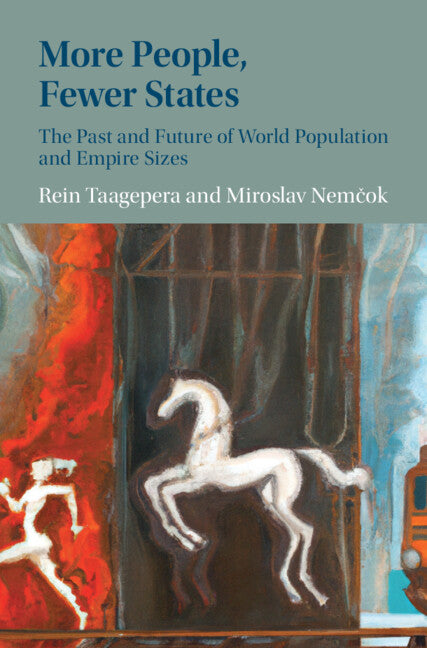
More People, Fewer States
The Past and Future of World Population and Empire Sizes
Explore 5000 years of human history, shaped by population surges and empires' rise and fall, both driven by socio-technological advancements.
Rein Taagepera (Author), Miroslav Nemčok (Author)
9781009427821, Cambridge University Press
Hardback, published 4 July 2024
300 pages
22.9 x 15.2 x 2.5 cm, 0.647 kg
'This book summarizes and extends Rein Taagepera's earlier prodigious quantitative comparative studies of the territorial sizes of empires and puts his results in a larger anthropological comparative framework that also considers primate groups, tribes, and chiefdoms. The methodological approach combines careful estimations of quantitative measures that make it possible to compare the scales and temporal changes in scale across cultures and civilizations over a very long period up to the present. This volume also adds the study of populations of polities and the sizes of cities which provides new insights into the timing and location of the upsweeps and down-sweeps of scale. This produces original insights about the nature of sociocultural evolution that have important implications for the future.' Christopher Chase-Dunn, University of California, Riverside
The long-term development of political systems over extended time periods has been somewhat neglected. More People, Fewer States examines world history through population explosion and empire size changes across 5000 years of socio-technological development, revealing three distinct phases: Runner, Rider, and Engineer empires. A careful comparative approach reveals that Old Egypt, Achaemenid, Caliphate, Mongol, and Britain each achieved remarkable yet rarely acknowledged expansions, leading to their successive record empire sizes. If identified past trends persist, a potential single world state could emerge by 4600, although environmental concerns may intervene. Focusing on population dynamics and area metrics of states, this book provides a novel framework for evaluating the growth, structure, and decline of empires. It not only illuminates ancient historical space but also ventures into future projections, making it an essential read for scholars interested in the long-term evolution of political systems.
1. More People and yet Fewer States
2. Two Phases in World Population Growth: A Novel Visualization and a Logical Model
3. Did Written Records Give a New Boost to Population Growth? 4. From Populations to Empires and The Role of Technology
5. Empires: Definitions, Measurements, and Growth-Decline Curves
6. Talkers, Doers, Regulators, and Followers: A Conceptual Framework for States
7. From Pecking Order to Political Order
8. Runner Empires (-3000 to -600)
9. Early Rider Empires (-600 to +600)
10. An Apparent Dead-End: Republics
11. Stirrup Empires (600 to 1200)
12. The Last Rider Empires (1200 to 1800)
13. Engineer Empires (from 1800 on)
14. How Top States Have Become Larger
15. How the Number of States Has Decreased – and What's Ahead
16. Population Density, and Connecting World and Top State Populations
17. Growth-Decline Patterns and Durations of Empires
18. Empire Shapes, Languages, and Reigns
19. Cities and Empires
20. How History Fades – and Expands
21. The Future of the Super-Cancer of the of Biosphere.
Subject Areas: International relations [JPS]