Freshly Printed - allow 10 days lead
Couldn't load pickup availability
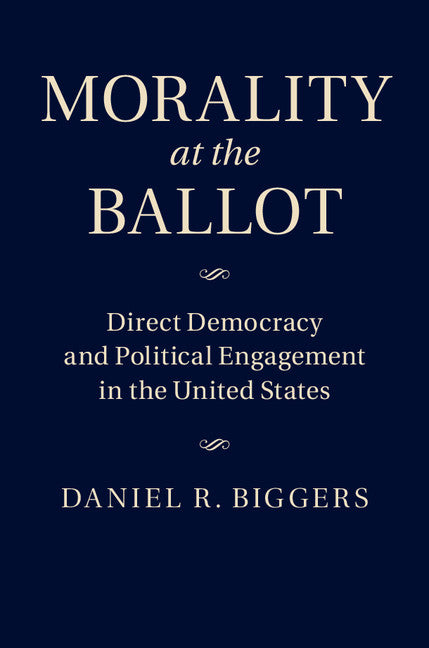
Morality at the Ballot
Direct Democracy and Political Engagement in the United States
Morality at the Ballot examines the ability of direct democracy (the process of deciding policy through the ballot) to increase turnout.
Daniel R. Biggers (Author)
9781107084575, Cambridge University Press
Hardback, published 15 December 2014
260 pages, 32 b/w illus.
23.5 x 15.7 x 2 cm, 0.55 kg
'Daniel Biggers makes a strong case that not all ballot measures are created equal in mobilizing voters. He persuasively shows that most ballot measures produce little to no effect on voter turnout. Instead, what matters most is morality at the ballot. By transforming voting into an expressive act, moral issues increase turnout by enticing peripheral voters. This is a book of great importance that should appeal to readers interested in direct democracy, morality politics and voter mobilization.' Stephen Nicholson, University of California, Merced
Across the United States, there is wide variation in opportunities for citizens to craft legislation through the process of direct democracy. Previous studies suggest that an active role in policy making can spark political interest and engagement, encouraging individuals, who would otherwise abstain from voting, to turn out. Daniel R. Biggers challenges this contention, testing a new theoretical framework that details the exact circumstances under which any proposition might increase participation. Morality at the Ballot reveals that the ability of direct democracy to increase turnout is significantly more limited than currently thought, and that the propositions that do affect participation are restricted to a small subset of ballot issues that include morality policy. Biggers uses these morality propositions to demonstrate the conditions necessary for direct democracy to influence turnout, affect who votes, and shape electoral and policy outcomes. The investigation provides significant insights into the consequences of deciding policy via the ballot and expanding the role for citizens in the political process.
1. Introduction
2. A theoretical framework
3. The case for moral issue propositions
4. Enticing peripheral voters
5. Statewide ballot measures and turnout
6. Local-level ballot measures and turnout
7. A partisan advantage?
8. Policy outcomes and lessons from morality at the ballot.
Subject Areas: Political parties [JPL], Political ideologies [JPF], Political science & theory [JPA], Politics & government [JP], Social theory [JHBA]