Freshly Printed - allow 10 days lead
Couldn't load pickup availability
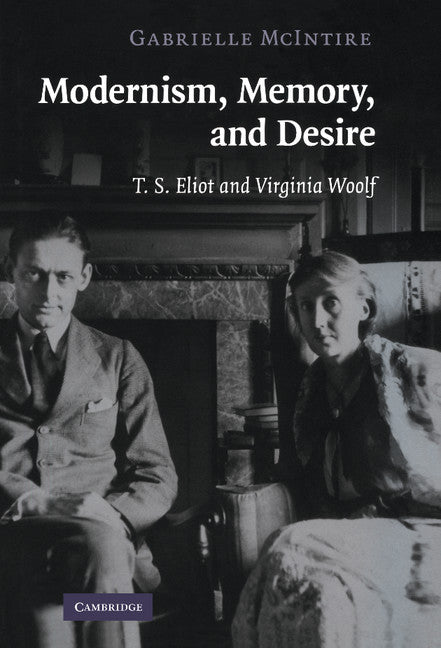
Modernism, Memory, and Desire
T. S. Eliot and Virginia Woolf
A detailed comparative study of memory in the works of Eliot and Woolf.
Gabrielle McIntire (Author)
9780521877855, Cambridge University Press
Hardback, published 7 February 2008
276 pages
23.4 x 16.1 x 2.1 cm, 0.588 kg
Review of the hardback: '… fascinating book … [a] searching inquiry into the erotics of memory.' Alec Marsh, Muhlenberg College, and Elisabeth Däumer, Eastern Michigan University
T. S. Eliot and Virginia Woolf were almost exact contemporaries, readers and critics of each others' work, and friends for over twenty years. Their writings, though, are rarely paired. Modernism, Memory, and Desire proposes that some striking correspondences exist in Eliot and Woolf's poetic, fictional, critical, and autobiographical texts, particularly in their recurring turn to the language of desire, sensuality, and the body to render memory's processes. The book includes extensive archival research on some mostly unknown bawdy poetry by T. S. Eliot while offering readings of major work by both writers, including The Waste Land, 'The Love Song of J. Alfred Prufrock', Orlando and To the Lighthouse. McIntire juxtaposes Eliot and Woolf with several major modernist thinkers of memory, including Sigmund Freud, Friedrich Nietzsche, Henri Bergson and Walter Benjamin, to offer compelling reconsiderations of the relation between textuality, remembrance and the body in modernist literature.
Introduction
1. An unexpected beginning: sex, race, and history in T. S. Eliot's Columbo and Bolo Poems
2. Mixing memory and desire: rereading Eliot and the body of history
3. Eliot, Eros, and desire: 'oh, do not ask, 'what is it?'
4. T. S. Eliot: writing time and blasting memory
5. Virginia Woolf, (auto)biography, and the Eros of memory: reading Orlando
6. Other kinds of autobiographies: sketching the past, forgetting Freud, and reaching the Lighthouse
7. Remembering what has 'almost already been forgotten:' where memory touches history
Epilogue.
Subject Areas: Literary studies: general [DSB]