Freshly Printed - allow 8 days lead
Couldn't load pickup availability
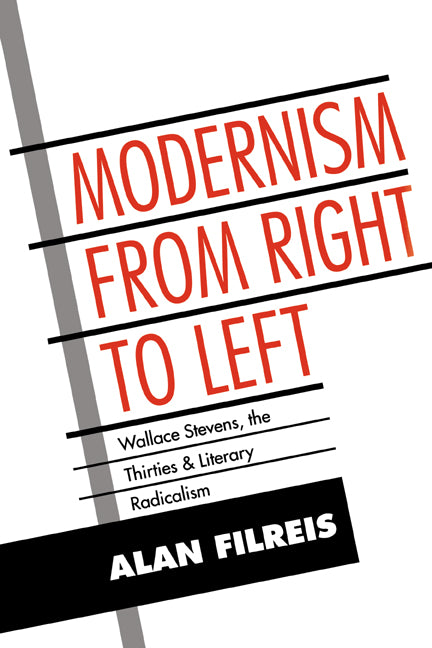
Modernism from Right to Left
Wallace Stevens, the Thirties, & Literary Radicalism
A study of relations between American radicalism and modernism in the 1930s, focusing on Wallace Stevens.
Alan Filreis (Author)
9780521619400, Cambridge University Press
Paperback, published 8 June 2005
396 pages, 7 b/w illus.
22.9 x 15.3 x 2.3 cm, 0.588 kg
'This is an indispensable book, not only for scholars of Wallace Stevens and modernism, but for anyone interested in reading lyric poetry within a rich historical and political context. Filreis has done an extraordinary amount of original research into what he calls 'circles of reputation and response' in the literary-political wars of the thirties. His research amounts to a kind of 'thick description' of these battles, in which the very texture of the various positions taken up in the shuttling between left, right, and middle becomes available to us in the language of the participants. Filreis shows how little agreement there was among thirties radicals on questions of aesthetic criteria. Surprisingly, he also demonstrates the importance of Stevens to all sides in the debate. From now on, nobody can write about these issues without consulting Filreis's lucid, engaging and comprehensive book.' Charles Berger, University of Utah
Part biography and part literary history, this book is about the experience of the American modernist poet Wallace Stevens in the 1930s. Stevens is generally thought to have antagonised, even engaged, the young literary radicals of the period. Using the archives of many little-known political poets, Alan Filreis offers a detailed description of these battles, in which the very texture of the various positions taken up in the movement between left and right becomes available to us in the language of the participants. Filreis demonstrates that the radicals knew and appreciated modernism more than has been generally recognised, and that Stevens's poetry - as well as that of other then-eminent modernists was significantly influenced by political poets and critics on the left. This book is a contribution to the cultural history of the American 1930s as well as a novel approach to an oft-studied figure.
List of illustrations
Acknowledgements
Abbreviations
Introduction
1. Which side are you on?
Part I. Arrogations: 2. The poet and the depression
3. What superb mechanics
Part II. Convergences: 4. The rage for order
5. Turmoil in the middle ground: politicizing the lyric
6. Toward a rhyming of opposites: 'Owl's Clover'
7. A million people on one string
Notes
Index.
Subject Areas: Literary studies: poetry & poets [DSC]