Freshly Printed - allow 10 days lead
Couldn't load pickup availability
Modernism and the Idea of India
The Art of Passive Resistance
Claims that 'passive resistance', a phrase promoted and then rejected by Gandhi, aptly describes a modernist aesthetic movement in India.
Judith Brown (Author)
9781009505246, Cambridge University Press
Hardback, published 9 January 2025
208 pages
23.5 x 16 x 1.8 cm, 0.446 kg
'Brown presents a kaleidoscope of interpretations as she examines narratives interpreting colonialism, misfortunes, and spiritualism in the works of G. V. Desani, Ahmed Ali, and Anand Rao as a form of non-violent conflict. … Recommended.' B. Gupta, CHOICE
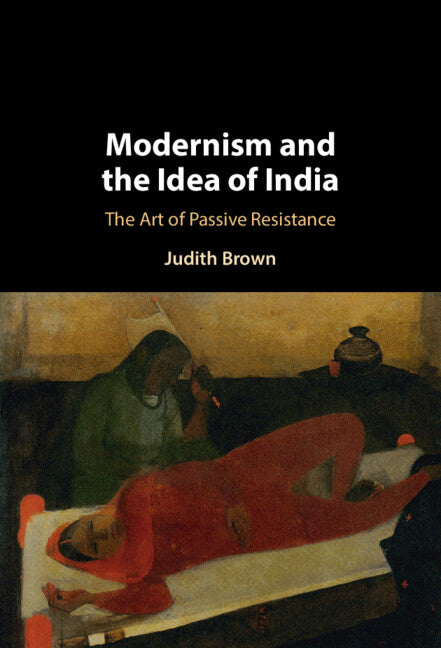
In his 1909 manifesto Hind Swaraj, Gandhi made an impassioned call for passive resistance that he soon retracted. 'Passive resistance' didn't, in the end, serve his overarching aims, but was troubled on multiple grounds from its use of the English phrase to the weakness implied by passivity. Modernism and the Idea of India: The Art of Passive Resistance claims that the difficulty embedded in the phrase 'passive resistance,' from its seeming internal contradiction to the troubling category of passivity itself, transforms in artistic expression, where its dynamism, ambivalence, and receptivity enable art's capacity to create new forms of meaning. India provides the ground and the fantasy for writers and artists including Rabindranath Tagore, R. K. Narayan, Ahmed Ali, Amrita Sher-Gil, G. V. Desani, Virginia Woolf, and Le Corbusier. These artists and writers explore the capacities of passive resistance inspired by Gandhi's treatise, but move beyond its call for activism into new languages of art.
Introduction
1. Tagore's emancipated Spectator
2. Questions for R. K. Narayan
3. Amrita Sher-Gil's passive figures
4. Languishing in Ahmed Ali's Delhi
5. Love and Castration in G. V. Desani
6. Virginia Woolf's passive revolution
7. Le Corbusier's impassive partition monument.
Subject Areas: Literary studies: from c 1900 - [DSBH]