Freshly Printed - allow 10 days lead
Couldn't load pickup availability
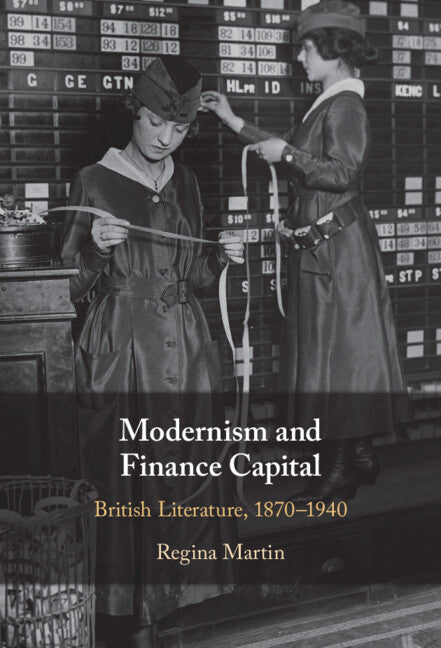
Modernism and Finance Capital
British Literature, 1870–1940
This book interprets modernism as a historical moment of financial crisis.
Regina Martin (Author)
9781009474368, Cambridge University Press
Hardback, published 19 December 2024
232 pages
23.6 x 16.1 x 2.1 cm, 0.498 kg
Modernism and Finance Capital interprets modernism as a historical moment of financial crisis. It expands the definition of finance capital beyond mode of capital accumulation and value form to include a complex of historical processes during the modernist period, which includes the growth of the professional classes, the rise of the modern corporation, the economic turn toward London, and the emergence of affect as economic and literary value form. The book thereby locates the origins of twenty-first century affective economy in the turn-of-the-twentieth century modernist and financial revolutions. Scholars working at the crossroads of economic and cultural studies will find a model for how to interpret literature and other cultural artifacts as participating in economic processes of finance capital even when they do not engage explicitly with such issues.
Acknowledgements
Introduction: modernism and finance capital
Part I. From Victorian Character to Modernist Professional: 1. Finance capital and the value form of character in Anthony Trollope's palliser series
2. Detecting modernist form and the new professional: the moonstone and a study in scarlet
3. Speculating subjects: finance capital and the professional classes in keynes and Woolf
Part II. Finance Capital and the Cultural Turn Toward London: 4. Reading character in the country and the city in tess of the D'Urbervilles
5. Slicing, dicing, and repackaging: finance capital and the novel in Tono-Bungay
6. The unhomeliness of finance capital in voyage in the dark
Part III. Modernism, Affect, and the Rise of the Modern Corporation: 7. Finance capital and the modern corporation in conrad's imperial novels
8. The affective bloom-space of imagism
9. Literary value and affective intensity in the waste land
Conclusion: the values of literary affect
Works cited.
Subject Areas: Literary studies: from c 1900 - [DSBH]