Freshly Printed - allow 10 days lead
Couldn't load pickup availability
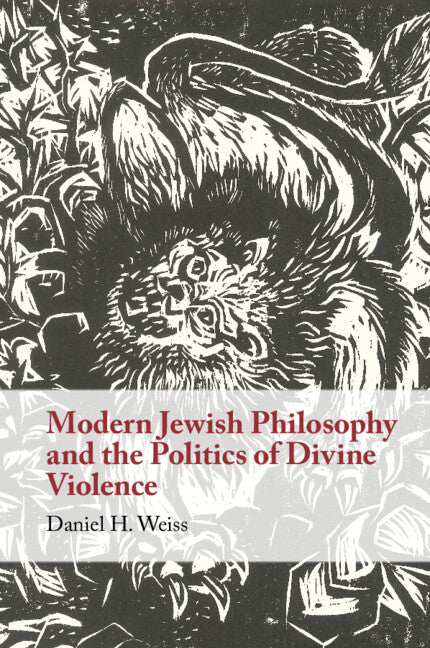
Modern Jewish Philosophy and the Politics of Divine Violence
Uncovers connections between modern Jewish philosophers and classical rabbinic thought, arguing for rethinking of Judaism, politics, and violence.
Daniel H. Weiss (Author)
9781009221672, Cambridge University Press
Paperback / softback, published 6 March 2025
344 pages
22.8 x 15 x 2.1 cm, 0.52 kg
'Weiss's readings of these canonical philosophical works is always generative and persuasive, especially insofar as he emphasizes Jewish philosophy as a site of resistance to Christian political supremacy.' Martin Kavka, The Journal of Religion
Is commitment to God compatible with modern citizenship? In this book, Daniel H. Weiss provides new readings of four modern Jewish philosophers – Moses Mendelssohn, Hermann Cohen, Franz Rosenzweig, and Walter Benjamin – in light of classical rabbinic accounts of God's sovereignty, divine and human violence, and the embodied human being as the image of God. He demonstrates how classical rabbinic literature is relevant to contemporary political and philosophical debates. Weiss brings to light striking political aspects of the writings of the modern Jewish philosophers, who have often been understood as non-political. In addition, he shows how the four modern thinkers are more radical and more shaped by Jewish tradition than has previously been thought. Taken as a whole, Weiss' book argues for a fundamental rethinking of the relationship between Judaism and politics, the history of Jewish thought, and the ethical and political dynamics of the broader Western philosophical tradition.
Introduction
1. Moses Mendelssohn and the rabbinic suspending of coercive punishment
2. Who can command violence, and who should obey? Mendelssohn on divine sovereignty and the limits of modern Jewish integration
3. Jewishness and the prophetic anarchism of Hermann Cohen
4. Franz Rosenzweig and the Jewish alternative to militarism
5. Walter Benjamin and the antinomianism of classical rabbinic Judaism
Conclusion: no other gods, no other masters.
Subject Areas: Judaism [HRJ], Philosophy of religion [HRAB], History of Western philosophy [HPC]