Freshly Printed - allow 10 days lead
Couldn't load pickup availability
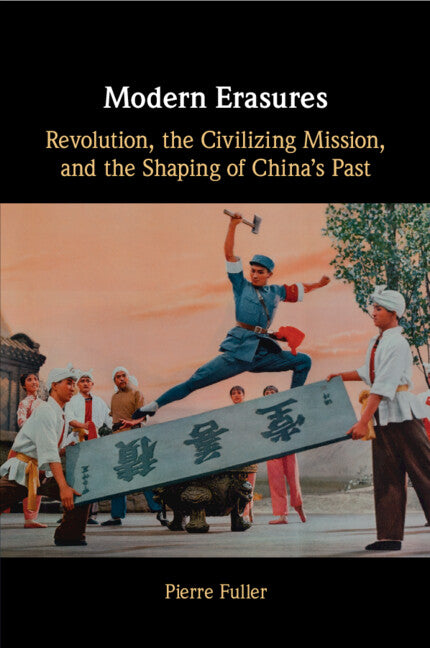
Modern Erasures
Revolution, the Civilizing Mission, and the Shaping of China's Past
Reveals the acts of epistemic violence behind China's revolutionary transformation from a semi-colonized republic to Communist state over the twentieth century.
Pierre Fuller (Author)
9781009012935, Cambridge University Press
Paperback / softback, published 25 January 2024
362 pages
22.8 x 15.1 x 1.9 cm, 0.53 kg
'… a remarkably nuanced and largely persuasive contribution to the burgeoning field of memory studies and to our knowledge of the structure of China's twentieth century revolution.' Peter Zarrow, Journal of Chinese History
Modern Erasures is an ambitious and innovative study of the acts of epistemic violence behind China's transformation from a semicolonized republic to a Communist state over the twentieth century. Pierre Fuller charts the pedigree of Maoist thought and practice between the May Fourth movement of 1919 and the peak of the Cultural Revolution in 1969 to shed light on the relationship between epistemic and physical violence, book burning and bloodletting, during China's revolutions. Focusing on communities in remote Gansu province and the wider region over half a century, Fuller argues that in order to justify the human cost of revolution and the building of the national party-state, a form of revolutionary memory developed in China on the nature of social relations and civic affairs in the recent past. Through careful analysis of intellectual and cultural responses to, and memories of, earthquakes, famine and other disaster events in China, this book shows how the Maoist evocation of the 'old society' earmarked for destruction was only the most extreme phase of a transnational, colonial-era conversation on the 'backwardness' of rural communities.
List of Figures and Maps
Acknowledgements
Note on the Text
Introduction
Part I. Seeing and Not Seeing: 1. Networks into China's Northwest
2. New Culture Lenses onto Rural Life
3. Western Projections onto a 'Chinese Screen'
Part II. Revolutionary Memory in Republican China: 4. Civics Lessons
5. Party Discipline
6. The Emergence of the Peasantry
7. Woodcuts and Forsaken Subjects
Part III. Maoist Narratives in the 1940s: 8. Village Drama
9. Reaching Urban Youth
Part IV. Politics of Oblivion in the People's Republic: 10. Communal Memory over Two Republics
11. The National Subsumes the Local: the Fifties
12. Culture as Historical Foil: the Great Leap Forward
13. Politics of Oblivion: the Cultural Revolution
Conclusion
Bibliography
Index.
Subject Areas: Social & cultural history [HBTB], Asian history [HBJF]