Freshly Printed - allow 7 days lead
Couldn't load pickup availability
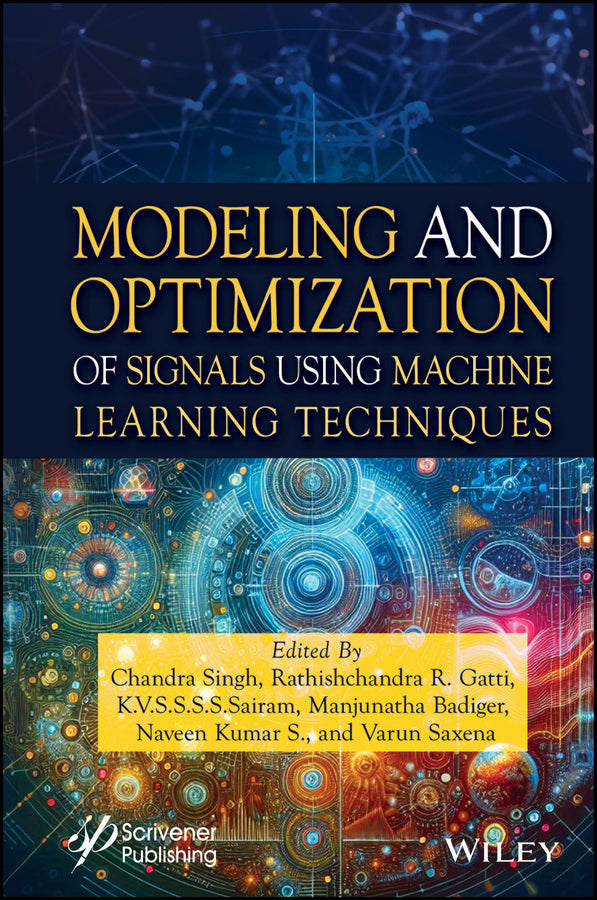
Modeling and Optimization of Signals Using Machine Learning Techniques
Chandra Singh (Edited by), Rathishchandra R. Gatti (Edited by), K.V.S.S.S.S. Sairam (Edited by), Manjunatha Badiger (Edited by), Naveen Kumar S. (Edited by), Varun Saxena (Edited by)
9781119847687, Wiley
Hardback, published 3 September 2024
416 pages
22.9 x 15.2 x 2.6 cm, 0.862 kg
Explore the power of machine learning to revolutionize signal processing and optimization with cutting-edge techniques and practical insights in this outstanding new volume from Scrivener Publishing. Modeling and Optimization of Signals using Machine Learning Techniques is designed for researchers from academia, industries, and R&D organizations worldwide who are passionate about advancing machine learning methods, signal processing theory, data mining, artificial intelligence, and optimization. This book addresses the role of machine learning in transforming vast signal databases from sensor networks, internet services, and communication systems into actionable decision systems. It explores the development of computational solutions and novel models to handle complex real-world signals such as speech, music, biomedical data, and multimedia. Through comprehensive coverage of cutting-edge techniques, this book equips readers with the tools to automate signal processing and analysis, ultimately enhancing the retrieval of valuable information from extensive data storage systems. By providing both theoretical insights and practical guidance, the book serves as a comprehensive resource for researchers, engineers, and practitioners aiming to harness the power of machine learning in signal processing. Whether for the veteran engineer, scientist in the lab, student, or faculty, this groundbreaking new volume is a valuable resource for researchers and other industry professionals interested in the intersection of technology and agriculture.
Preface xix 1 Land Use and Land Cover Mapping of Remotely Sensed Data Using Fuzzy Set Theory-Related Algorithm 1 1.1 Introduction 2 1.2 Image Classification 5 1.3 Unsupervised Classification 7 1.4 Supervised Classification 8 1.5 Overview of Fuzzy Sets 9 1.6 Methodology 11 1.7 Results and Discussion 16 1.8 Conclusion 21 2 Role of AI in Mortality Prediction in Intensive Care Unit Patients 23 2.1 Introduction 24 2.2 Background 24 2.3 Objectives 25 2.4 Machine Learning and Mortality Prediction 26 2.5 Discussions 34 2.6 Conclusion 34 2.7 Future Work 35 2.8 Acknowledgments 35 2.9 Funding 35 2.10 Competing Interest 35 3 A Survey on Malware Detection Using Machine Learning 41 3.1 Background 41 3.2 Introduction 42 3.3 Literature Survey 44 3.4 Discussion 53 3.5 Conclusion 53 4 EEG Data Analysis for IQ Test Using Machine Learning Approaches: A Survey 55 4.1 Related Work 57 4.2 Equations 62 4.3 Classification 64 4.4 Data Set 65 4.5 Information Obtained by EEG Signals 69 4.6 Discussion 70 4.7 Conclusion 72 5 Machine Learning Methods in Radio Frequency and Microwave Domain 75 5.1 Introduction 76 5.2 Background on Machine Learning 77 5.3 ML in RF Circuit Modeling and Synthesis 86 5.4 Conclusion 93 6 A Survey: Emotion Detection Using Facial Reorganization Using Convolutional Neural Network (CNN) and Viola-Jones Algorithm 97 6.1 Introduction 98 6.2 Review of Literature 99 6.3 Report on Present Investigation 101 6.4 Algorithms 102 6.5 Viola-Jones Algorithm 104 6.6 Diagram 105 6.7 Results and Discussion 107 6.8 Limitations and Future Scope 111 6.9 Summary and Conclusion 111 7 Power Quality Events Classification Using Digital Signal Processing and Machine Learning Techniques 115 7.1 Introduction 116 7.2 Methodology for the Identification of PQ Events 117 7.3 Power Quality Problems Arising in the Modern Power System 118 7.4 Digital Signal Processing-Based Feature Extraction of PQ Events 124 7.5 Feature Selection and Optimization 129 7.6 Machine Learning-Based Classification of PQ Disturbances 131 7.7 Summary and Conclusion 141 8 Hybridization of Artificial Neural Network with Spotted Hyena Optimization (SHO) Algorithm for Heart Disease Detection 145 8.1 Introduction 146 8.2 Literature Survey 147 8.3 Proposed Methodology 149 8.4 Artificial Neural Network 152 8.5 Software Implementation Requirements 163 8.6 Conclusion 170 9 The Role of Artificial Intelligence, Machine Learning, and Deep Learning to Combat the Socio-Economic Impact of the Global COVID-19 Pandemic 173 9.1 Introduction 174 9.2 Discussions on the Coronavirus 175 9.3 Bad Impacts of the Coronavirus 180 9.4 Benefits Due to the Impact of COVID-19 186 9.5 Role of Technology to Combat the Global Pandemic COVID-19 190 9.6 The Role of Artificial Intelligence, Machine Learning, and Deep Learning in COVID-19 198 9.7 Related Studies 203 9.8 Conclusion 203 10 A Review on Smart Bin Management Systems 209 10.1 Introduction 209 10.1.1 Internet of Things (IoT) 210 10.2 Related Work 211 10.3 Challenges, Solution, and Issues 213 10.4 Advantages 216 11 Unlocking Machine Learning: 10 Innovative Avenues to Grasp Complex Concepts 219 11.1 Regression 220 11.2 Classification 222 11.3 Clustering 227 11.4 Clustering (k-means) 227 11.5 Reduction of Dimensionality 230 11.6 The Ensemble Method 233 11.7 Transfer of Learning 240 11.8 Learning Through Reinforcement 241 11.9 Processing of Natural Languages 242 11.10 Word Embeddings 242 11.11 Conclusion 243 12 Recognition Attendance System Ensuring COVID-19 Security 245 12.1 Introduction 246 12.2 Literature Survey 246 12.3 Software Requirements 248 12.4 Hardware Requirements 249 12.5 Methodology 252 12.6 Building the Database 253 12.7 Pi Camera for Extracting Face Features 255 12.8 Real-Time Testing on Raspberry Pi 256 12.9 Contactless Body Temperature Monitoring 256 12.10 Raspberry-Pi Setting Up an SMTP Email 258 12.11 Uploading to the Database 259 12.12 Updating the Website 260 12.13 Report Generation 260 12.14 Result 262 12.15 Discussion 267 12.16 Conclusion 267 13 Real-Time Industrial Noise Cancellation for the Extraction of Human Voice 271 13.1 Introduction 272 13.2 Literature Survey 273 13.3 Methodology 275 13.4 Experimental Results 278 13.5 Conclusion 280 14 Machine Learning-Based Water Monitoring System Using IoT 283 14.1 Introduction 283 14.2 Smart Water Monitoring System 284 14.3 Sensors and Hardware 286 14.4 PowerBI Reports 288 14.5 Conclusion 291 15 Design and Modelling of an Automated Driving Inspector Powered by Arduino and Raspberry Pi 295 15.1 Introduction 296 15.2 Literature Survey 296 15.3 Results 306 15.4 Conclusion 309 16 Kalman Filter-Based Seizure Prediction Using Concatenated Serial-Parallel Block Technique 313 16.1 Introduction 314 16.2 Prior Work 314 16.3 Proposed Method 316 16.4 Serial-Parallel Block Concatenation Approach 318 16.5 Algorithm 319 16.6 Kalman Filter 320 16.7 Results and Discussion 321 16.8 Conclusion 323 17 Current Advancements in Steganography: A Review 327 17.1 Introduction 328 17.2 Evaluation Parameters 329 17.3 Types of Steganography 330 17.4 Traditional Steganographic Techniques 332 17.5 CNN-Based Steganographic Techniques 336 17.6 GAN-Based Steganographic Techniques 338 17.7 Steganalysis 340 17.8 Applications 341 17.9 Dataset Used for Steganography 341 17.10 Conclusion 344 18 Human Emotion Recognition Intelligence System Using Machine Learning 349 18.1 Introduction 350 18.2 Literature Review 350 18.3 Problem Statement 352 18.4 Methodology 353 18.5 Results 355 18.6 Applications 355 18.7 Conclusion 357 18.8 Future Work 357 19 Computing in Cognitive Science Using Ensemble Learning 361 19.1 Introduction 362 19.2 Recognition of Human Activities 363 19.3 Methodology 366 19.4 Applying the Boosting-Based Ensemble Learning 369 19.5 Human Activity Features Computability 373 19.6 Conclusion 378 References 378 About the Editors 383 Index 385
Adithya Kumar and Shivakumar B.R.
Prabhudutta Ray, Sachin Sharma, Raj Rawal and Dharmesh Shah
Devika S. P., Pooja M. R. and Arpitha M. S.
Bhoomika Patel H. C., Ravikumar V. and Pavan Kumar S. P.
Shanthi P. and Adish K.
Vaibhav C. Gandhi, Dwij Kishor Siyal, Shivam Pankajkumar Patel and Arya Vipesh Shah
E. Fantin Irudaya Raj and M. Balaji
Shwetha N., Gangadhar N., Mahesh B. Neelagar, Sangeetha N. and Virupaxi Dalal
Biswa Ranjan Senapati, Sipra Swain and Pabitra Mohan Khilar
Bhoomika Patel H. C., Soundarya B. C. and Pooja M. R.
K. Vidhyalakshmi and S. Thanga Ramya
Praveen Kumar M., Ramya Poojary, Saksha S. Bhandary and Sushmitha M. Kulal
Vinayprasad M. S., Chandrashekar Murthy B. N. and Yashwanth S. D.
T. Kesavan, E. Kaliappan, K. Nagendran and M. Murugesan
Raghunandan K. R., Dilip Kumar K., Krishnaraj Rao N.S. Krishnaprasad Rao and Bhavya K.
Purnima P. S. and Suresh M.
Mallika Garg, Jagpal Singh Ubhi and Ashwani Kumar Aggarwal
Bhakthi P. Alva, Krishma Bopanna N., Prajwal S., Varun A. Naik and Lahari Vaidya
Om Prakash Singh
Subject Areas: Computer science [UY]