Special Order - allow 2+ weeks lead
Couldn't load pickup availability
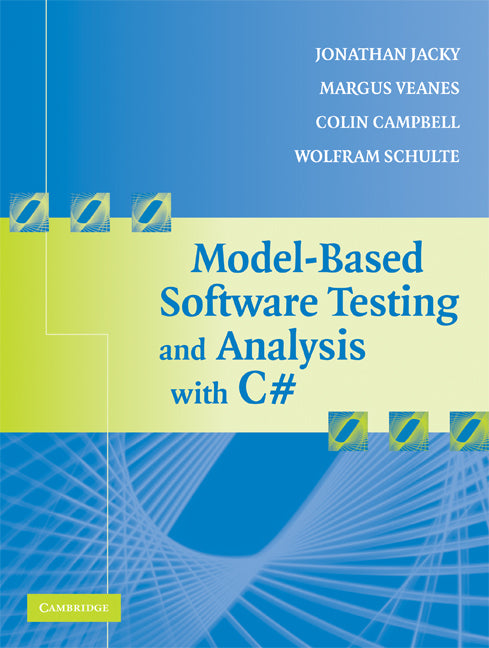
Model-Based Software Testing and Analysis with C#
Teaches new methods for specifying, analyzing and testing software that increase automation in each step.
Jonathan Jacky (Author), Margus Veanes (Author), Colin Campbell (Author), Wolfram Schulte (Author)
9780521687614, Cambridge University Press
Paperback / softback, published 12 November 2007
366 pages, 2 tables 43 exercises
23.4 x 17.5 x 1.6 cm, 0.594 kg
"This is a fascinating and well-written book. The writing style is highly readable and the authors wear their learning lightly. I warmly recommend this book."
Software Engineering Notes
This book teaches model-based analysis and model-based testing, with important new ways to write and analyze software specifications and designs, generate test cases, and check the results of test runs. These methods increase the automation in each of these steps, making them more timely, more thorough, and more effective. Using a familiar programming language, testers and analysts will learn to write models that describe how a program is supposed to behave. The authors work through several realistic case studies in depth and detail, using a toolkit built on the C# language and the .NET framework. Readers can also apply the methods in analyzing and testing systems in many other languages and frameworks. Intended for professional software developers including testers, and for university students, this book is suitable for courses on software engineering, testing, specification, or applications of formal methods.
Part I. Overview: 1. Describe, analyze, test
2. Why we need model-based testing
3. Why we need model-based analysis
4. Further reading
Part II. Systems with Finite Models: 5. Model programs
6. Exploring and analyzing finite models
7. Structuring model programs with features and composition
8. Testing closed systems
9. Further reading
Part III. Systems with Complex States: 10. Modeling systems with structured state
11. Analyzing systems with complex state
12. Testing systems with complex state
13. Further reading
Part IV. Advanced Topics: 14. Compositional modeling
15. Modeling objects
16. Reactive systems
17. Further reading
Part V. Appendices: A. Modeling library reference
B. Command reference
C. Glossary
D. Index.
Subject Areas: Software testing & verification [UMZT], Software Engineering [UMZ]