Freshly Printed - allow 10 days lead
Couldn't load pickup availability
Mobilizing at the Urban Margins
Citizenship and Patronage Politics in Post-Dictatorial Chile
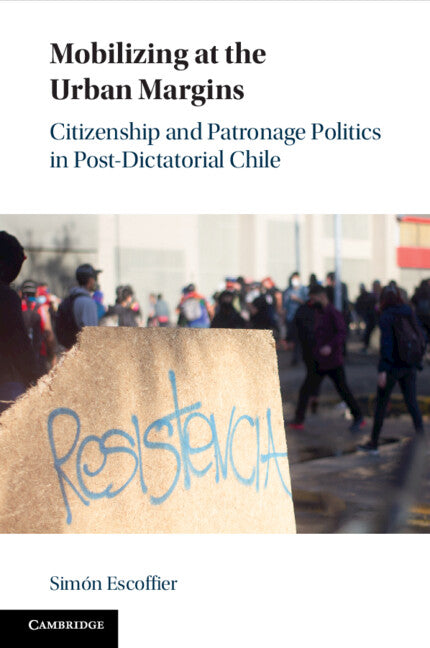
Through the concept of 'mobilizational citizenship', this book explains durable collective action in excluded urban communities.
Simón Escoffier (Author)
9781009306928, Cambridge University Press
Paperback / softback, published 8 August 2024
272 pages
22.9 x 15.2 x 1.4 cm, 0.398 kg
'This text is useful not only for scholars of urban poor neighborhoods and contentious action but also for undergraduate and graduate students and anyone asking broad questions about the differential capacity for collective action. Additionally, it offers a very pedagogical explanation of how methodological comparisons are constructed in space and time.' Emmanuelle Barozet, PoLAR: Political and Legal Anthropology Review
In October 2019, unprecedented mobilizations in Chile took the world by surprise. An outburst of protests plunged a stable democracy into the deepest social and political crisis since its dictatorship in the 1980s. Although the protests involved a myriad of organizations, the organizational capabilities provided by underprivileged urban dwellers proved essential in sustaining collective action in an increasingly repressive environment. Based on a comparative ethnography and over six years of fieldwork, Mobilizing at the Urban Margins uses the case of Chile to study how social mobilization endures in marginalized urban contexts, allowing activists to engage in large-scale democratizing processes. The book investigates why and how some urban communities succumb to exclusion, while others react by resurrecting collective action to challenge unequal regimes of citizenship. Rich and insightful, the book develops the novel analytical framework of 'mobilizational citizenship' to explain this self-produced form of political incorporation in the urban margins.
Introduction
1. The mobilizational citizenship framework
2. The history of mobilization in Chile's urban settings
3. The demobilization of the urban margins
4. Memory of subversion
5. We, the informal urban dwellers
6. Protagonism and community building
Conclusion.
Subject Areas: Citizenship & nationality law [LNDA], Political activism [JPW], Civil rights & citizenship [JPVH1], Political ideologies [JPF], Society & culture: general [JF]