Freshly Printed - allow 8 days lead
Couldn't load pickup availability
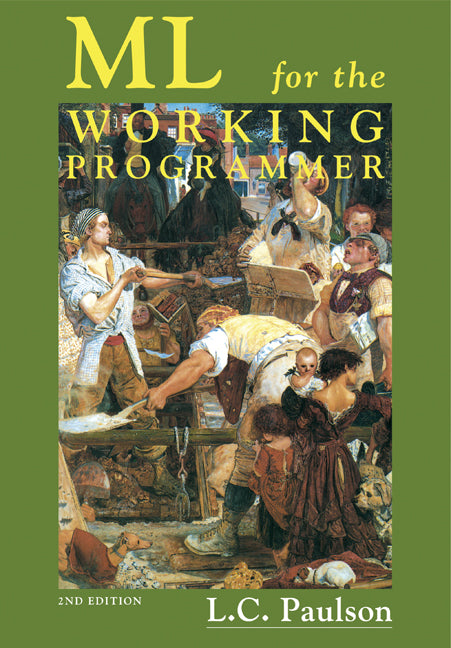
ML for the Working Programmer
This new edition of a successful text treats modules in more depth, and covers the revision of ML language.
Larry C. Paulson (Author)
9780521565431, Cambridge University Press
Paperback, published 28 June 1996
500 pages, 50 b/w illus. 300 exercises
24.6 x 17.4 x 2.9 cm, 0.811 kg
"The book is an excellent introduction to ML, but even better, it provides a good overview of functional programming." Jeffrey Putnam, Computing Review
The new edition of this successful and established textbook retains its two original intentions of explaining how to program in the ML language, and teaching the fundamentals of functional programming. The major change is the early and prominent coverage of modules, which are extensively used throughout. In addition, the first chapter has been totally rewritten to make the book more accessible to those without experience of programming languages. The main features of new Standard Library for the revised version of ML are described and many new examples are given, while references have also been updated. Dr Paulson has extensive practical experience of ML and has stressed its use as a tool for software engineering; the book contains many useful pieces of code, which are freely available (via the Internet) from the author. He shows how to use lists, trees, higher-order functions and infinite data structures. Many illustrative and practical examples are included.. Efficient functional implementations of arrays, queues, priority queues, etc. are described. Larger examples include a general top-down parser, a lambda-calculus reducer and a theorem prover. The combination of careful explanation and practical advice will ensure that this textbook continues to be the preferred text for many courses on ML.
1. Standard ML
2. Names, functions and types
3. Lists
4. Trees and concrete data
5. Functions and infinite data
6. Reasoning about functional programs
7. Modules
8. Imperative programming in ML
9. Writing interpreters for the lambda-calculus
10. A tactical theorem prover
Bibliography.
Subject Areas: Programming & scripting languages: general [UMX]