Freshly Printed - allow 10 days lead
Couldn't load pickup availability
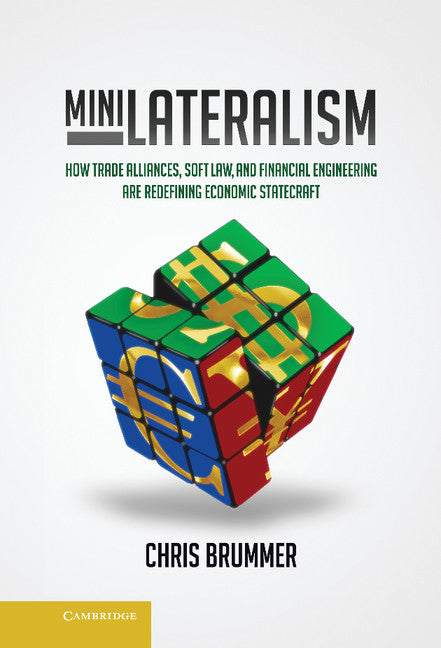
Minilateralism
How Trade Alliances, Soft Law and Financial Engineering are Redefining Economic Statecraft
This book explains how minilateral strategies work and how this new diplomatic toolbox will reshape how countries do business with one another.
Chris Brummer (Author)
9781107053144, Cambridge University Press
Hardback, published 7 April 2014
228 pages, 4 b/w illus. 3 tables 1 exercise
23.1 x 15.5 x 2 cm, 0.48 kg
'Professor Brummer ably captures the recent evolution from standard-setting and consensus building via large, multilateral institutions promoting universalist principles, to norms established via smaller coalitions focused on addressing the particularist needs of like-minded partners. Few books tackle so many topics so clearly and elegantly, and bundle them into one compelling narrative. Moving from the regulation of coins in medieval Europe to today's international money supply and the rise of the Chinese RMB, and from Venetian trade strategy to today's WTO, Minilateralism offers a compelling history and theory of how economic diplomacy works. For standard-setters looking to understand their role in the global economy, a must read from a top expert in the field.' Ethiopis Tafara, Vice President and General Counsel, International Finance Corporation, World Bank Group
Economic diplomacy is changing. The multilateral organizations that dominated the last half of the twentieth century no longer monopolize economic affairs. Instead, countries are resorting to more modest 'minilateral' strategies like trade alliances, informal 'soft law' agreements, and financial engineering to manage the global economy. Like traditional modes of economic statecraft, these tools are aimed at both liberalizing and supervising international financial policy in a world of diverse national interests. But unlike before, they are specifically tailored to navigating a post-American (and post-Western) world where economic power is more diffuse than ever before. This book explains how these strategies work and reveals how this new diplomatic toolbox will reshape how countries do business with one another for decades to come.
Introduction: rethinking cooperation in a multipolar world
1. Multilateralism's rise and fall
2. Playing the numbers in trade
3. Soft law in international finance
4. Hedging bets in the monetary system
5. Managing minilateralism.
Subject Areas: International economic & trade law [LBBM], Law [L], Political economy [KCP]