Freshly Printed - allow 7 days lead
Couldn't load pickup availability
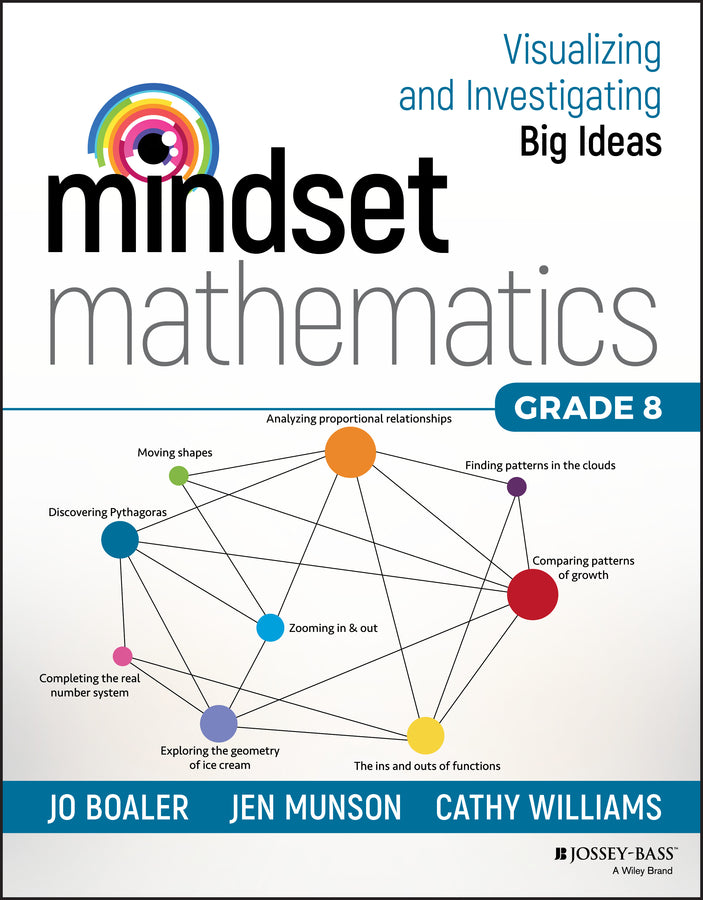
Mindset Mathematics: Visualizing and Investigating Big Ideas, Grade 8
Jo Boaler (Author), Jen Munson (Author), Cathy Williams (Author)
9781119358749, Wiley
Paperback / softback, published 16 March 2020
272 pages
27.4 x 21.6 x 1.5 cm, 0.726 kg
Engage students in mathematics using growth mindset techniques The most challenging parts of teaching mathematics are engaging students and helping them understand the connections between mathematics concepts. In this volume, you'll find a collection of low floor, high ceiling tasks that will help you do just that, by looking at the big ideas at the eighth-grade level through visualization, play, and investigation. During their work with tens of thousands of teachers, authors Jo Boaler, Jen Munson, and Cathy Williams heard the same message—that they want to incorporate more brain science into their math instruction, but they need guidance in the techniques that work best to get across the concepts they needed to teach. So the authors designed Mindset Mathematics around the principle of active student engagement, with tasks that reflect the latest brain science on learning. Open, creative, and visual math tasks have been shown to improve student test scores, and more importantly change their relationship with mathematics and start believing in their own potential. The tasks in Mindset Mathematics reflect the lessons from brain science that: With engaging questions, open-ended tasks, and four-color visuals that will help kids get excited about mathematics, Mindset Mathematics is organized around nine big ideas which emphasize the connections within the Common Core State Standards (CCSS) and can be used with any current curriculum.
Introduction 1 Low-Floor, High-Ceiling Tasks 2 Youcubed Summer Camp 3 Memorization versus Conceptual Engagement 4 Mathematical Thinking, Reasoning, and Convincing 5 Big Ideas 9 Structure of the Book 9 Note on Materials 17 Manipulatives and Materials Used in This Book 18 Activities for Building Norms 21 Encouraging Good Group Work 21 Paper Folding: Learning to Reason, Convince, and Be a Skeptic 22 Big Idea 1: Moving Shapes 27 Visualize: What Does It Mean to Be the Same? 29 Play: Pixel Puzzles 35 Investigate: Slide It, Flip It, Turn It 45 Big Idea 2: Zooming In and Out 53 Visualize: What is Similarity? 55 Play: Find the Fakes 60 Investigate: Growing on a Grid 65 Big Idea 3: Analyzing Proportional Relationships 71 Visualize: Dropping the Altitude 73 Play: Seeing Triangles under the Line 79 Investigate: Stairway to Eleven 85 Big Idea 4: Comparing Patterns of Growth 91 Visualize: Squared Squares 93 Play: Skip-Counting Arrays 100 Investigate: Stacking Pennies 107 Big Idea 5: The Ins and Outs of Functions 117 Visualize: Growing Functions 120 Play: Getting Warmer! 134 Investigate: The Functions of Near Squares 140 Big Idea 6: Finding Patterns in the Clouds 149 Visualize: What’s Going On in This Graph? 151 Play: What’s the Story Here? 158 Investigate: Creating Data Visualizations 166 Big Idea 7: Completing the Real Number System 177 Visualize: Square Sides 179 Play: Between 4 × 4 and 5 × 5 187 Investigate: The Hypotenuse Hypothesis 193 Big Idea 8: Discovering Pythagoras 201 Visualize: Unpacking Pythagoras 204 Play: Pythagorean Triples 209 Investigate: Approximating Square Roots 214 Big Idea 9: Exploring the Geometry of Ice Cream 221 Visualize: Building Intuition about Volume 223 Play: Comparing Cylinders 227 Investigate: Scooping Up Volume 233 Appendix 239 Centimeter Grid Paper 240 Grid Paper 241 Isometric Dot Paper 242 Dot Paper 243 About the Authors 245 Acknowledgments 247 Index 249
Subject Areas: Education [JN]