Freshly Printed - allow 8 days lead
Couldn't load pickup availability
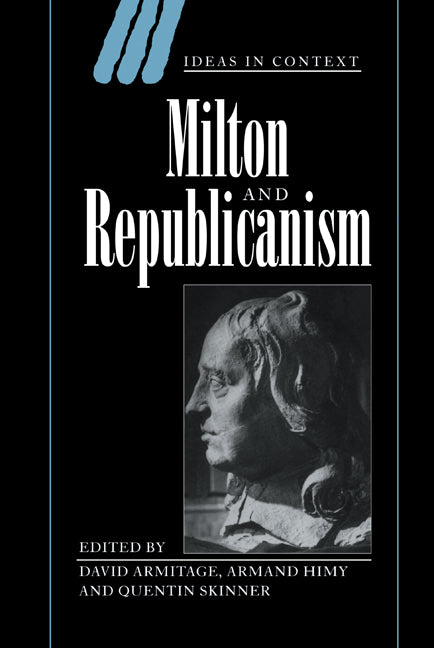
Milton and Republicanism
Historians and literary critics offer a comprehensive thematic assessment of Milton's political and literary career.
David Armitage (Edited by), Armand Himy (Edited by), Quentin Skinner (Edited by)
9780521551786, Cambridge University Press
Hardback, published 7 December 1995
296 pages
23.6 x 15.9 x 2.3 cm, 0.558 kg
'Milton and Republicanism … deserves a warm welcome for at last bringing Milton studies fully in contact with … developments in the history of political thought.' David Norbrook, The Times Literary Supplement
Drawing upon the expertise of both historians and literary critics, this volume examines the classical sources of Milton's republicanism, the genesis of that republicanism in the 1640s, its disappointment in the 1650s and its presence in his work (particularly in Paradise Lost) after the Restoration.
Preface
Part 1. Defining Milton's Republicanism: 1. Milton's classical republicanism Martin Dzelzainis
2. Milton and the characteristics of a free commonwealth Thomas N. Corns
3. Great senates and godly education: politics and cultural renewal in some pre- and post-revolutionary texts of Milton Cedric C. Brown
Part II. Milton and Republican Literary Strategy: 4. Biblical reference in the political pamphlets of the Levellers and Milton, 1638–1654 Elizabeth Tuttle
5. The metaphorical contract in Milton's Tenure of Kings and Magistrates Victoria Kahn
6. Milton, Satan, Salmasius and Abdiel Roger Lejosne
7. Paradise Lost as a republican 'tractatus theologico-politicus' Armand Himy
Part III. Milton and the Republican Experience: 8. Popular republicanism in the 1650s: John Streater's 'heroick mechanicks' Nigel Smith
9. Milton and Marchamont Nedham Blair Worden
10. Milton and the protectorate in 1658 Martin Dzelzainis
11. John Milton: poet against Empire David Armitage
Part IV. Milton and the Republican Tradition: 12. The Whig Milton, 1667–1700 Nicholas von Maltzahn
13. Borrowed language: Milton, Jefferson, Mirabeau Tony Davies.
Subject Areas: History of ideas [JFCX]