Freshly Printed - allow 7 days lead
Couldn't load pickup availability
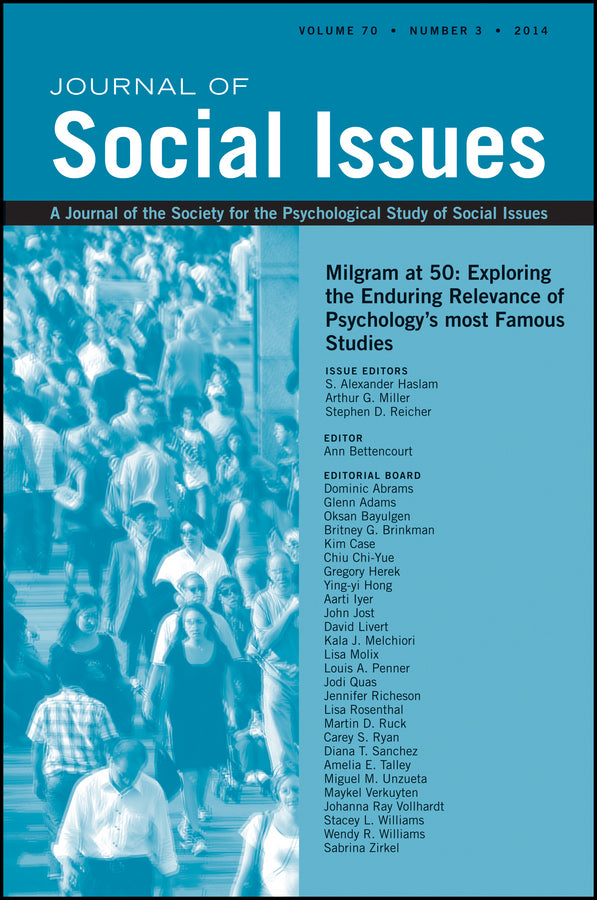
Milgram at 50
Exploring the Enduring Relevance of Psychology's most Famous Studies
S. Alexander Haslam (Edited by), Arthur G. Miller (Edited by), Stephen Reicher (Edited by), Ann Bettencourt (Edited by)
9781119029021, Wiley
Paperback / softback, published 2 October 2014
210 pages
22.9 x 15.2 x 1.1 cm, 0.304 kg
To mark the 50th anniversary of Milgram's first major publication—"Behavioral study of obedience" (1963)—this issue contains fourteen papers from eading Milgram scholars examining the contemporary relevance of the famous Yale studies. The issue offers a critical appraisal of the impact of Milgram's work, as well as its moral dangers and analytic weaknesses. Several important new perspectives obtained from archival analysis and innovative methodologies are also presented. The relevance of Milgram's experiments for an understanding of the Holocaust is given particular emphasis. The issue presents a range of fresh material that provides the basis for a significant updating of our appreciation of Milgram's legacy, and that will inform forthcoming scholarship and debate.
INTRODUCTION What Makes a Person a Perpetrator? The Intellectual, Moral, and Methodological Arguments for Revisiting Milgram’s Research on the Influence of Authority 393 The Emergence of Milgram’s Bureaucratic Machine 409 Discourse, Defiance, and Rationality: “Knowledge Work” in the “Obedience” Experiments 424 Revisioning Obedience: Exploring the Role of Milgram’s Skills as a Filmmaker in Bringing His Shocking Narrative to Life 439 Milgram’s Unpublished Obedience Variation and its Historical Relevance 454 Nothing by Mere Authority: Evidence that in an Experimental Analogue of the Milgram Paradigm Participants are Motivated not by Orders but by Appeals to Science 471 Beyond Obedience: Situational Features in Milgram’s Experiment That Kept His Participants Obeying, Joining, Following, Resisting, and Other Processes in the Milgram Studies, and in the Holocaust and Other Genocides: Situations, Personality, and Bystanders 499 “Ordinary Men,” Extraordinary Circumstances: Historians, Social Psychology, and the Holocaust 513 Authorities and Uncertainties: Applying Lessons from the Study of Jewish Resistance during the Holocaust to the Milgram Legacy 529 Observing Obedience: How Sophisticated are Social Perceivers? 542 The Explanatory Value of Milgram’s Obedience Experiments: A Contemporary Appraisal 556 Obedience, Self-Control, and the Voice of Culture 572 50:50 Hindsight: Appreciating Anew the contributions of Milgram’s Obedience Experiments 585
Stephen D. Reicher, S. Alexander Haslam, and Arthur G. Miller
SECTION I: THE GAPS IN MILGRAM’S ANALYSIS: NEW INSIGHTS FROM THE MILGRAM ARCHIVES
Nestar Russell
Stephen Gibson
Kathryn Millard
SECTION II: THE RICHNESS OF MILGRAM’S FINDINGS: INSIGHTS FROM EMPIRICAL AND CONCEPTUAL EXTENSIONS
Francois Rochat and Thomas Blass
S. Alexander Haslam, Stephen D. Reicher, and Megan E. Birney
Shocking 487
Jerry M. Burger
SECTION III: THE SIGNIFICANCE OF MILGRAM’S EXPERIMENTS: OBEDIENCE, DESTRUCTIVENESS, AND RESISTANCE
Ervin Staub
Richard Overy
Rachel L. Einwohner
SECTION IV: THE MEANING OF MILGRAM’S EXPERIMENTS: CAUSALITY, RESPONSIBILITY, AND CONTEXT
Andrew E. Monroe and Glenn D. Reeder
Arthur G. Miller
Michael R. Ent and Roy F. Baumeister
SECTION V: OVERVIEW AND COMMENTARY
Jolanda Jetten and Frank Mols
Subject Areas: Psychology [JM]