Freshly Printed - allow 7 days lead
Couldn't load pickup availability
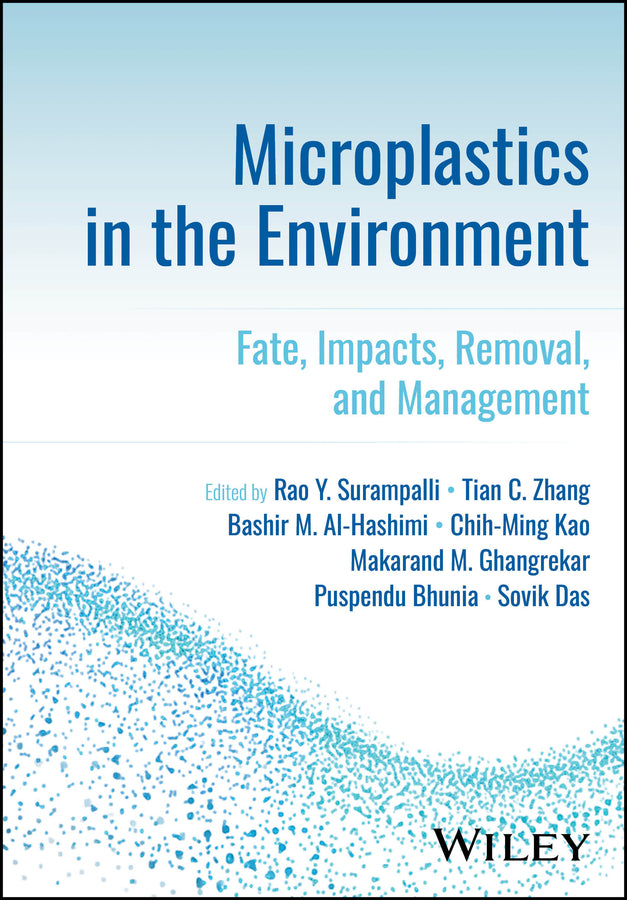
Microplastics in the Environment
Fate, Impacts, Removal, and Management
Rao Y. Surampalli (Edited by), Tian C. Zhang (Edited by), Bashir M. Al-Hashimi (Edited by), Chih-Ming Kao (Edited by), Makarand M. Ghangrekar (Edited by), Puspendu Bhunia (Edited by), Sovik Das (Edited by)
9781394251070, Wiley
Hardback, published 28 March 2025
656 pages
24.4 x 17 x 1.5 cm, 0.68 kg
Enables readers to assess, manage and prevent damage from the environment’s biggest enemy: microplastics Microplastics in the Environment addresses the biggest unresolved pollution issue: microplastics accumulating in the environment at a rapidly growing rate, giving rise to severe ecological stress and novel diseases in both aquatic and terrestrial organisms. This book is a one-stop resource that ties together the latest developments in this fast-moving field, including analytical techniques, risk assessment methods and predictive approaches, and evaluates different strategies that make it possible to minimize and redress microplastics pollution in the near and distant future. The book is organized into three main parts. Part one explains the fundamental ideas underlying microplastics, including their classification, major sources, detection and characterisation, as well as risk assessment methods. The second part covers the fate and transport of microplastics in various environmental domains, their interaction with ecosystems and the exposure of humans to environment-borne microplastics. The final part surveys current and future approaches to limit and remove the environmental effects of microplastics, from replacement of plastics with biodegradable substitutes to more efficient recycling of plastics to their active removal and remediation. Microplastics in the Environment includes information on: With its emphasis on management and remediation, Microplastics in the Environment is a valuable resource for environmental scientists, government agencies and researchers working in the field of microplastics pollution.
Preface xvii Notes on Editors xix Section I The Existence and Characterization of Microplastics 1 1 Introduction and Book Overview 3 1.1 Background and Definition 3` 1.2 Impacts of MPs on the Environment, Society, and Economics 7 1.3 Solutions, Knowledge Gaps, and Challenges 9 1.4 Policies and Practices to Regulate MPs 10 1.5 Book Structure and Overview of Chapters 11 1.6 Conclusion 12 References 13 2 Classifications and Physiochemical Properties of Microplastics 17 2.1 Introduction 17 2.2 Structural Properties 21 2.3 Physical Properties 28 2.4 Chemical Properties 31 2.5 Thermal Stability 33 2.6 Conclusion 34 References 35 3 Degradation of Plastics and Formation of Primary and Secondary Microplastics 43 3.1 Introduction 43 3.2 Physical and Mechanical Degradation 46 3.3 Chemical Degradation 50 3.4 Biological Degradation 51 3.5 Degradation Pathway 54 3.6 Degradation Products and Byproducts 58 3.7 Toxicity of Products and Byproducts 59 3.8 Conclusion 61 References 61 4 Advanced Techniques for Sampling, Quantification, and Characterization of Microplastics 69 4.1 Screening 69 4.2 Sampling and Extraction 71 4.3 Characterization for Size, Shape, and Chemical Composition 84 4.4 Quantification 88 4.5 Harmonizing Approaches and Valuable Minimal Technical Criteria and Specification 90 4.6 Quality Assurance/Quality Control 95 4.7 Conclusion 97 References 98 5 Technologies for Polymer Identification and Monitoring of Microplastics Distribution 107 5.1 Introduction 107 5.2 Instrumentational Methods to Study Microplastics in Different Matrices 112 5.3 Technologies for Measuring Nano-Microplastics and Determining the Relative Contributions of Particles of Varying Size, Shape and Chemical Composition 115 5.4 Distribution and Monitoring of Microplastics 117 5.5 Review of Existing Monitoring Programs for Marine Microplastics 119 5.6 Other Techniques for Monitoring 127 5.7 Conclusions 130 References 130 6 Characterizing Microplastics in the Context of Risk Assessment 135 6.1 Introduction 135 6.2 The TK/TD of MPs in a Representative Organism 136 6.3 Determining the Particle Size Range Where Any Toxicity Resides 142 6.4 Identifying Potential Uncertainties and Concerns 144 6.5 Determining Relative Levels of Confidence Regarding Toxicological Data 145 6.6 Conclusion 148 References 148 7 Understanding Environmental and Socio-economic Risks Associated with Microplastics 153 7.1 Background 153 7.2 Economic Impacts 154 7.3 Social Impacts 155 7.4 Environmental Sensitivity and Variability of Microplastic 157 7.5 Toxicological Impact of Microplastics on Aquatic Organisms 159 7.6 Strategies for Managing Microplastic in the Environment 161 7.7 Conclusion and Way-forward 162 References 163 Section II Microplastics in Different Compartments and Their Effects on Environments and Humane Society 167 8 Microplastics in the Environment: Sources, Distribution, Fate, and Transport 169 8.1 MPs in the Aquatic Environment (Surface/Ground Waters and Ocean) 169 8.2 MPs in the Terrestrial Environment (Soil and Sediment) 171 8.3 MPs in the Polar Region 173 8.4 MPs in the Atmospheric Environment and Transboundary Transport 175 8.5 MPs in Food and Agricultural Crops 179 8.6 MPs Associated with the Construction Industry 180 8.7 MPs in Urban Environmental Management Systems 183 8.8 Contaminants Released from Aged MPs 186 8.9 Fate/Transport and Behavior of MPs in Pollution Control Systems 188 8.10 Conclusion 200 References 200 9 Modeling the Fate and Transport of Microplastics in Various Aquatic Environmental Compartments 207 9.1 Introduction 207 9.2 Transport Mechanisms of Microplastics in the Environment 210 9.3 Modeling the Fate and Transport of Microplastics in Riverine Environment 215 9.4 Modeling the Fate and Transport of Microplastics in Estuaries 226 9.5 Modeling the Fate and Transport of Microplastics in Marine Environment 231 9.6 Modeling the Fate and Transport of Microplastics in the Subsurface 236 9.7 Conclusions 243 Acknowledgments 243 Nomenclature 244 References 247 10 Ecological Impacts of Microplastics and Their Additives: Exposure Risk/Toxicity Assessment and Fate/Transport of Persistent, Bio-Accumulative and Toxic Substances 259 10.1 Introduction 259 10.2 Creating Standardized Toxicity Tests for MPs 260 10.3 Dose–Response Analysis and Formulation of Standards 264 10.4 Acute and Chronic Toxicity of Microplastics 265 10.5 Chemical Risk Posed by Ingested Microplastics 265 10.6 Development of Health-Based Threshold 266 10.7 Effects of Exposure: Microplastics Transferred to the Consumers 266 10.8 Are Microplastics Vectors (for Organisms or Chemical Pollutants in the Environment)? – Sorption of Potentially Toxic Pollutants on Microplastics 269 10.9 Connect Microplastics to Existing or Novel Adverse Outcome Pathways 269 10.10 The Relevant Receptors 271 10.11 Exposure Pathways 272 10.12 Exposure Pathway to MP Via Ingestion 273 10.13 Exposure Pathway to MP Via Inhalation 273 10.14 Exposure Pathway to MP Via Dermal Contact 273 10.15 Toxicokinetic/Dynamic Processes 274 10.16 MPs Plus Chemicals/Nanomaterials/Pathogens Attached/Sorbed on them – Ecological Effects of Chemical Contaminants Adsorbed to Microplastics 274 10.17 Interrelationships Among Different Factors 276 10.18 Interaction of Microplastics with PBTs and Other Emerging Contaminants 276 10.19 Conclusion 277 References 278 11 Interactions of Microplastics with Microbial Communities and the Food Web/Plants 283 11.1 Introduction 283 11.2 Interactions of MPs with Natural Organic Materials, Crops, and Plants 285 11.3 Interaction Between Microbial Community and MPs 291 11.4 Effect of MPs on Metabolic Activities of the Organisms 295 11.5 Leaching of MPs from Dumpsites to Soil 295 11.6 MPs from Silage Film for Storage of Silage 296 11.7 Change in the Geo-chemical Properties of Soil due to MPs 296 11.8 Effect of MPs on the Food Web and Food Chain 297 11.9 Are Biodegradable Plastics Less Negative Than the Others? 298 11.10 Biostimulation by Nutrients 299 11.11 Conclusion 300 References 300 12 Environmental and Toxicological Effects of Microplastics on Aquatic Ecosystems 311 12.1 Background 311 12.2 Sources of MPs in Aquatic Environments 312 12.3 Consumption of MPs by Aquatic Organisms and Increase in Aquatic Leaching Rate 316 12.4 Transport of MPs in the Aquatic Trophic Level 317 12.5 Occurrence of MPs in Aquatic Ecosystems 318 12.6 Effects of MPs on Freshwater Ecosystems 321 12.7 Effects of MPs in Marine Ecosystems 325 12.8 Increase in Toxicity and Impacts on Biodiversity 334 12.9 Conclusions 336 References 336 13 Human Exposures to Microplastics: Impact of Different Routes 347 13.1 Introduction 347 13.2 Pathways of Human Exposure to Microplastics 349 13.3 Toxic Effects of Microplastics on Human Beings 356 13.4 Use of Biomarkers to Elucidate Microplastic Toxicity 362 13.5 Case Studies on Human Exposure 366 13.6 Conclusions 368 References 368 Section III Removal, Control, and Management of Microplastics 383 14 Plastic Pollution Management—Innovative Solutions for Plastic Waste 385 14.1 Introduction 385 14.2 Design and Production 390 14.3 Packaging and Distribution 394 14.4 Disposal 402 14.5 System-based Approaches 407 14.6 Conclusion 410 References 411 15 Preventing Secondary Sources of Microplastics in the Environment 417 15.1 Introduction 417 15.2 Reducing Usage of Plastics 418 15.3 Recycle and Reuse of Microplastics 419 15.4 Chemical Upcycling of Polymers 424 15.5 Polymer Construction and Deconstruction 427 15.6 Cleaning of Plastic Waste from Environment 428 15.7 Proper Monitoring of Plastic Waste 430 15.8 Different Multiple Thresholds the Tiered Framework 434 15.9 Conclusion 435 15.10 Future Perspective 436 References 436 16 Reducing and Eliminating Plastic Waste via Societal Changes 447 16.1 Introduction 447 16.2 The Importance of Consumer Culture and Behavior 448 16.3 Reduction, Substitution, and Control of Microplastics From Human Usage 453 16.4 Future Directions 464 16.5 Conclusion 465 References 465 17 Technologies for Removal and Remediation of Microplastics 469 17.1 Introduction 469 17.2 Microplastic Remediation Technologies 470 17.3 Conclusions 530 References 532 18 Catalysis for the Upcycling of Polymers 545 18.1 Introduction 545 18.2 Considerations for Substrates and Characterization 547 18.3 Application of Bio-Based Catalysts 549 18.4 Application of Electrocatalysts 550 18.5 Application of Chemical Catalysts 553 18.6 Conclusion 555 References 555 19 Biodegradable Bioplastics 559 19.1 Production of Bioplastics 559 19.2 Standards and Guidelines to Test the Biodegradability of Bioplastics 561 19.3 Application of Bioplastics 563 19.4 Limitations of Bioplastic 564 19.5 Environmental Sustainability of Bioplastics 566 19.6 Economic Assessment of Bioplastics 569 19.7 Comparison of Bioplastic with Polymer-Based Plastic 570 19.8 Conclusion and Future Perspectives 571 References 572 20 Global Strategies/Policies and Citizen Science for Microplastic Management 577 20.1 Guidelines for Pollutant Control at Source 577 20.2 Enforcement of Legislative Measures 580 20.3 Existing Regulations and Acts in Global Scenarios 583 20.4 Public Perception and Participation 587 20.5 Community Analysis-Based Models 591 20.6 Conclusions 593 References 594 21 Life Cycle and Techno-Economic Assessment of Microplastics Remediation Technologies and Policies 599 21.1 Introduction 599 21.2 Technological Efficiency and Social Impact 599 21.3 Economic Aspect and Cost–Benefit Analysis 601 21.4 LCA of Treatment Techniques 604 21.5 Conclusion 608 References 608 22 Case Studies on Microplastic Contamination with a Focus on the Impact of the COVID-19 Pandemic 611 22.1 Introduction 611 22.2 Microplastic Contamination 612 22.3 COVID-19 Pandemic: Impact on Waste Management 615 22.4 Interactions Between Microplastics and COVID-19 616 22.5 Case Studies: COVID-19-Related Microplastic Pollution 617 22.6 Environmental Consequences of Microplastics and COVID-19 618 22.7 Human Health Risks 621 22.8 Mitigation Strategies 622 22.9 Conclusion 624 References 625 Index 629
Yasser Bashir, Nehaun Zargar, Neha Sharma, Almeenu Rasheed, Sovik Das, Makarand M. Ghangrekar, Puspendu Bhunia, Bashir M. Al-Hashimi, Rao Y. Surampalli, Tian C. Zhang, and Chih-Ming Kao
Sudeep Kumar Mishra, Sanket Dey Chowdhury, Puspendu Bhunia, Arindam Sarkar, Rao Y. Surampalli, and Tian C. Zhang
Sudeep Kumar Mishra, Sanket Dey Chowdhury, Puspendu Bhunia, Arindam Sarkar, Rao Y. Surampalli, and Tian C. Zhang
Chathura Dhanasinghe, Chih-Ming Kao, Pu-Fong Liu, Rao Y. Surampalli, Tian C. Zhang, and Bashir M. Al-Hashimi
Akhil Gupta and Pratik Kumar
Akash Tripathi, Makarand M. Ghangrekar, and Rao Y. Surampalli
Azhan Ahmad, Monali Priyadarshini, Makarand M. Ghangrekar, and Rao Y. Surampalli
Hua-Bin Zhong, Ying-Liang Yu, Chih-Ming Kao, Rao Y. Surampalli, Tian C. Zhang, and Bashir M. Al-Hashimi
Mahima John Horta, Yerramilli Sai Rama Krishna, N. Seetha, and Pritha Chatterjee
Qamaruz Zaman Khaki and Pratik Kumar
Santosh Kumar, Akash Tripathi, Shraddha Yadhav, Srishti Mishra, and Makarand M. Ghangrekar
Jin-Min Li, Hua-Bin Zhong, Chih-Ming Kao, Rao Y. Surampalli, and Tian C. Zhang
Sanket Dey Chowdhury, Sudeep Kumar Mishra, Puspendu Bhunia, Rao Y. Surampalli, and Tian C. Zhang
Saikat Sinha Ray, Randeep Singh, Mahesh Ganesapillai, and Young-Ho Ahn
Zaid Mushtaq Bhat, Asif Farooq, Mavra Farooq, Mariha Feroz, and Khalid Muzamil Gani
Pu-Fong Liu, Chathura Dhanasinghe, Ying-Liang Yu, Chih-Ming Kao, Rao Y. Surampalli, and Tian C. Zhang
Sanket Dey Chowdhury, Sudeep Kumar Mishra, Puspendu Bhunia, Rao Y. Surampalli, and Tian C. Zhang
Debanjali Dey, Manisha Sain, Zahoor Manzoor, and Shamik Chowdhury
Neha Sharma, Koran Barman, Nehaun Zargar, Almeenu Rasheed, and Sovik Das
Jin-Min Li, Ming-Fang Yu, Chih-Ming Kao, Rao Y. Surampalli, and Tian C. Zhang
Almeenu Rasheed, Divyanshu Sikarwar, and Sovik Das
Lourembam Nongdren, Sai Lahar Reddy, Biswajit Samal, Kumar Raja Vanapalli, and Brajesh K. Dubey
Subject Areas: The environment [RN]