Freshly Printed - allow 7 days lead
Couldn't load pickup availability
Microgrids for Commercial Systems
Palanisamy Sivaraman (Edited by), Chenniappan Sharmeela (Edited by), Sanjeevikumar Padmanaban (Edited by)
9781394166305, Wiley
Hardback, published 5 March 2024
480 pages
22.9 x 15.2 x 2.9 cm, 0.885 kg
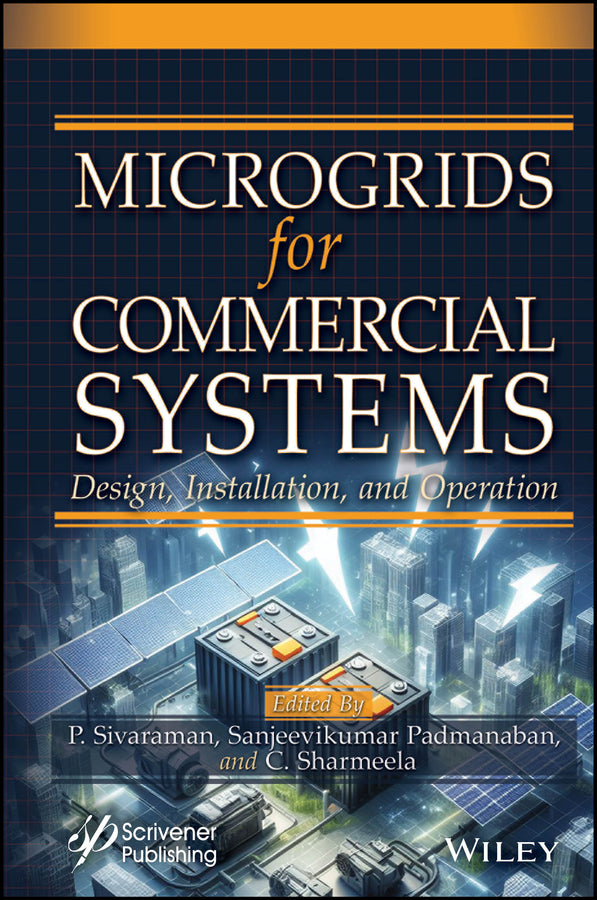
MICROGRIDS for COMMERCIAL SYSTEMS This distinct volume provides detailed information on the concepts and applications of the emerging field of microgrids for commercial applications, offering solutions in the design, installation, and operation of this new, cutting-edge technology. The microgrid is defined as Distributed Energy Resources (DER) and interconnected loads with clearly defined electrical boundaries that act as a single controllable entity concerning the grid as per IEEE standard 2030.7-2017. It provides an uninterrupted power supply to end-user loads with high reliability. Commercial systems like IT/ITES, shopping complexes, malls, the banking sector, hospitals, etc., need an uninterrupted input power supply with high reliability. Microgrids are more suitable for commercial systems to service their clients with no service discontinuity. The microgrid enables both connection and disconnection from the grid. That is, the microgrid can operate both in grid-connected and islanded modes of operation. The microgrid controller plays an important role in microgrid systems. It shall have an energy management system and real-time control functions that operate in the following conditions: both grid-connected and islanded modes of operation, automatic transfer from grid-connected mode to islanding mode, reconnection and re-synchronization from islanded mode to grid-connected mode, optimization of both real and reactive power generation and consumption by the energy management system, grid support, ancillary services, etc. Whenever a microgrid is in islanded mode, it will work as an autonomous system without a distribution grid power supply. In this mode of operation, fault in the transmission or distribution grid will not propagate into the microgrid. Whenever a microgrid operates in grid-connected mode, power flows bi-directionally between the distribution grid and microgrid at the point of interconnection. Hence, microgrids ensure the interrupted power supply to the end-user loads with high reliability. This book aims to bring together the design, installation, operation, and new research that has been carried out in the field of microgrid applications for commercial power systems.
Acknowledgements xv 1 Smart Energy Source Management in a Commercial Building Microgrid 1 2 Renewable Power Generation Price Prediction and Forecasting Using Machine Learning 21 3 Energy Storage System for Microgrid for Commercial Systems 49 4 Emerging Topologies of DC–DC Converters for Microgrid Applications 73 5 Analysis of PWM Techniques on Multiphase Multilevel Inverter for PV Applications in Microgrids 133 6 Mathematical Modeling and Analysis of Solar PV–Electrolyzer–Fuel Cell-Based Power Generation System 157 7 Design of DC EV Charging Infrastructure in a Commercial Building Using the Solar PV System 187 8 Design and Simulation of a Rooftop Stand-Alone Photovoltaic Power System for an Academic Institution 207 9 Integration of Wind Energy Control with Electric Vehicle 223 10 Interactive Use of D-STATCOM and Storage Resource to Maintain Microgrid Stability for Commercial Systems 241 11 Power System Studies for Microgrids 271 12 EV Charging Infrastructure in Microgrid 307 13 Operation and Control of EV Infrastructure for Microgrid 345 14 Renewable-Energy-Powered EV Charging Station for Microgrid PSO-Based Controller for PV-Powered EV Charging Station 381 15 Closed-Loop Control of Microgrids With Wind and Battery Storage System in Islanding Mode 409 References 452 Index 455
A. C. Vishnu Dharssini, S. Charles Raja and P. Venkatesh
Challa Krishna Rao, Sarat Kumar Sahoo and Franco Fernando Yanine
Anushree Ramanath
Stutee Patra, Aditi Chatterjee and K.C. Patra
B. Hemanth Kumar, Kavali Janardhan, R. Seshu Kumar, J. Ramesh Rahul and P. Sanjeevi Kumar
R. Aruna and K. Punitha
J. Nishanthy, N. Sivakumar, S. Charles Raja and S. Arockia Edwin Xavier
Saswati Dey, Nilanjan Mukhopadhyay, Kuntal Das, Neha Shaw and Rajesh Halder
Abhishek Kumar
Mostafa Eidiani, Mohammad Kargar and Hossein Zeynal
Aditi Chatterjee and Festus Okinyi Maklago
K. Narasimhaiah Achari and Pallavi Gajbhiye
Tamilarasu Viswanathan, B. Gunapriya, M. Mathankumar, S. Suryaprakash and M. Mohamed Iqbal
K. Punitha, R. Aruna and S. Kanthammal
Shruti Sahu, Jyoti Shukla and Basanta K. Panigrahi
Subject Areas: Electronics & communications engineering [TJ]