Freshly Printed - allow 7 days lead
Couldn't load pickup availability
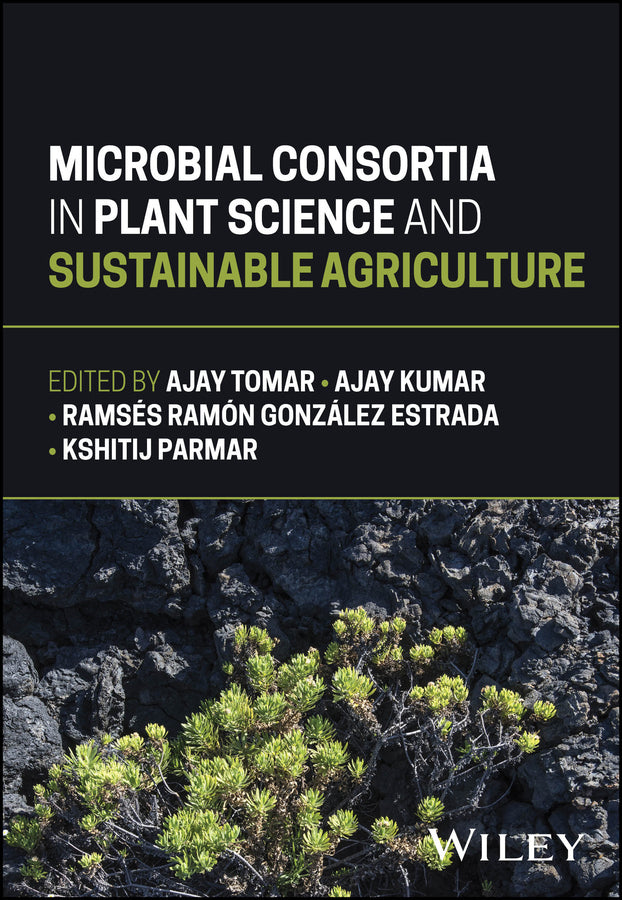
Microbial Consortia in Plant Science and Sustainable Agriculture
Ajay Tomar (Edited by), Ajay Kumar (Edited by), Ramses Ramon Gonzalez Estrada (Edited by), Kshitij Parmar (Edited by)
9781394324972, Wiley
Hardback, published 4 February 2026
352 pages
24.4 x 17 x 2 cm, 0.794 kg
An up-to-date discussion of how agriculturally important bacteria enhance plant productivity and stress tolerance In Microbial Consortia in Plant Science and Sustainable Agriculture, a team of distinguished researchers delivers an expert discussion of how bacteria can be used to enhance plant productivity and alleviate stress in plants. The book focuses on the physiological, biochemical, and molecular aspects of microbial consortia. It updates the existing body of knowledge with the latest studies on the benefits of using plant growth-promoting bacteria. You’ll find expansive explorations of how bacteria counteract the stress caused by abiotic factors. You’ll also discover deep dives into plant-microbiota interactions and various molecular methods used by microbial consortia to diagnose plant diseases. Inside the book: Perfect for researchers, academics, students, and professionals working in the agricultural and biological sciences, Microbial Consortia will also benefit professionals in the bio-fertilizer and bio-pesticide industries.
List of Contributors xiii 1 Microbial Consortia Used as Biofertilizers and Biocontrol Agents in Agriculture 1 1.1 Introduction 1 1.2 Microbial Consortia 2 1.3 Microbial Consortia for Plant Nutrition 3 1.4 Microbial Consortia for Plant Protection 5 1.5 Microbial Consortia Development and Production 7 1.6 Microbial Consortia’s Challenges and Limitations 8 1.7 Conclusions and Future Perspectives 8 2 Microbial Consortia to Increase Crop Resilience to Drought Stress 15 2.1 Introduction 15 2.2 Selection and Design of Microbial Consortia to Increase Crop Resistance to Drought 16 2.3 Action Mechanisms of Microbial Consortia Against Drought Stress 18 2.4 Plant–Microbe Communication 19 2.5 Microbial Consortia Applied in Drought Stress Mitigation 20 2.6 Genomic and Biotechnological Advances in Microbial Consortia 24 2.7 Interactions Between Arthropods and Microbial Consortia in Drought Conditions 24 2.8 Inert Dusts and Their Synergy with Microbial Consortia in Water Retention 27 2.9 Leading Countries in Microbial Consortia Research 29 2.10 Temporal Dynamics of Keywords in Microbial Consortia Studies 30 2.11 Conclusions or Future Prospective 31 3 Impediments and Limitations in the Production and Use of Biofertilizers 43 3.1 Introduction 43 3.2 Biological and Ecological Factors 44 3.2.1 Microbial Interactions in the Rhizosphere 44 3.2.2 Effect of Soil Contaminants on Biofertilizer Efficacy 46 3.3 Technical and Production Limitations 49 3.3.1 Solid Formulations 49 3.3.2 Liquid Formulations 50 3.3.3 Metabolite-based Formulations 50 3.3.4 Encapsulation Technology 50 3.4 Economic Barriers 51 3.5 Regulatory Challenges in Biofertilizer Commercialization 52 3.5.1 Regulatory Frameworks in Developed Countries 52 3.5.2 Global Disparities in Biofertilizer Regulations 53 3.5.3 The Challenge of GM Biofertilizers 53 3.6 Social and Cultural Acceptance 54 3.7 Research and Development 55 3.8 Conclusions 56 4 The Regulation of Nutrient Uptake, Transportation, and Physiological Functions of Microbial Consortia in Rice Crop Under Abiotic Stresses 65 4.1 Introduction 65 4.2 Root System in Rice and Essential Nutrients 66 4.2.1 Root Structure 66 4.2.2 Essential Nutrients 67 4.3 Mechanisms of Nutrient Uptake and Transport in Rice 67 4.3.1 Nutrient Uptake 67 4.3.2 Nutrient Transport 69 4.4 Microbial Consortia and Their Role in Rice Nutrition 70 4.4.1 Rhizosphere Microbes 70 4.4.2 Phyllosphere Microbes 70 4.4.3 Endosphere Microbes 71 4.5 Abiotic Stress in Rice Crops: Effects and Physiological Responses 72 4.5.1 Drought Stress 72 4.5.2 Salinity Stress 72 4.5.3 Flooding Stress 72 4.5.4 Heat Stress 72 4.5.5 Cold Stress 73 4.5.6 Nutrient Deficiency Stress 73 4.6 Response of Microbial Consortia to Abiotic Stress Conditions 73 4.6.1 Drought Stress 74 4.6.2 Salinity Stress 74 4.6.3 Flooding Stress 75 4.6.4 Heat and Cold Stress 75 4.7 Microbial Mechanisms for Enhancing Nutrient Availability Under Abiotic Stress 77 4.8 Perspectives and Challenges in the Research of Microbial Consortia and Their Regulation Under Stress Conditions 79 4.9 Conclusions 80 5 Plant Pathogen-specific PR Proteins Produced in Response to PGPR 89 5.1 Introduction 89 5.2 Recognition Systems in Plant Immunity 90 5.3 PR Proteins 91 5.3.1 PR Protein Classification 92 5.3.2 Factors That Promote PR Protein Production 93 5.4 Plant Growth-promoting Rhizobacteria 95 5.4.1 Mechanism of the Production of PR Proteins by PGPRs 95 5.4.2 PGPR Inducers of PR Proteins in Plants 96 5.4.3 PGPR Consortia in the Induction of the Defense System 97 5.4.4 Application of PGPR Bacteria in Plants and Their Beneficial Effect Against Phytopathogens 98 5.5 Conclusion 101 6 Current and Emerging Molecular Techniques for Microbial Consortia to Diagnose Plant Diseases 111 6.1 Introduction 111 6.2 Molecular Techniques 112 6.2.1 PCR and Its Modification 112 6.2.2 DNA Microarray 114 6.2.3 DNA Macroarrays 115 6.2.4 Fluorescence In Situ Hybridization 115 6.2.5 Next-generation Sequencing 116 6.2.6 RNA Interference 116 6.2.7 CRISPR/Cas Technology 117 6.3 Immunological Methods 118 6.3.1 Enzyme-linked Immunosorbent Assay 118 6.3.2 Lateral Flow Immunoassay 122 6.3.3 Aptamers Binding Assay 124 6.4 Biochemical Methods 124 6.4.1 Flow Cytometry 124 6.4.2 Gas Chromatography–Mass Spectroscopy 125 6.5 Biosensors 126 6.5.1 Classification of Biosensors 126 7 Microbes: A New Approach Towards Sustainable Environment 141 7.1 Introduction 141 7.1.1 Microbial Diversity and Ecosystem Functioning 143 7.2 Regulating Services 150 7.2.1 Climate Regulation 150 7.2.2 Microbial Communities and the Carbon Cycle 150 7.2.3 Water Regulation and Purification 151 7.2.4 Disease and Pest Regulation 151 7.2.5 Biodegradation of Organic Waste and Xenobiotics 152 7.2.6 Metal Detoxification 153 7.3 Supporting Services 153 7.3.1 Microbial Interactions in Soil Formation 154 7.3.2 Nutrient Cycling 154 7.3.3 Organic Matter Transformation 155 7.3.4 Role of Microbes in Plant Growth Promotion 156 7.3.5 Soil Microorganisms as Indicators 156 7.4 Provisioning Services 157 7.4.1 Importance of Microorganisms in Food Processing 158 7.4.2 Importance of Microorganisms in Food Production 158 7.4.3 Use of Microorganisms in Pharmaceuticals 159 7.5 Cultural Services 160 7.6 Conclusion 161 8 Identification of Plant-derived Microbial Consortium Resistant to Biotic Stress 171 8.1 Introduction 171 8.2 Microbial Diversity in Plant Systems 172 8.2.1 Types of Beneficial Plant-associated Microbes 172 8.2.2 Common Microbial Genera Associated with Plant Protection 172 8.2.3 Role of Microbial Consortia in Plant–Microbe Interactions 173 8.3 Mechanisms of Biotic Stress Resistance Mediated by Microbial Consortia 174 8.3.1 Direct Mechanisms 174 8.3.2 Indirect Mechanisms 174 8.4 Methods for Identification and Characterization of Microbial Consortia 176 8.4.1 Culture-dependent Approaches 176 8.4.2 Culture-independent Molecular Tools 176 8.4.3 Biochemical and Physiological Screening 177 8.5 Plant-associated Factors Influencing Microbial Consortia Selection 177 8.6 Application of Microbial Consortia in Biotic Stress Management 178 8.6.1 Development of Bioinoculants and Biopesticides 178 8.6.2 Field Application Strategies (Seed Treatment, Foliar Spray, Soil Drenching) and Compatibility with Integrated Pest and Disease Management Programs 179 8.6.3 Case Studies of Successful Microbial Consortia in Disease Suppression 179 8.7 Conclusion 181 9 Support of Microbial Formulations to Achieve the Sustainable Development Goal 2 (SDGs) 189 9.1 Introduction 189 9.2 Bioformulation as Plant Growth-promoting Bacteria 191 9.2.1 Molecular Approaches in Plant–Microbe Interaction 195 9.3 Biofertilizers and Biopesticides as Microbial Bioformulation 197 9.4 Bioplastics 197 9.4.1 Polyhydroxybutyrates as a Promising Approach to Achieve Zero Hunger 198 9.5 Microbial Biochar 200 9.6 Bioaugmentation Support to Crop Productivity 201 9.7 Microbial Formulations as Bio-control Agents 202 9.7.1 Molecular Mechanism of Microbial Cells: As Biocontrol Agents Against Plant Pathogens 202 9.8 Microbial Enzymes Promoting Nutrient Uptake 204 9.8.1 Soil Enzymes’ Role in Agriculture 205 9.8.2 Enzymes Promoting Plant Growth 205 9.9 Challenges and Future Prospects 206 9.10 Conclusion 206 10 The Synergism of Microbial Interactions Impacting Health and the Environment 215 10.1 Introduction 215 10.2 Microbial Synergistic Activities and Antimicrobial Resistance 216 10.3 Microbes Alter Metabolism 217 10.4 Microbial Synergism, Biofilms, and Plastisphere 218 10.5 Conclusive Remarks 219 Acknowledgment 219 11 Encouraging Probiotics as Plant Stimulants for Sustainable Agriculture Through Microbial Consortium 223 11.1 Introduction 223 11.2 Plant Stimulants as Probiotics 225 11.2.1 Different Biostimulants with Different Modes of Action 227 11.2.2 Organic Extracts 227 11.2.3 Microbial Endophytes 227 11.2.4 Role of PGPRs 228 11.3 Role of Biostimulants 229 11.4 Microbial Consortium-mediated Protection 231 11.5 Conclusion 231 12 Commercialization Aspects of Microbial Biocontrol Agents 239 12.1 Introduction 239 12.1.1 History of BCAs 240 12.1.2 Mechanisms of Action 240 12.1.3 Indirect Mechanisms 240 12.1.4 Biocontrol Microorganisms 242 12.1.5 Types of Biocontrol Microorganisms 242 12.1.6 Applications in Agriculture 243 12.1.7 Success Stories in Biocontrol 244 12.1.8 Challenges and Future Directions 244 12.1.9 Advantages and Disadvantages of BCAs 244 12.1.10 Challenges in Adopting BCAs 246 12.1.11 Government Regulations on BCAs 248 12.1.12 Case Studies of Biocontrol Regulation 248 12.1.13 Biocontrol Industries 249 12.1.14 Types of BCAs 249 12.1.15 Evolution and Development of Biocontrol Industries 250 12.1.16 Key Players and Market Dynamics 250 12.1.17 Production and Formulation Challenges in the Commercialization of MBAs 251 12.1.18 Regulatory and Market Barriers in the Commercialization of MBAs 252 12.1.19 Regulatory Barriers 252 12.1.20 Market Barriers 253 12.1.21 Addressing Regulatory and Market Barriers 253 12.1.22 Strategies for Successful Commercialization of MBAs 254 12.1.23 Commercialization of BCAs 256 12.1.24 Challenges in Commercialization of BCAs 256 12.2 Future Prospects 257 12.3 Conclusion 257 12.3.1 The Future of the Commercialization of BCAs: Opportunities, Challenges, and Pathways Forward 258 12.4 Conclusion 258 13 Management of Soil-borne Diseases with Trichoderma spp. 263 13.1 Introduction 263 13.2 Soilborne Pathogens and Their Impact 264 13.2.1 Economic Consequences 264 13.3 Trichoderma spp. 265 13.3.1 Taxonomy of Trichoderma 265 13.3.2 Biology of Trichoderma 265 13.3.3 Morphology of Trichoderma 266 13.3.4 Trichoderma spp. as Biocontrol Agents 267 13.3.5 Major Trichoderma spp. 267 13.4 Mode of Action/Mechanisms of Trichoderma spp. 267 13.4.1 Mycoparasitism 267 13.4.2 Antibiosis 268 13.4.3 Competition 268 13.4.4 Induced Systemic Resistance 269 13.5 Effect of Trichoderma spp. Against Soil-borne Phytopathogens 269 13.6 Formulation and Application Techniques 270 13.6.1 Formulation Types 270 13.7 Application Methods of Trichoderma spp. 270 13.8 Merit and Demerit of Trichoderma spp. as Biocontrol Agents 272 13.8.1 Merit (Advantages) 272 13.8.2 Demerit (Limitations) 272 13.9 Challenges and Future Prospects of Trichoderma spp. 272 13.10 Conclusion 273 14 Significance of Microbial Genome Protective Enzymes in Tolerating Synthetic Dyes 279 14.1 Introduction 279 14.2 Variation in Chemical Nature 280 14.3 Microbial Pigments 282 14.4 Environmental Toxicity 283 14.5 Role of Microbes and Genome Protection 285 14.6 Control of DNA Damage 288 14.7 Conclusive Remarks 289 Acknowledgment 290 15 Microbial Consortia: Enhanced Availability of Micronutrients and Elimination of Biotic Stresses in Plants 295 15.1 Introduction 295 15.2 Source of Microbial Consortia 296 15.2.1 Bacteria 297 15.2.2 Fungus 298 15.2.3 Actinomycetes 300 15.2.4 Viruses 301 15.2.5 Algae 301 15.3 Microbial Consortia for Biotic Stress 302 15.3.1 Microbial Consortia for Plant Diseases 303 15.3.2 Microbial Consortia for Pest 309 15.4 Microbial Consortia for Micronutrient Availability 310 15.4.1 Siderophore Production and Micronutrient Availability 310 15.4.2 Zinc-solubilizing Bacteria for Zinc Solubilization and Micronutrient Availability in Crops 312 15.4.3 Other Micronutrients 313 Acknowledgment 315 Index 325
Tomás Rivas-García, Pablo Preciado-Rangel, Bernardo Murillo-Amador, Rita Schwentesius-Rindermann, Ramsés Ramón González Estrada, Benjamín Hernandez-Vazquez, and Juan Antonio Torres-Rodríguez
Juan Antonio Torres-Rodriguez, Mercedes Susana Carranza-Patiño, Mayra Carolina Vélez Ruiz, Robinson J. Herrera-Feijoo, and Tomás Rivas-García
Gema Cárdenas-Flores, Ana Yareli Flores-Ramírez, Juan Edgardo Cortés-Aguilera, Martina Alejandra Chacón-López, Selene Aguilera-Aguirre, Rosa Isela Ortiz-Basurto, and Ulises Miguel López-García
Mario Alberto Soltero-Rios
Selene Aguilera-Aguirre, María Fernanda Olmedo-Díaz, Miriam del Carmen Bañuelos-González, Gema Cárdenas-Flores, Ulises Miguel López-García, Rosa Isela Ortiz-Basurto, and Martina Alejandra Chacón-López
Dalpat Lal, Aparna, Sunidhi Tiwari, Nidhi Bhatt, and Durga Prasad
Abha Sharma, Abhay Sharma, Agrim Rattan, Guneshori Maisnam, and Devashish
Ashwini Ananda, Aditya Kumar, Abha Sharma, Victor Thingujam, and Aashita Shree
Monika Singh, R.S. Sengar, Karuna Singh, Rakesh, Aastha, Shivani Pal, and Rocky Kumar
Meenakshi Sharma, Raj Kishor Kapardar, and Rajpal Srivastav
Deepika Sharma and Sakshi Singh
Saurabh Sharma, Justine Sanasam, Umalaxmi Thingujam, Krishnakumari Yendrembam, and Guneshori Maisnam
Manoj Kumar Maurya, Vivek Singh, and Ajay Tomar
Riya Raghav, Raj Kishor Kapardar, and Rajpal Srivastav
Vikash Kumar, Lucky Gupta, Saurabh Singh, Nikhil Raghuvanshi, and Lokesh Sisodiya
Subject Areas: Science: general issues [PD]