Freshly Printed - allow 10 days lead
Couldn't load pickup availability
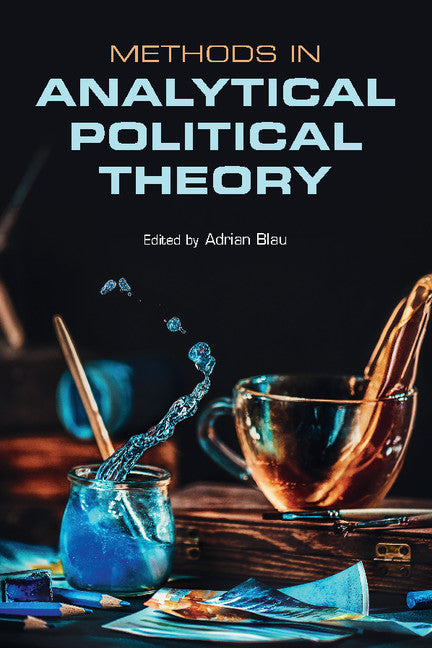
Methods in Analytical Political Theory
A guide to methods in analytical political theory, offering concrete advice and clear examples of good and bad practice.
Adrian Blau (Edited by)
9781107491700, Cambridge University Press
Paperback / softback, published 2 May 2017
344 pages
22.8 x 15 x 1.8 cm, 0.49 kg
This is the first book to explain how to use key methods in analytical political theory. The methods discussed include contractualism, reflective equilibrium, positive political theory, thought experiments and ideological analysis. Many discussions of political theory methods describe and justify these methods with little or no discussion of their application, emphasizing 'what is' and 'why do' over 'how to'. This book covers all three. Each chapter explains what kinds of problems in political theory might require researchers to use a particular method, the basic principles behind the method being proposed, and an analysis of how to apply it, including concrete principles of good practice. The book thus summarizes methodological ideas, grouped in one place and made accessible to students, and it makes innovative contributions to research methods in analytical political theory.
1. Introduction: a 'how-to' approach Adrian Blau
2. How to write analytical political theory Robert E. Goodin
3. Thought experiments Kimberley Brownlee and Zofia Stemplowska
4. Reflective equilibrium Carl Knight
5. Contractualism Jonathan Guong
6. Moral sentimentalism Michael L. Frazer
7. Realism Robert Jubb
8. Realistic idealism David Schmidtz
9. Conceptual analysis Johan Olsthoorn
10. Positive political theory Alan Hamlin
11. Rational choice theory Brian Kogelmann and Gerald Gaus
12. Interpreting texts Adrian Blau
13. Comparative political thought Brooke Ackerly and Rochana Bajpai
14. Ideological analysis Jonathan Leader Maynard
15. How to do a political theory PhD Keith Dowding and Robert E. Goodin.
Subject Areas: Political science & theory [JPA]