Freshly Printed - allow 10 days lead
Couldn't load pickup availability
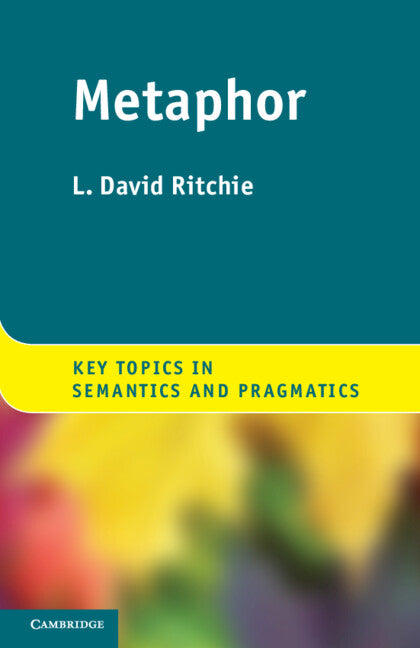
Metaphor
A summary, critique and comparison of the most important theories on how metaphors are used and understood.
L. David Ritchie (Author)
9781107606661, Cambridge University Press
Paperback / softback, published 10 January 2013
240 pages, 7 b/w illus.
21.6 x 13.8 x 1.1 cm, 0.33 kg
'Metaphor by Ritchie is a stimulating book that gives an overview of current theories on metaphor and gives interesting insights about a widely studied topic. The book is agreeable to read and can be used both for study and reference. The use of examples taken from actual texts and the specific structure of the book make Ritchie's work an appealing book in metaphor studies.' Donatella Resta, The Linguist List
'Metaphor', a form of figurative language in which one thing or idea is expressed in terms of another, is becoming an increasingly popular area of study, as it is relevant to the work of semanticists, pragmatists, discourse analysts and also those working at the interface of language and literature and in other disciplines such as philosophy and psychology. This book provides a summary, critique and comparison of the most important theories on how metaphors are used and understood, drawing on research from linguistics, psychology and other disciplines. In order to ground the discussion in actual language use, the book uses examples from discourse, including casual conversations, political speeches, literature, humor, religion and science. Written in a non-technical style, the book includes clear definitions, examples, discussion questions and a glossary, making it ideal for graduate-level seminars.
1. Introduction
2. Understanding metaphors: substitution and property attribution theories
3. Categorization and relevance
4. Conceptual metaphors
5. Perceptual simulation
6. Metaphors and framing effects
7. Language play: metaphors, stories, and humor
8. Metaphors in conversation
9. Metaphors in politics
10. Metaphors in literature
11. Closing reflections.
Subject Areas: Semantics, discourse analysis, etc [CFG]