Freshly Printed - allow 7 days lead
Couldn't load pickup availability
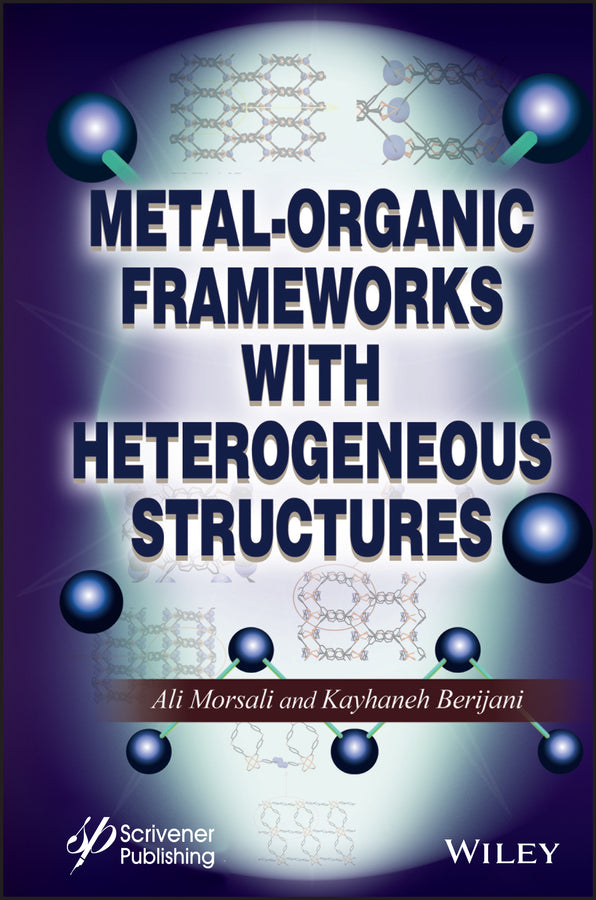
Metal-Organic Frameworks with Heterogeneous Structures
Ali Morsali (Edited by), A Morsali (Author), Kayhaneh Berijani (Edited by)
9781119792048, Wiley
Hardback, published 5 November 2021
224 pages
1 x 1 x 1 cm, 0.454 kg
METAL-ORGANIC FRAMEWORKS WITH HETEROGENEOUS STRUCTURES A unique book that sheds light on Metal-Organic Frameworks complex systems that often display behaviors that surprise and cannot be easily described. In this book, MOF-based heterostructures technology with key characteristics is completely analyzed and the current state-of-the-art is discussed. The authors focus on the complex heterostructures promoted by MOFs with advantage of their recent new advances for various applications with particular emphasis on their design. As an extension of the design and synthesis, the shaping technology of heterostructure MOFs is also of great significance to the future practical applications in industry (adsorption/desorption, gas storage, catalysis, conductivity, optical activity) of this class of complex porous materials. As this unique book covers all of the aspects of complexity in MOFs with heterogeneous structures, it serves as an essential reference to the concepts of introducing complexity to designing the future new platforms of materials with advanced and superior properties. This important compact book provides the reader with: Audience This book will be beneficial for chemists, materials engineers, advanced postgraduate and graduate students, researchers and specialists who are working in the area of materials design and their chemistry, porous crystalline materials, coordination polymers, hybrid and functional materials, as well as industry professionals, such as those working on selective catalysis and adsorption-separation, optics, gas capture, processes of biological and pharmaceutical.
List of Illustrations vii List of Tables xv List of Schemes xvii Preface xix Abbreviations xxi 1 Introduction: A Brief Introduction About Metal-Organic Frameworks 1 1.1 Metal-Organic Frameworks 1 1.2 Conclusion 8 References 8 2 Metal-Organic Frameworks Complexity 13 2.1 Perspectives on Complexity in MOFs 13 2.2 Conclusion 21 References 22 3 Complexity Based on Ligand—Part 1 27 3.1 Mixed Ligand 27 3.2 Conclusion 50 References 51 4.1 Polytopic Linkers 57 4.2 Multi-Heterotopic Ligands 63 4.3 Conclusion 66 References 66 5 Complexity Based on Metal Node 71 5.1 Mixed Metal 71 5.2 Multiple SBUs 81 5.3 Conclusion 92 References 92 6 Complexity Based on Chiral Framework—Part 1 105 6.1 Inherent Chirality 105 6.2 Direct Chirality 109 6.3 Conclusion 120 References 121 7 Complexity Based on Chiral Framework—Part 2 127 7.1 Chiral-Template Synthesis 127 7.2 Post-Synthesis 131 7.3 Conclusion 144 References 144 8 Complexity Based on Structural Defects 149 8.1 Inherent Defect 149 8.2 Designed Defect 154 8.3 Conclusion 161 References 162 9 Complexity Based on Heterogeneous Pores 171 9.1 Heterogeneous Pores 171 9.2 Conclusion 178 References 179 10 Complexity Based on Mixed MOFs 185 10.1 Complex Mixed MOFs 185 10.2 Conclusion 192 References 193 Index 199
4 Complexity Based on Ligand—Part 2 57
Subject Areas: Chemistry [PN]