Special Order - allow 2+ weeks lead
Couldn't load pickup availability
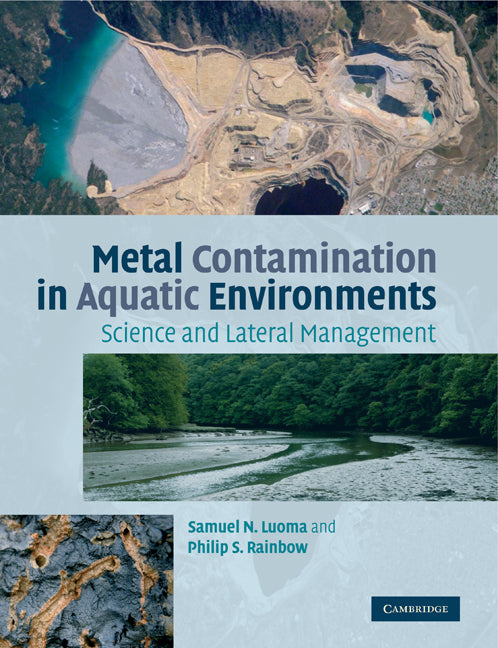
Metal Contamination in Aquatic Environments
Science and Lateral Management
This book explains why controversies exist in managing metal contamination, highlighting opportunities for policy solutions and effective management in the future.
Samuel N. Luoma (Author), Philip S. Rainbow (Author)
9780521279017, Cambridge University Press
Paperback / softback, published 9 June 2011
588 pages
24.6 x 18.9 x 3 cm, 1.4 kg
Review of the hardback: 'There are so many things to like about this book; I hardly know where to start. It can serve as an authoritative reference for anyone involved with the environmental chemistry or toxicology of metals in aquatic ecosystems. … it would serve as an excellent advanced text. … I am glad to have this book and expect to refer to it often. In particular, I plan to use it as a guide to updating the metals module in the CADDIS website.' Integrated Environmental Assessment and Management
Metal contamination is one of the most ubiquitous, persistent and complex environmental issues, encompassing legacies of the past (e.g. abandoned mines) as well as impending, but poorly studied, threats (e.g. metallo-nanomaterials). Writing for graduate students, risk assessors and environmental managers, Drs Luoma and Rainbow explain why controversies exist in managing metal contamination and highlight opportunities for policy solutions stemming from the latest advances in the field. They illustrate how the 'lateral' approach offers opportunities in both science and management, making the case that the advanced state of the science now allows bridging of traditional boundaries in the field (e.g. between field observations and laboratory toxicology). The book has a uniquely international and interdisciplinary perspective, integrating geochemistry, biology, ecology, and toxicology, as well as policy and science. It explicitly shows how science ties into today's regulatory structure, identifying opportunities for more effective risk management in the future.
1. Introduction
2. Conceptual underpinnings: science and management
3. Historical and disciplinary context
4. Sources and cycles of trace metals
5. Concentrations and speciation of metals in natural waters
6. Trace metals in suspended particulates and sediments: concentrations and geochemistry
7. Trace metal bioaccumulation
8. Biomonitors
9. Manifestation of the toxic effects of trace metals: the biological perspective
10. Toxicity testing
11. Manifestation of metal effects in nature
12. Mining and metal contamination: science, controversies and policies
13. Selenium: dietary exposure, trophic transfer and food web effects
14. Organometals: tributyl tin and methyl mercury
15. Hazard rankings and water quality guidelines
16. Sediment quality guidelines
17. Harmonizing approaches to managing metal contamination: integrative and weight of evidence approaches
18. Conclusions: science and policy.
Subject Areas: Geochemistry [RBGK], Toxicology [non-medical PSBT], Ecological science, the Biosphere [PSAF]