Freshly Printed - allow 7 days lead
Couldn't load pickup availability
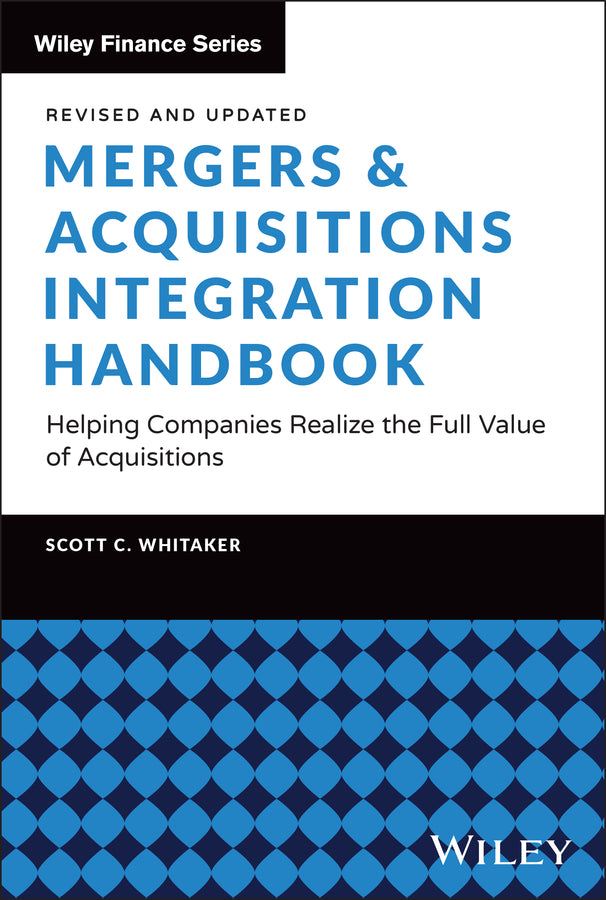
Mergers & Acquisitions Integration Handbook
Helping Companies Realize the Full Value of Acquisitions, Revised and Updated
Scott C. Whitaker (Author)
9781394343201, Wiley
Hardback, published 26 January 2026
272 pages
23.1 x 16.3 x 3 cm, 0.454 kg
A comprehensive, up-to-date discussion of maximizing the value of M&A transactions In the newly updated second edition of the Mergers & Acquisitions Integration Handbook: Helping Companies Realize the Full Value of Acquisitions, Revised and Updated, 30-year M&A professional Scott Whitaker delivers a pragmatic and actionable discussion of how to plan and execute integrations across a wide variety of tiers, markets, and business sectors. The author provides best practices and lessons learned from his first-hand experience managing hundreds of integrations. You’ll find expert guidance on managing mergers and acquisitions, integration and carve-out planning, and the overall PMI (post-merger integration) process. . You’ll also discover resources for managing communications, culture, and change management requirements. This book provides a no-nonsense handbook-style approach to manage an effective integration and to help integration managers quickly get up to speed on various integration challenges and learn how to navigate them. It is a desktop reference to inform and craft the optimal integration strategy for your company. The 2nd edition update includes: The Merger & Acquisition Integration Handbook 2nd Edition will get readers up to speed on the most common integration issues and outline some basic practices to tackle integration projects in a rational and efficient manner that preserves and protects the value of your transaction.
Acknowledgments xi Chapter 1 Introduction 1 Who Should Use This Book? 2 How This Book Is Organized 2 A Word to the Wise 6 Chapter 2 Mergers and Acquisitions 101 and Assessing Integration Complexity and Risk 9 Mergers and Acquisitions 101 9 Understanding Transaction Types and Integration Scope 10 Assessing Integration Complexity and Risk 14 Assessing Integration “Debt” 19 The Evaluation and Measurement of Performance 22 Summary 22 Chapter 3 Making the Business Case for Integration 23 The Business Drivers of M&A Activity 23 Why M&A Can Be So Difficult 27 Making the Business Case for Integration Support 30 The Challenges of Integration 32 Integration Success Factors 36 Summary 37 Chapter 4 An Introduction to Integration Planning 39 Integration Activities 40 Integration Timetable Considerations 41 Integration and Business Planning 44 Managing the Change, People, and Potential Business Disruption 46 Summary 48 Chapter 5 The Pre-planning Phase 49 Key Activities 50 Reviewing Planning Documents 52 Assessing Potential Challenge Areas 55 Managing Integration Delays 59 Summary 60 Chapter 6 The Importance of Due Diligence 61 Due Diligence Documents Lists 63 A Few Words about IT Due Diligence 75 The Due Diligence Process and AI 76 Assessing “Integration Debt” 78 Summary 79 Chapter 7 Establishing an Integration Management Office 81 Setting Up an IMO Office 83 Determining Functional Resource Commitments 89 Setting Up an IMO Project Charter 94 A Note on Carve-outs 96 Summary 99 Chapter 8 Executing Your Integration Plan 101 Defining the Overall Integration Strategy 102 Developing the Functional Work Plans 104 Project Management Tools 107 Functional Work Plans 108 Integration Workstreams 110 Functions Requiring Extra Attention 118 Summary 123 Chapter 9 Planning Your Integration’s End State 125 How to Know When an Integration Is Finished 126 The Typical Process: Roles, Responsibilities, Tracking, and Finishing Well 130 Summary 134 Chapter 10 Effective Communication Planning 135 Communication Planning Objectives 136 Guiding Principles for an Effective Communication Plan 137 Establishing a Communication Matrix 138 Communication Planning and Execution Scope 149 Summary 152 Chapter 11 Managing Culture and Change During M&A 153 What Is Culture Exactly? 153 Managing Cultural Integration Activities 154 Managing Change During M&A 162 Summary 165 Chapter 12 HR Diligence and the Talent Assessment Process 167 Human Resource Diligence 168 Talent Assessment Guiding Principles 173 Talent Assessment Objectives 174 Evaluation Tools for Assessing Talent 174 Retention/Separation Guidelines and Policies 176 Dependencies for Talent Assessment/Retention and Separation Activities 183 Things to Avoid 185 Summary 186 Chapter 13 Synergy Program Management 187 “Synergy” in the M&A Context 188 Effectively Managing Synergies 192 Common Synergy Realization Pitfalls and Warnings 197 Summary 199 Chapter 14 Information Technology and Infrastructure Integration 201 IT Integration in M&A 201 IT’s Role During Early Integration Planning 202 Day 1 Planning 204 IT Workload Examples 206 Application Decisions 210 Summary 214 Chapter 15 Evaluating Integration Results and Improving Your Post-merger Integration Program 215 Improving Initial Deal Thesis Clarity 215 Measuring Progress at Day 90 (Close +90 Days) 219 Other Lessons Learned During Periods of Transformation 219 Additional Tips 227 Summary 228 Chapter 16 Creating an Integration Playbook 229 Example Playbook Phasing Constructs 232 Playbook Optimization 232 Applying the Playbook 236 Integration Manager Sample Job Description 237 IMO Process Documentation 240 Summary 241 Chapter 17 Artificial Intelligence and the M&A Process 243 Deal Sourcing 243 Due Diligence 244 The Valuation Process 244 Integration Planning and Execution 245 Summary 246 About the Author 247 Index 249
Subject Areas: Finance & accounting [KF]