Freshly Printed - allow 10 days lead
Couldn't load pickup availability
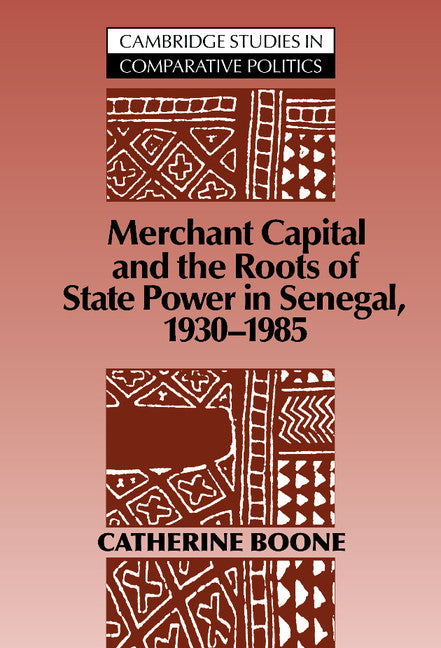
Merchant Capital and the Roots of State Power in Senegal
1930–1985
A 1993 study of the ways in which the exercise of state power in Africa has inhibited economic growth, focusing on Senegal.
Catherine Boone (Author)
9780521410786, Cambridge University Press
Hardback, published 30 October 1992
318 pages, 4 b/w illus. 23 tables
23.7 x 15.8 x 2.6 cm, 0.555 kg
"...instructive for anyone concerned with the politics of economic reform, not only in Africa but in postcommunist Eastern Europe as well." Ronald Kassimir, Contemporary Sociology
In most post-colonial regimes in sub-Saharan Africa, state power has been used to structure economic production in ways that have tended to produce economic stagnation rather than growth. In this 1993 book, Catherine Boone examines the ways in which the exercise of state power has inhibited economic growth, focusing on the case of Senegal. She traces changes in the political economy of Senegal from the heyday of colonial merchant capital in the 1930s to the decay of the 1980s and reveals that old trading monopolies and commercial hierarchies were preserved at the cost of reforms that would have stimulated economic growth. Boone uses this case to develop an argument against analyses of political-economic development that identify state institutions and ideologies as independent forces driving the process of economic transformation. State power, she argues, is rooted in the material and social bases of ruling alliances.
List of tables and figures
Preface and acknowledgements
Introduction
1. Capital and contingencies of post-colonial politics
2. The colonial market
3. Consolidation of a regime: neo-colonialism in the 1960s
4. Growth of Senegal's textile industry, 1960–75
5. Reappropriation of the state: the 1970s
6. Demise of the Dakar textile industry
7 Conclusion: states, capital and capitalist states
Appendix: exchange rates
References
Index.
Subject Areas: Political economy [KCP]