Freshly Printed - allow 8 days lead
Couldn't load pickup availability
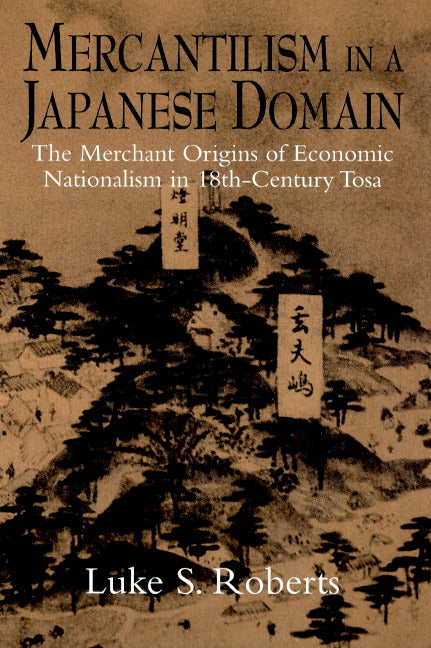
Mercantilism in a Japanese Domain
The Merchant Origins of Economic Nationalism in 18th-Century Tosa
Luke S. Roberts (Author)
9780521893350, Cambridge University Press
Paperback, published 2 May 2002
268 pages
22.8 x 15.4 x 1.5 cm, 0.445 kg
This book explores the historical roots of economic nationalism within Japan. By examining how mercantilist thought developed in the eighteenth-century domain of Toas, Luke Roberts shows how economic ideas were generated at the regional level. During the Edo period (1600-1867), Japan was divided into over 230 competitive states, many of which wished to reduce the dominance of the shogun's economy. The seventeenth-century Japanese economy was based on samurai notions of service - especially the duty performed by the dominal lord to the shogun - and the rhetoric of political economy that centred on the lord and the samurai class. This 'economy of service,' however, led to crises in deforestation and land degradation, government fiscal insolvency and increasingly corrupt tax levies, and finally a loss of faith in government.
List of maps, tables and figures
Acknowledgments
Dates and units of measurement used in the text
1. Introduction
2. The geography and politics of seventeenth-century Tosa
3. Creating a crisis in Tosa, 1680-1787
4. The decline and restoration of domain finances
5. Voices of dissatisfaction and change: the petition box
6. Imagined economies: merchants and samurai
7. Declining service
8. Cooking up a country: sugar, eggs and gunpowder, 1759-1868
9. Conclusion
Glossary of terms and manuscript document titles used in the text
Sources for figures and tables
Index.
Subject Areas: General & world history [HBG]