Freshly Printed - allow 10 days lead
Couldn't load pickup availability
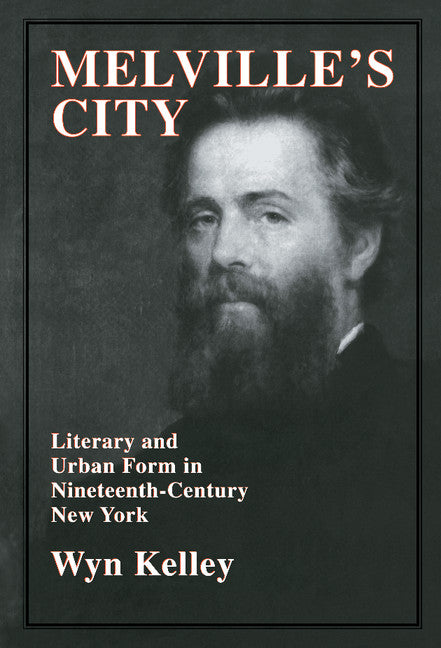
Melville's City
Literary and Urban Form in Nineteenth-Century New York
Through an examination of Melville's works, Kelley forges an analysis of connections between urban and literary form.
Wyn Kelley (Author)
9780521560542, Cambridge University Press
Hardback, published 26 July 1996
332 pages, 15 b/w illus.
23.7 x 15.9 x 2.6 cm, 0.64 kg
"Ultimately, Kelley's text is an astute analysis of an important field of Melville scholarship. It is clearly a well-researched book--Kelley has studied (and apllied) Melville criticism in great depth. One comes away from Melville's City with a good sense of Melville's complex relationship with New York....Kelley's work highlights the oftentimes glossed-over relationship Melville had with that vast world away from the sea--the city." American Studies International
Melville's City argues that Melville's relationship to the city was considerably more complex than has generally been believed. By placing him in the historical and cultural context of nineteenth-century New York, Kelley presents a Melville who borrowed from the colourful cultural variety of the city while at the same time investigating its darker and more dangerous social aspects. She shows that images both from Melville and from popular sources of the time represented New York variously as Capital, Labyrinth, City of Man and City of God and she goes on the demonstrate that he resisted a generalising or totalising representation of the city by revealing its hybrid identity and giving voice to the poor, the displaced and the racially excluded. Through close examination of works spanning Melville's career, Kelley forges an analysis of connections between urban and literary form.
Introduction: Proud City, Proudest Town
Part I. Travelling the Town: 1. Urban space
2. Spectator in the capital
3. Provincial in a labyrinth
Part II. Escaping the City: 4. Town ho
5. Sojourner in the city of man
6. Pilgrim in the city of God
Conclusion. Citified man
Notes
Index.
Subject Areas: Literary studies: c 1800 to c 1900 [DSBF]