Freshly Printed - allow 7 days lead
Couldn't load pickup availability
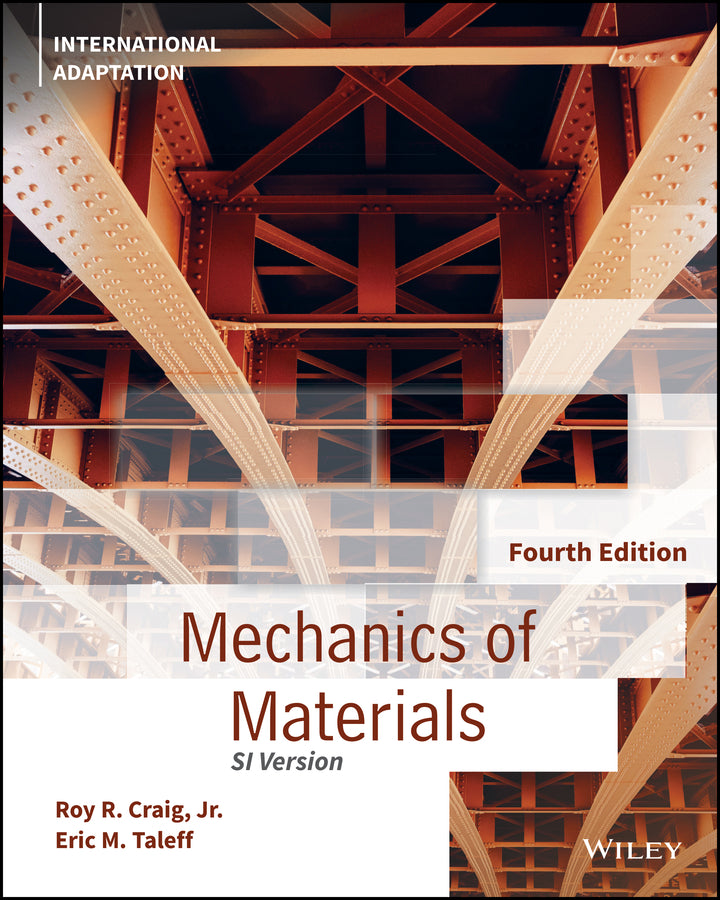
Mechanics of Materials, International Adaptation
Roy R. Craig, Jr. (Author), Eric M. Taleff (Author)
9781119676294, Wiley
Paperback / softback, published 10 June 2021
864 pages
1 x 1 x 1 cm, 0.454 kg
Mechanics of Materials provides an in-depth yet accessible introduction to the behavior of solid materials under various stresses and strains. Emphasizing the three key concepts of deformable-body mechanics—equilibrium, material behavior, and geometry of deformation—this popular textbook covers the fundamental concepts of the subject while helping students strengthen their problem-solving skills. Throughout the text, students are taught to apply an effective four-step methodology to solve numerous example problems and understand the underlying principles of each application. Focusing primarily on the behavior of solids under static-loading conditions, the text thoroughly prepares students for subsequent courses in solids and structures involving more complex engineering analyses and Computer-Aided Engineering (CAE). The text provides ample, fully solved practice problems, real-world engineering examples, the equations that correspond to each concept, chapter summaries, procedure lists, illustrations, flow charts, diagrams, and more. This International adaptation has been thoroughly updated to use SI units. In addition to the new and updated materials, this updated edition includes new Python computer code examples, problems, and homework assignments that require only basic programming knowledge.
1 INTRODUCTION 1.1 What Is Mechanics of Materials? 1.2 The Fundamental Equations of Deformable-Body Mechanics 1.3 Problem-Solving Procedures 1.4 Review of Static Equilibrium; Equilibrium of Deformable Bodies Chapter 1 Review Problems 2 STRESS AND STRAIN 2.1 Introduction 2.2 Normal Stress 2.3 Extensional Strain; Thermal Strain 2.4 Stress-Strain Diagrams; Mechanical Properties of Materials 2.5 Elasticity and Plasticity; Temperature Effects 2.6 Linear Elasticity; Hooke's Law and Poisson's Ratio 2.7 Shear Stress and Shear Strain; Shear Modulus 2.8 Introduction to Design-Axial Loads and Direct Shear 2.9 Stresses on an Inclined Plane in an Axially Loaded Member 2.10 Saint-Venant's Principle 2.11 Hooke's Law for Plane Stress; the Relationship Between E and G 2.12 General Definitions of Stress and Strain *2.13 Cartesian Components of Stress; Generalized Hooke's Law for Isotropic Materials Chapter 2 Review Problems 3 AXIAL DEFORMATION 3.1 Introduction 3.2 Basic Theory of Axial Deformation 3.3 Examples of Nonuniform Axial Deformation 3.4 Statically Determinate Structures 3.5 Statically Indeterminate Structures 3.6 Thermal Effects on Axial Deformation 3.7 Geometric "Misfits" 3.8 Displacement-Method Solution of Axial-Deformation Problems *3.9 Force-Method Solution of Axial-Deformation Problems *3.10 Introduction to the Analysis of Planar Trusses Chapter 3 Review Problems 4 TORSION 4.1 Introduction 4.2 Torsional Deformation of Circular Bars 4.3 Torsion of Linearly Elastic Circular Bars 4.4 Stress Distribution in Circular Torsion Bars; Torsion Testing 4.5 Statically Determinate Assemblages of Uniform Torsion Members 4.6 Statically Indeterminate Assemblages of Uniform Torsion Members *4.7 Displacement-Method Solution of Torsion Problems 4.8 Power-Transmission Shafts *4.9 Thin-Wall Torsion Members *4.10 Torsion of Noncircular Prismatic Bars Chapter 4 Review Problems 5 TRANSFORMATION OF STRESS AND STRAIN 5.1 Introduction 5.2 Plane Stress 5.3 Stress Transformation for Plane Stress 5.4 Principal Stresses and Maximum Shear Stress 5.5 Mohr's Circle for Plane Stress 5.6 Triaxial Stress; Absolute Maximum Shear Stress 5.7 Plane Strain 5.8 Transformation of Strains in a Plane 5.9 Mohr's Circle for Strain 5.10 Measurement of Strain; Strain Rosettes Chapter 5 Review Problems 6 EQUILIBRIUM OF BEAMS 6.1 Introduction 6.2 Equilibrium of Beams Using Finite Free-Body Diagrams 6.3 Equilibrium Relationships Among Loads, Shear Force, and Bending Moment 6.4 Shear-Force and Bending-Moment Diagrams: Equilibrium Method 6.5 Shear-Force and Bending-Moment Diagrams: Graphical Method *6.6 Discontinuity Functions to Represent Loads, Shear, and Moment Chapter 6 Review Problems 7 STRESSES IN BEAMS 7.1 Introduction 7.2 Strain-Displacement Analysis 7.3 Flexural Stress in Linearly Elastic Beams 7.4 Design of Beams for Strength 7.5 Flexural Stress in Nonhomogeneous Beams *7.6 Unsymmetric Bending *7.7 Inelastic Bending of Beams 7.8 Shear Stress and Shear Flow in Beams 7.9 Limitations on the Shear-Stress Formula 7.10 Shear Stress in Thin-Wall Beams 7.11 Shear in Built-up Beams *7.12 Shear Center Chapter 7 Review Problems 8 DEFLECTION OF BEAMS 8.1 Introduction 8.2 Differential Equations of the Deflection Curve 8.3 Slope and Deflection by Integration-Statically Determinate Beams 8.4 Slope and Deflection by Integration-Statically Indeterminate Beams *8.5 Use of Discontinuity Functions to Determine Beam Deflections 8.6 Slope and Deflection of Beams: Superposition Method *8.7 Slope and Deflection of Beams: Displacement Method Chapter 8 Review Problems 9 PRESSURE VESSELS; STRESSES DUE TO COMBINED LOADING 9.1 Introduction 9.2 Thin-Wall Pressure Vessels 9.3 Thick-Wall Pressure Vessels 9.4 Stress Distribution in Beams 9.5 Stresses Due to Combined Loads Chapter 9 Review Problems 10 BUCKLING OF COLUMNS 10.1 Introduction 10.2 The Ideal Pin-Ended Column; Euler Buckling Load 10.3 The Effect of End Conditions on Column Buckling *10.4 Eccentric Loading; the Secant Formula *10.5 Imperfections in Columns *10.6 Inelastic Buckling of Ideal Columns 10.7 Design of Centrally Loaded Columns Chapter 10 Review Problems 11 ENERGY METHODS 11.1 Introduction 11.2 Work and Strain Energy 11.3 Elastic Strain Energy for Various Types of Loading 11.4 Work-Energy Principle for Calculating Deflections 11.5 Castigliano's Second Theorem; the Unit-Load Method *11.6 Virtual Work *11.7 Strain-Energy Methods *11.8 Complementary-Energy Methods Chapter 11 Review Problems 12 SPECIAL TOPICS RELATED TO DESIGN 12.1 Introduction 12.2 Stress Concentrations *12.3 Failure Theories *12.4 Fatigue and Fracture Chapter 12 Review Problems A NUMERICAL ACCURACY; APPROXIMATIONS A.1 Numerical Accuracy; Significant Digits A.2 Approximations B SYSTEMS OF UNITS B.1 Introduction B.2 SI Units B.4 Useful Physical Properties C GEOMETRIC PROPERTIES OF PLANE AREAS C.1 First Moments of Area; Centroid C.2 Moments of Inertia of an Area C.3 Product of Inertia of an Area C.4 Area Moments of Inertia about Inclined Axes; Principal Moments of Inertia C.5 Geometric Properties of Plane Areas D SECTION PROPERTIES OF SELECTED STRUCTURAL SHAPES E DEFLECTIONS AND SLOPES OF BEAMS; FIXED-END ACTIONS F MECHANICAL PROPERTIES OF SELECTED ENGINEERING MATERIALS G MECHANICAL PROPERTIES OF COMPOSITE MATERIALS H POISSON'S RATIO VALUES FOR VARIOUS MATERIALS ANSWERS TO SELECTED ODD-NUMBERED PROBLEMS REFERENCES INDEX
Subject Areas: Mechanical engineering & materials [TG]