Freshly Printed - allow 7 days lead
Couldn't load pickup availability
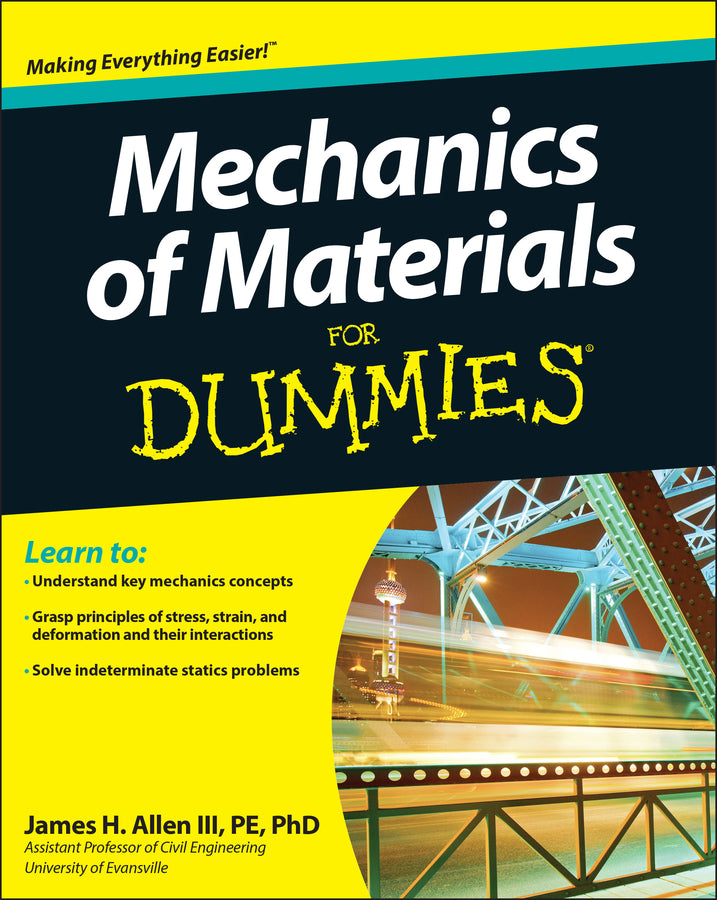
Mechanics of Materials For Dummies
James H. Allen, III (Author)
9780470942734, Wiley
Paperback / softback, published 8 July 2011
384 pages
23.1 x 18.5 x 2.8 cm, 0.522 kg
Your ticket to excelling in mechanics of materials With roots in physics and mathematics, engineering mechanics is the basis of all the mechanical sciences: civil engineering, materials science and engineering, mechanical engineering, and aeronautical and aerospace engineering. Tracking a typical undergraduate course, Mechanics of Materials For Dummies gives you a thorough introduction to this foundational subject. You'll get clear, plain-English explanations of all the topics covered, including principles of equilibrium, geometric compatibility, and material behavior; stress and its relation to force and movement; strain and its relation to displacement; elasticity and plasticity; fatigue and fracture; failure modes; application to simple engineering structures, and more. From geometric principles to solving complex equations, Mechanics of Materials For Dummies is an invaluable resource for engineering students!
Introduction 1 Part I: Setting the Stage for Mechanics of Materials 7 Chapter 1: Predicting Behavior with Mechanics of Materials 9 Chapter 2: Reviewing Mathematics and Units Used in Mechanics of Materials 15 Chapter 3: Brushing Up on Statics Basics 25 Chapter 4: Calculating Properties of Geometric Areas 41 Chapter 5: Computing Moments of Area and Other Inertia Calculations 55 Part II: Analyzing Stress 83 Chapter 6: Remain Calm, It’s Only Stress! 85 Chapter 7: More than Meets the Eye: Transforming Stresses 99 Chapter 8: Lining Up Stress Along Axial Axes 131 Chapter 9: Bending Stress Is Only Normal: Analyzing Bending Members 149 Chapter 10: Shear Madness: Surveying Shear Stress 161 Chapter 11: Twisting the Night Away with Torsion 177 Part III: Investigating Strain 189 Chapter 12: Don’t Strain Yourself: Exploring Strain and Deformation 191 Chapter 13: Applying Transformation Concepts to Strain 201 Chapter 14: Correlating Stresses and Strains to Understand Deformation 215 Part IV: Applying Stress and Strain 233 Chapter 15: Calculating Combined Stresses 235 Chapter 16: When Push Comes to Shove: Dealing with Deformations 251 Chapter 17: Showing Determination When Dealing with Indeterminate Structures 273 Chapter 18: Buckling Up for Compression Members 301 Chapter 19: Designing for Required Section Properties 313 Chapter 20: Introducing Energy Methods 331 Part V: The Part of Tens 343 Chapter 21: Ten Mechanics of Materials Pitfalls to Avoid 345 Chapter 22: Ten Tips to Solving Mechanics of Materials Problems 349 Index 355
Subject Areas: Science: general issues [PD]