Freshly Printed - allow 8 days lead
Couldn't load pickup availability
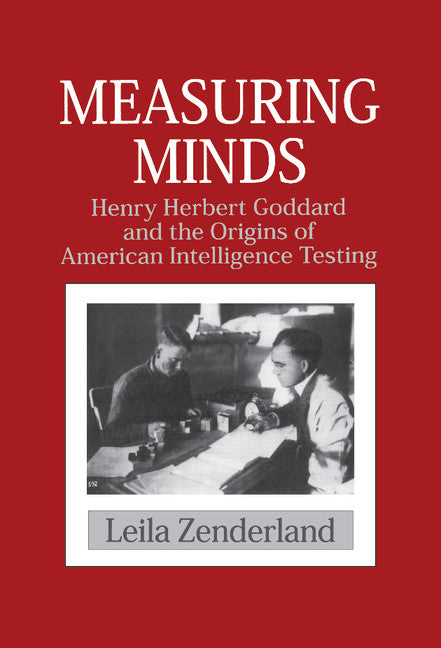
Measuring Minds
Henry Herbert Goddard and the Origins of American Intelligence Testing
This book explores intelligence testing in the US through the career of Henry Herbert Goddard.
Leila Zenderland (Author)
9780521443739, Cambridge University Press
Hardback, published 13 March 1998
480 pages
22.9 x 15.2 x 3 cm, 0.87 kg
'Measuring Minds works on multiple levels. Most importantly, it is enjoyable to read. It presents the gripping story of a man who built an enormously successful career and then found himself rather suddenly assigned the part of the incompetent scientist blinded by right-wing prejudice. Secondly, Measuring Minds informs the reader not only of the early American intelligence test movement but also of the history of child study and the history of eugenics.' British Journal of Psychology
This book explores the origins of the American intelligence testing movement. It follows the life and work of Henry Herbert Goddard, America's first intelligence tester and author of the most popular American eugenics tract, The Kallikak Family. The book traces the controversies surrounding Goddard's efforts to bring Alfred Binet's tests of intelligence from France to America and to introduce them into the basic institutions of American life - from hospitals to classrooms to courtrooms. It shows how testers used their findings to address the most pressing social and political questions of their day, including poverty, crime, prostitution, alcoholism, immigration restriction, and military preparedness. It also explores the broader legacies of the testing movement by showing how Goddard's ideas helped to reshape the very meaning of mental retardation, special education, clinical psychology, and the 'normal' mind in ways that would be felt for the rest of the century.
Introduction: motives, meanings, and contexts
1. Spirit and science: faith, healing, and mission
2. 'A little child shall lead them': educational evangelism and child study
3. 'Psychological work among the feeble-minded': the medical meaning of 'mental deficiency'
4. Psychological work in the schools: the statistical meaning of 'subnormality'
5. Causes and consequences: the Kallikak family as eugenic parable
6. The biology and sociology of 'prevention': defectives, dependents, and delinquents
7. Psychological work and the state: reformers, professionals, and the public
8. Psychological work and the nation: the political meaning of intelligence
9. Leaving Vineland: popularity, notoriety, and a place in history
Epilogue: psychological legacies, historical lessons, and luck.
Subject Areas: History of science [PDX], Intelligence & reasoning [JMRN], Psychology [JM], History of the Americas [HBJK]