Freshly Printed - allow 7 days lead
Couldn't load pickup availability
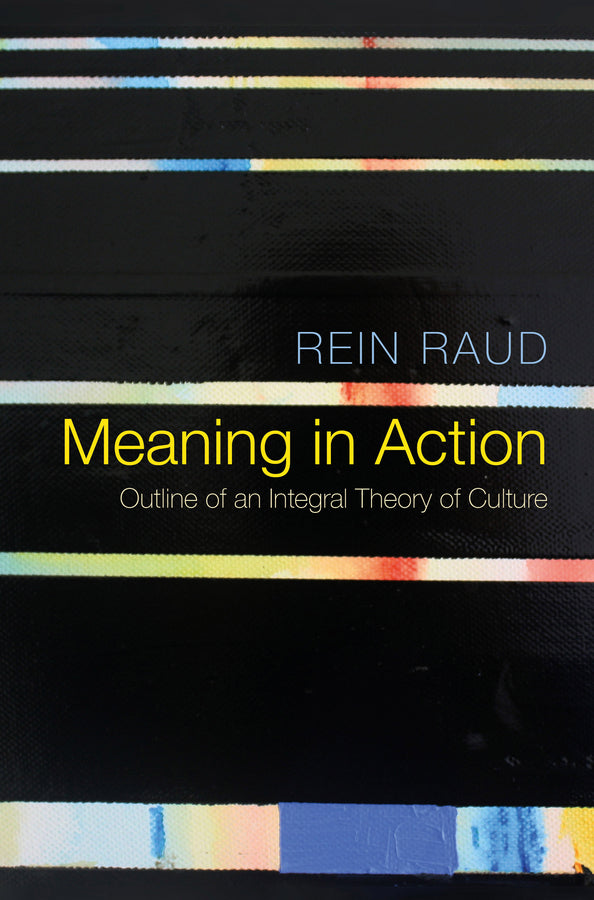
Meaning in Action
Outline of an Integral Theory of Culture
Rein Raud (Author)
9781509511242, Polity Press
Hardback, published 29 July 2016
240 pages
23.6 x 15.8 x 2 cm, 0.445 kg
"A high wire act of cultural theorizing, ambitious and original. Raud pushes the textual tradition of semiotics further than anybody has ever done, into situated, existential practices and circulating cultural institutions. The case studies are fascinating in themselves and illustrate how Raud's theory might work in practice." "Professor Raud's range is amazing and his book combines in an exciting way perspectives which usually are kept separate. His voice, coming from a less well-known tradition, adds a genuinely new element." "Meaning in Action would be worth reading for the ambition and importance of its project alone, but Raud's thorough analysis of the fundamentals of culture make this an extremely worthwhile read, and one that I think may spawn a vital discussion about the basic conceptual structure of culture itself."
—Jeffrey Alexander, Yale University
—Maurice Bloch, The London School of Economics and Political Science
—Cultural Sociology
In this important new book Rein Raud develops an original theory of culture understood as a loose and internally contradictory system of texts and practices that are shared by intermittent groups of people and used by them to make sense of their life-worlds. This theory views culture simultaneously in two ways: as a world of texts, tangible and shareable products of signifying acts, and as a space of practices, repeatable activities that produce, disseminate and interpret these clusters of meaning. Both approaches are developed into corresponding models of culture which, used together, are able to provide a rich understanding of any meaning in action.
In developing this innovative theory, Raud draws on a wide range of disciplines, from anthropology, sociology and cultural studies to semiotics and philosophy. The theory is illustrated throughout with examples drawn from both �high� and popular culture, and from Western and Asian traditions, dealing with both contemporary and historical topics. The book concludes with two case studies from very different contexts one dealing with Italian poetry in the 13th century, the other dealing with the art scene in Eastern Europe in the 1990s.
This timely and original work makes a major new contribution to the theory of culture and will be welcomed by students and scholars throughout the social sciences and humanities.
Acknowledgements Introduction An outline of the theory and the book 1 Looking for culture, looking at things Social/cultural Cultural communities The cultural subject Summary 2 Meaning and signification The problem of reference Two kinds of concepts The internalisation of meaning Claims and bids Summary 3 Culture as textuality Base-texts and result-texts The operational memory Organisation of knowledge Standards and codes Summary 4 Culture as a network of practices The cultural role: functions and goals of a practice The social position: the carrier and status of a practice Materials and rules Cultural institutions Summary 5 Case Study I: The metaphysics of love and the beginnings of Italian vernacular poetry Italian political landscape in the 13th century: the bidding space The poetic context The carriers of the practice The science of love as privileged knowledge Vulgare, the medium Institutions and textuality Summary 6 Case Study II: Art and politics in Eastern Europe in the 1990s The institutions The carriers Textuality, codes and languages Summary 7 Concluding remarks A few final words References Index
Subject Areas: Society & culture: general [JF]