Special Order - allow 2+ weeks lead
Couldn't load pickup availability
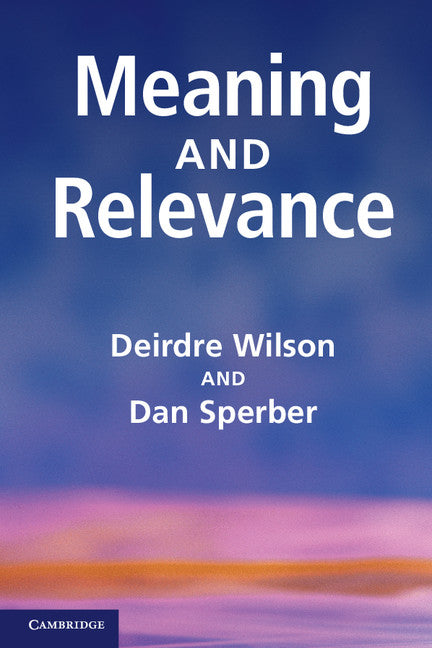
Meaning and Relevance
Enriches and updates relevance theory and explores its implications for linguistics, philosophy, cognitive science and literary studies.
Deirdre Wilson (Author), Dan Sperber (Author)
9780521747486, Cambridge University Press
Paperback / softback, published 22 March 2012
395 pages, 5 b/w illus. 11 tables
22.7 x 15.1 x 1.9 cm, 0.63 kg
'Twenty-five years ago, Sperber and Wilson published Relevance, Communication and Cognition: this was a major breakthrough in pragmatics. Philosophers and cognitive scientists intrigued by the subtle mapping between concepts and words should delve right away into their new Meaning and Relevance.' Pierre Jacob, Institut Jean Nicod, CNRS, Paris
When people speak, their words never fully encode what they mean, and the context is always compatible with a variety of interpretations. How can comprehension ever be achieved? Wilson and Sperber argue that comprehension is a process of inference guided by precise expectations of relevance. What are the relations between the linguistically encoded meanings studied in semantics and the thoughts that humans are capable of entertaining and conveying? How should we analyse literal meaning, approximations, metaphors and ironies? Is the ability to understand speakers' meanings rooted in a more general human ability to understand other minds? How do these abilities interact in evolution and in cognitive development? Meaning and Relevance sets out to answer these and other questions, enriching and updating relevance theory and exploring its implications for linguistics, philosophy, cognitive science and literary studies.
Introduction: 1. Pragmatics
Part I. Relevance and Meaning: 2. The mapping between the mental and the public lexicon
3. Truthfulness and relevance
4. Rhetoric and relevance
5. A deflationary account of metaphors
6. Explaining irony
Part II. Explicit and Implicit Communication: 7. Linguistic form and relevance
8. Pragmatics and time
9. Recent approaches to bridging: truth, coherence, relevance
10. Mood and the analysis of non-declarative sentences
11. Metarepresentation in linguistic communication
Part III. Cross-disciplinary Themes: 12. Pragmatics, modularity and mindreading
13. Testing the cognitive and communicative principles of relevance
14. The why and how of experimental pragmatics
15. A pragmatic perspective on the evolution of language.
Subject Areas: Semantics, discourse analysis, etc [CFG], Linguistics [CF]