Freshly Printed - allow 10 days lead
Couldn't load pickup availability
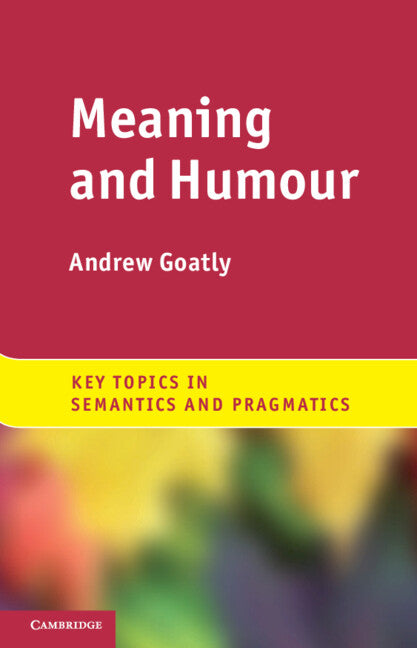
Meaning and Humour
Introduces and critiques a wide range of semantic and pragmatic theories in relation to humour.
Andrew Goatly (Author)
9781107004634, Cambridge University Press
Hardback, published 10 May 2012
380 pages, 25 b/w illus. 40 tables 90 exercises
22.2 x 14.2 x 2.1 cm, 0.63 kg
'Goatly's work is an interesting, innovative, and useful book. It is the first systematic consideration of the linguistic phenomena of humor. I would recommend it for students and scholars alike.' Salvatore Attardo, Editor-in-Chief, HUMOR: International Journal of Humor Research and Encyclopedia of Humor Studies
How are humorous meanings generated and interpreted? Understanding a joke involves knowledge of the language code (a matter mostly of semantics) and background knowledge necessary for making the inferences to get the joke (a matter of pragmatics). This book introduces and critiques a wide range of semantic and pragmatic theories in relation to humour, such as systemic functional linguistics, speech acts, politeness and relevance theory, emphasising not only conceptual but also interpersonal and textual meanings. Exploiting recent corpus-based research, it suggests that much humour can be accounted for by the overriding of lexical priming. Each chapter's discussion topics and suggestions for further reading encourage a critical approach to semantic and pragmatic theory. Written by an experienced lecturer on the linguistics of the English language, this is an entertaining and user-friendly textbook for advanced students of semantics, pragmatics and humour studies.
1. Introduction
2. Meaning in the language system: aspects of form and meaning
3. Semantics and conceptual meaning of grammar
4. Semantics and the conceptual meaning of lexis
5. Personal, social and affective meanings
6. Textual meaning and genre
7. Metaphor and figures of speech
8. Pragmatics, reference and speech-acts
9. Pragmatics: co-operation and politeness
10. Relevance theory, schemas and deductive inference
11. Lexical priming: information, collocation, predictability and humour.
Subject Areas: Semantics, discourse analysis, etc [CFG], Linguistics [CF]