Freshly Printed - allow 7 days lead
Couldn't load pickup availability
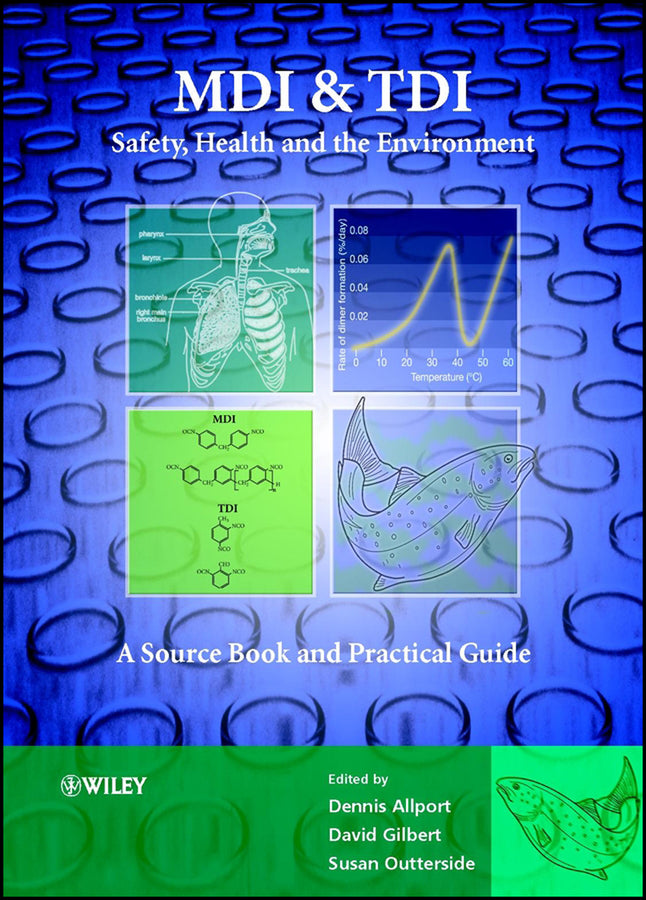
MDI and TDI: Safety, Health and the Environment
A Source Book and Practical Guide
D. C. Allport (Edited by), D. S. Gilbert (Edited by), S. M. Outterside (Edited by)
9780471958123, Wiley
Hardback, published 28 March 2003
464 pages
26.9 x 19.8 x 2.6 cm, 1.276 kg
“...this book is a superb contribution to the literature.” (Journal of Hazardous Materials, Vol. 106, 2004) "....This book covers all the important topics concerning MDI and TDI and provides comprehensive coverage on the health and environmental science associated with these. (European Occupational Health & Safety Magazine, June 2003)
- MDI und TDI sind Diisocyanate, die industriell als Bausteine für Polymere verwendet werden, aber für die Gesundheit und die Umwelt nicht unbedenklich sind
- erstmals werden hier Gesundheits- und Umweltrisiken von TDI und MDI gezielt in einem Band angesprochen
- mit zahlreichen Photos, Spektren, Tabellen und Diagrammen
- Beiträge von Experten aus Forschung, Industrie und Behörden
List of authors and affiliations ix A book of distinction xv Acknowledgements xvii MDI and TDI usage: responsible risk management 1 Exposure, hazard and risk 1 Responsible Care®: a framework for industry action 5 Reading 10 1 MDI, TDI and the polyurethane industry 11 Types of MDI 13 Types of TDI 15 Test substances 16 Misapprehensions 16 Polyurethanes made from MDI and TDI 17 Reading 23 2 Handling MDI and TDI 25 Pride in safety 25 Successful systems 25 Safety systems for the handling of MDI and TDI 26 Key Theme 1: Know your product 28 Health 31 Environment 32 Key Theme 2: Protecting health 33 Duty of care 33 Exposure: how can MDI or TDI enter the body? 34 Medical symptoms 35 Medical checks 36 Key Theme 3: Neutralization, decontamination and disposal of wastes 39 Types of neutralizer 40 Routine cleaning of equipment and drums 40 Neutralization after a spillage 43 Neutralizer formulations 46 Key Theme 4: Using personal protective equipment 47 Normal operations 47 Emergency situations 48 Selection of personal protective equipment 49 Protective clothing 50 Respiratory protection 51 Key Theme 5: Monitoring exposure 59 How should monitoring be carried out? 60 When should monitoring be carried out? 61 Key Theme 6: Dealing with accidents 62 Accidents can happen 62 Spillages 63 Development of excess pressure inside containers 68 Incidents involving fire 70 Transport of MDI and TDI 72 Transport regulations 73 MDI and TDI: transport temperatures 73 Typical containers for the transport of diisocyanates 75 Accidents and emergencies 85 The workplace: storage and use of MDI and TDI 86 Designing the systems and minimizing the risks 87 Physical and chemical properties relating to storage and processing 93 Storage of MDI and TDI 95 Safety issues in workplaces using MDI and TDI 106 Safety issues in some important polyurethane processes 117 Use of MDI and TDI in laboratories 122 Visitors to the workplace 123 Emergencies in the workplace 124 Releases to atmosphere from polyurethane manufacturing sites 126 Properties of MDI and TDI relevant to releases to atmosphere 127 Releases from polyurethane processes 127 Abatement of releases 138 Reading 148 3 Health 155 Perspective on immediate effects following over exposure 156 First aid procedures 156 Commentary on first aid procedures 157 Human health: the medical background 160 Effects on the eyes 163 Effects on the skin 163 Effects when swallowed 165 Effects on the respiratory tract 165 Other health effects of MDI and TDI 185 Biomonitoring of MDI and TDI 186 Experimental toxicology 187 The interaction of MDI and TDI with biological systems 188 Toxicology studies 193 Diagnosis of diisocyanate asthma 203 Appendices (David I. Bernstein) 203 Reading 216 4 The environment 229 A general approach to environmental risk assessment 229 Exposure 233 Sources of exposure 233 Distribution and persistence 237 Biodegradation 256 Bioaccumulation 257 Hazard 258 Test procedures 258 Aquatic ecotoxicity 259 Terrestrial ecotoxicity 264 Risk assessment 265 Accidental release of MDI and TDI 266 Normal usage 268 Reading 273 5 Supporting sciences 277 5.1 Chemistry of manufacture of MDI and TDI 277 Manufacture of MDI 277 Manufacture of TDI 280 Modified MDI and TDI 282 Reading 284 5.2 Structures and nomenclature 285 Structures 285 CAS Registry numbers and preferred names 286 IUPAC names 287 Convenient names for MDI and TDI 288 Synonyms 289 Commercial product names 289 Reading 291 5.3 Chemical reactions of MDI and TDI 291 Reaction with –OH groups 292 Reaction with –NH groups 293 Reaction with –SH groups 293 Reaction with biological molecules 294 Self-reactions 295 Catalysts 298 Reading 299 5.4 Physical and fire properties 300 MDI 301 TDI 311 Reading 319 5.5 Fire behaviour of MDI and TDI 321 Test methodology 321 Fire tests on MDI and TDI 323 Reading 340 5.6 Occupational exposure limits, stack limits and community limits 343 Occupational exposure limits 343 Stack release limits and community limits 351 Reading 357 5.7 Sampling and analysis 358 Materials to be measured 358 Airborne MDI and TDI species 359 Choice of methods for the sampling and analysis of MDI and TDI in air 360 Analysis of nonairborne MDI and TDI 418 A critical review of exposure assessment techniques used in occupational health studies of MDI and TDI 420 Reading 422 Index 431
D C Allport, D S Gilbert and S M Outterside
D C Allport, D S Gilbert and S M Outterside
D C Allport, R C Blake, C Bastian, C Galavitz, D S Gilbert, R Hurd, B Reeve, W Robert, S M Outterside, A Solinas, D Walsh, U Walber and H Wolfson
DC Allport, P Davies, W F Diller, J E Doe, F Floc’h H D Hoffmann, MKatoh and J P Lyon. Appendices by D I Bernstein
RE Bailey, A Gard, K H den Haan, F Heimbach, D Pemberton, II Tadokoro, M Takatsuki and Y Yakabe
D C Allport, D S Gilbert and B Tury
DC Allport, D S Gilbert and B Tury
DC Allport, D S Gilbert, D Pemberton and B Tury
SM Outterside and D Pemberton
J F Chapman, B Cope, G Marlair and F Prager
D C Allport, D S Gilbert, S M Outterside and B Tury
K S Brenner, V Dharmarajan and P Maddison
Subject Areas: The environment [RN]