Freshly Printed - allow 7 days lead
Couldn't load pickup availability
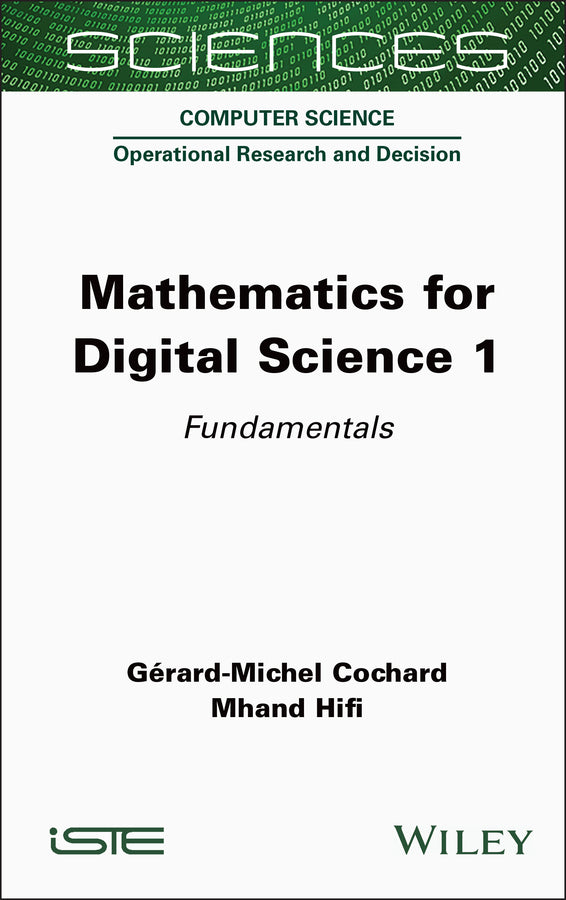
Mathematics for Digital Science 1
Fundamentals
Gérard-Michel Cochard (Author), Mhand Hifi (Author)
9781789451948, Wiley
Hardback, published 4 February 2025
368 pages
23.5 x 15.6 x 2.3 cm, 0.68 kg
Over the past century, advancements in computer science have consistently resulted from extensive mathematical work. Even today, innovations in the digital domain continue to be grounded in a strong mathematical foundation. To succeed in this profession, both today's students and tomorrow’s computer engineers need a solid mathematical background. The goal of this book series is to offer a solid foundation of the knowledge essential to working in the digital sector. Across three volumes, it explores fundamental principles, digital information, data analysis, and optimization. Whether the reader is pursuing initial training or looking to deepen their expertise, the Mathematics for Digital Science series revisits familiar concepts, helping them refresh and expand their knowledge while also introducing equally essential, newer topics.
Preface ix Chapter 1. The Concept of Logic 1 1.1. Syllogisms 1 1.2. Elementary operations of propositional calculus 5 1.2.1. Negation 5 1.2.2. Conjunction 6 1.2.3. Disjunction 7 1.2.4. Conditional 8 1.2.5. Biconditional 10 1.2.6. Tautologies 10 1.3. Tools of deductive reasoning 14 1.4. Quantification 17 1.5. Prenex forms and pure forms 20 Chapter 2. Sets and Relationships 25 2.1. Generalities 25 2.2. Algebra of sets 29 2.3. Parts and partitions 30 2.4. Cartesian product 31 2.5. Binary relationships 32 2.6. Properties of relationships 35 2.7. Applications 42 Chapter 3. Counting and Combinatorial Analysis 47 3.1. Set cardinals 47 3.2. Permutations, arrangements, combinations 48 3.3. Properties of binomial coefficients 51 3.4. Stirling's formula 54 Chapter 4. Boolean Algebra and Boolean Functions 61 4.1. Special elements of an ordered set 61 4.2. Lattice 66 4.3. Boolean algebra 68 4.4. Boolean functions 72 Chapter 5. Logic Circuits 75 5.1. Canonical forms of a Boolean function 75 5.2. Reduction of a Boolean function 80 5.3. Karnaugh tables 84 5.4. Elementary logic circuits 87 5.5. A little on electronics 93 5.6. Construction of logical functions 97 5.7. A basic circuit: the binary adder 100 Chapter 6. Arithmetic 103 6.1. Reminder about integers 103 6.2. Euclidean division 104 6.3. Divisibility and prime numbers 106 6.4. GCD and LCM 112 6.5. Congruencies 116 6.6. Elliptic curves 121 6.7. Identity, theorem and Bézout algorithm 127 Chapter 7. Error Protection 131 7.1. General context 131 7.2. Linear codes 136 7.3. Polynomial codes 140 7.4. Convolutional codes 142 Chapter 8. Encryption Systems 145 8.1. Substitution and transposition 145 8.2. Substitution methods 147 8.2.1. Replacement of a symbol by a symbol 147 8.2.2. The code: replacement of a word by a word 157 8.3. Transposition methods 158 8.4. Asymmetric systems 159 8.5. DES -- secret key system 160 8.6. RSA -- public key system 165 8.7. Cryptography with elliptic curves 167 8.8. Quantum cryptography 169 8.9. Appendix: the Crow and the Fox 176 Chapter 9. Probabilities 177 9.1. Chance 177 9.2. Counting and probabilities 178 9.3. Events and probabilities 183 9.4. Statistics and probabilities 189 9.5. Compound probabilities 191 9.6. Graphs, states, transitions 195 9.7. Markov chains 199 9.7.1. Definition 199 9.7.2. Transition matrix 201 9.7.3. Evolution rules 205 9.7.4. Ergodicity 206 Chapter 10. Descriptive Statistics 213 10.1. Statistical description 213 10.1.1. A little vocabulary 213 10.1.2. Tabular presentation and frequency 215 10.1.3. Two-dimensional series 219 10.2. Graphical representations 220 10.2.1. Bar charts 220 10.2.2. Histograms 222 10.2.3. Cumulative diagrams 223 10.2.4. Polar diagrams 226 10.2.5. Pie charts 227 10.2.6. Figurative diagrams 227 10.2.7. Point clouds 228 10.3. Position parameters 229 10.3.1. Mode 229 10.3.2. Median 230 10.3.3. Averages 235 10.3.4. Comparison of position parameters 237 10.4. Dispersion parameters 238 10.4.1. Range, interquartile range, mean range 238 10.4.2. Variance and standard deviation 240 10.4.3. Coefficient of variation and concentration index 242 10.5. Linear adjustment 243 10.5.1. Principle of adjustment 243 10.5.2. Linear adjustment 248 10.6. Chronological series 254 10.6.1. Introduction 254 10.6.2. Study of the general trend 257 10.6.3. Study of seasonal variations 260 10.7. Covariance and correlation 265 10.7.1. Regression lines 265 10.7.2. Linear correlation 268 Chapter 11. Probability Laws and Simulation 273 11.1. Random variables 273 11.2. Mathematical expectation, variance and standard deviation 283 11.3. Distribution function 287 11.4. Usual probability laws 289 11.4.1. Uniform law 289 11.4.2. Binomial or Bernoulli's law 290 11.4.3. Poisson's law 293 11.4.4. Exponential law 294 11.4.5. Normal law 298 11.5. General information on simulation 305 11.5.1. Weak law of large numbers 305 11.5.2. Some simulations 308 11.5.3. Generation of random numbers 313 11.6. Generating programs 316 11.6.1. Usual laws 317 11.6.2. Any probability law 318 11.7. M/M/1 waiting system 320 11.7.1. Theoretical study 322 11.7.2. Simulation 326 11.8. Appendices 333 11.8.1. Appendix 1: Table for Poisson's law 333 11.8.2. Appendix 2: Table for normal law 334 11.8.3. Appendix 3: Buffon's needle 335 11.8.4. Appendix 4: Results for M/M/1 337 References 339 List of Authors 341 Index 343
Subject Areas: Computer science [UY]